- Linux underpins most of the global digital infrastructure and is key to technological sovereignty and internet security.
- The free software model and the GNU/Linux ecosystem promote innovation, collaboration, and independence from proprietary software.
- Current technical trends (64 bits, Rust, immutable systems and autocorrect files) reinforce the stability and reliability of Linux.
- On the desktop, GNU/Linux is growing with modern desktops and an active community that is consolidating it as an increasingly attractive option.
Linux has become the silent protagonist of the digital age : it's in servers, mobile phones, supercomputers, televisions, connected cars, IoT devices, and much of the planet's critical infrastructure. Even so, many people still think of it only as "that weird system" for computer geeks. Nothing could be further from the truth: every time you check the weather on your phone, stream a series, or send an email, chances are one or more Linux systems are working behind the scenes to make it all work.
The avalanche of news and articles about Linux in recent years reflects a profound shift in how governments, businesses, developers, and users view free and open-source software. There's talk of internet security, technological independence in Europe, global scandals like the Jeffrey Epstein files and how data and privacy are managed; there's talk of open processors, tiny $35 boards used in schools, critical flaws in libraries like OpenSSL and how the community responds to them. And, underlying it all, Linux always emerges as a key component.
Linux as the backbone of the digital infrastructure
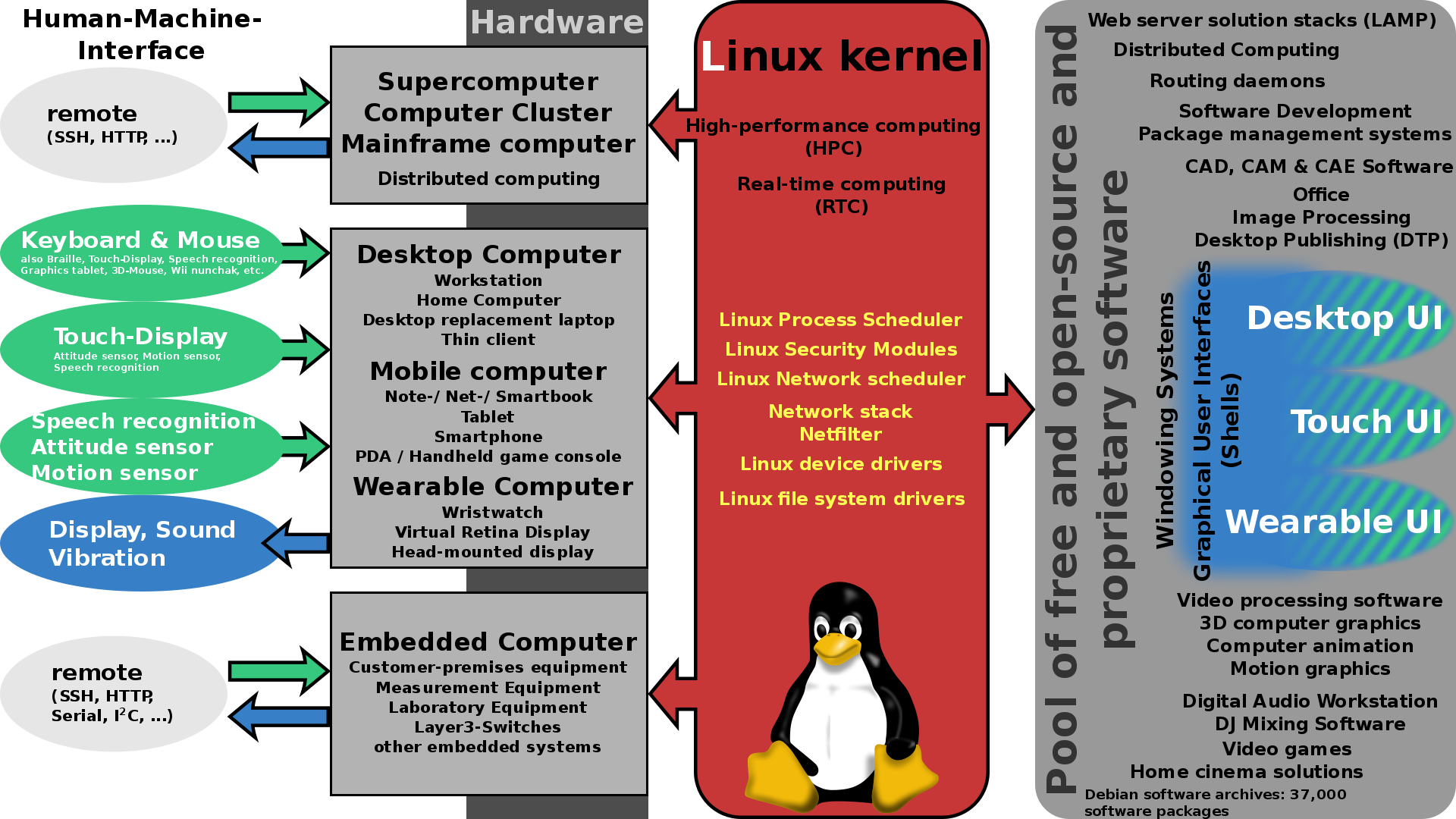
Currently, nearly 80% of the world's servers run on some Linux distribution , making this operating system the true "nervous system" of the internet. Major email platforms, social networks, streaming services, e-commerce platforms, and public clouds rely on Linux for its stability, scalability, and flexibility. For system administrators, it's the go-to choice when seeking a robust environment that can grow without losing control and manage networks using iproute2.
This omnipresence makes Linux a strategic asset for technological sovereignty . Governments and public bodies are increasingly aware that relying exclusively on proprietary software, controlled by a few multinational corporations, poses a risk. That's why experts and gurus of free software, such as Richard Stallman, are often cited. They have been insisting for years that states should migrate to free solutions to protect democracy, guarantee transparency, and avoid technological subjugation that is difficult to reverse.
Interest in Linux isn't limited to offices and data centers ; it also extends to the most demanding environments, such as the International Space Station, where astronauts have used laptops running Debian to work in an environment where stability and security are non-negotiable. The ISS's reliance on Linux isn't based on romantic notions, but rather on the fact that it offers the level of control and reliability needed when a software error could have serious consequences.
Even in areas seemingly unrelated to hard technology, such as major court cases or media scandals, Linux lags behind , because the management, analysis, and security of massive volumes of data rely on servers and systems that, in many cases, run on this operating system. The digital and legal worlds are increasingly intertwined, and open infrastructure is becoming key to ensuring traceability and independent auditing.
News reports about vulnerabilities and security breaches on the internet highlight both the risks and strengths of the open-source model . Centers like the SANS Internet Storm Center have gone so far as to describe certain incidents as "very, very, very serious and chilling," such as the case of a programmer who deleted a line of code essential for generating encryption keys. However, the community's ability to detect, review, and fix problems in projects like OpenSSL and threats like Voidlink , supported by entities such as the Linux Foundation, is a practical demonstration of why open source is critical to global security.
Free software, open source and the role of GNU/Linux
To understand the current relevance of Linux, we must go back to the birth of the free software movement , led by Richard Stallman in the 80s with the GNU project. Its goal was to build a completely free operating system, in which users could run, study, modify, and redistribute software without restrictions. When Linus Torvalds released the Linux kernel in 1991, the two pieces fell into place: Torvalds' kernel and the GNU tools formed the complete system we know today as GNU/Linux.
This union marked the beginning of a new era based on collaboration between users and developers . In contrast to the closed model, where the code is a company secret, GNU/Linux offered the possibility for anyone with the appropriate knowledge to propose improvements, correct errors, or adapt the system to their needs. The number of personal computers and servers using free and open-source applications has doubled annually, shifting the balance in many organizations.
The open-source software ecosystem has proven to be fertile ground for innovation . Projects are emerging that compete head-to-head with commercial solutions, not only on price (though that's a factor), but also on flexibility, security, and speed of development. The fact that large technology companies, banks, operators, and public administrations are now contributing to the kernel and open-source software in general demonstrates that the model has moved beyond being marginal and has become a central component of the digital economy.
It's important to remember that Linux is not just an operating system, but also a vibrant community made up of home users, individual developers, small businesses, and tech giants who participate in organizations like the Linux Foundation or Linux Foundation Europe. This mix of stakeholders, sometimes with very different interests, generates tensions, but also a diversity of contributions that is difficult to replicate in purely closed models.
Within this community, very different profiles coexist, from the teenager who starts by installing a distro on their old laptop to the engineer at a large multinational corporation . Personal stories, such as those of young people who started years ago with free distributions and who today work on large programming projects, show how GNU/Linux acts as a gateway to a professional career, but also to a different way of understanding technology: more shared, more transparent, and more focused on the common good.
Europe, technological independence and open architectures
In recent years, Europe has focused on the need for greater technological autonomy , and Linux and open source play a leading role in this. The continent aims to reduce its dependence on architectures and solutions controlled by third-party countries, opting instead for processors and platforms based on open standards that allow it to audit and adapt the technology to its own strategic needs.
Designing processors and systems using open architectures not only increases independence but also boosts competitiveness and innovation. Projects related to RISC-V and other open hardware initiatives combine with free operating systems like Linux to create a technology stack that European companies can build upon without fear of restrictions, license changes, or unilateral decisions by proprietary vendors.
Public administrations in regions like Andalusia and Extremadura demonstrated years ago that a firm commitment to free software is possible , migrating numerous administrative systems to Linux-based distributions. At the same time, organizations like Hispalinux have lobbied to ensure that e-government laws do not discriminate against citizens based on the software they use, demanding that open standards be fully recognized in legislation.
In this context, parliamentary debates on bills affecting public computing have increasingly included explicit references to the use of open standards . Some drafts have integrated all standards, including open ones, precisely to avoid excluding GNU/Linux and other free software solutions. The goal is to prevent citizens from being forced to use a specific proprietary program to interact with government agencies, which would constitute a veiled form of digital exclusion.
Conflicts have also arisen between different free software platforms within the Spanish ecosystem itself . Experts like Alan Robertson of the Linux Technology Center have even suggested that, to generate economies of scale, it would be advisable to reduce the number of distributions to two or three in a country, although this proposal clashes with the traditional diversity of the Linux world. The balance between variety and standardization remains a hot topic in any discussion about mass adoption.
Linux in education, affordable hardware, and low-cost devices
One of the areas where the social importance of Linux is most evident is education . Very low-cost minicomputers, originally designed for emerging markets, have ended up conquering classrooms worldwide. Thanks to their low price, ease of use, and pedagogical focus, they allow teachers and students to learn programming, robotics, or electronics without requiring large investments.
Tiny boards costing around $35 have proven that it's possible to deliver 50% more power than previous models while maintaining compatibility . This opens the door to all sorts of creative projects: home servers, small science labs, school weather stations, custom media players, or IoT devices fully adapted to the educational curriculum. Linux is the ideal operating system for these machines because its flexibility allows for customization at every level.
Furthermore, many of these solutions use distributions specifically designed for beginners , with desktops and tools designed so that someone with no prior experience can start experimenting without fear. There are free, open-source operating systems that are increasingly striving to offer clear interfaces, simple installation wizards, and user-friendly documentation. The idea is to break down the stereotype that Linux is complicated and only suitable for highly technical people.
In parallel, laptops and devices running Linux have emerged for educational use in developing countries , where low cost, educational focus, and ease of use are key. These devices allow thousands of students to access digital tools for the first time, directly impacting their learning opportunities. By not relying on expensive software licenses, educational projects can scale with fewer financial barriers.
The ecosystem has also taken specific steps in the mobile arena . Projects like Ubuntu for phones and other Linux-based systems have attempted to bring the free software philosophy to smartphones and connected devices. While they haven't managed to dethrone Android and iOS, they have demonstrated that it's possible to envision other models where the user has more control over the system and applications, and isn't subject to closed stores and policies.
Technical trends: 64-bit, Rust, desktops, and immutable systems
Beneath the media noise, the Linux world is undergoing a kind of "controlled demolition" of its foundations , to rebuild them more solidly and better prepared for the coming decades. This transformation isn't loud, but it is profound: old architectures are being abandoned, new programming languages are being adopted, and the organization of desktop systems and file systems is being rethought. All of this directly impacts the daily work of developers, administrators, and advanced users.
One of the most visible changes is the definitive end of 32-bit architecture . For many years, it was the workhorse of computing, ubiquitous in desktop computers, older laptops, and low-power devices. Even projects like Firefox advocated maintaining 32-bit support to extend hardware lifespan and prevent premature obsolescence. However, the reality is that most current hardware is now 64-bit, and continuing to support older platforms is a hindrance.
The gradual abandonment of 32-bit architecture is more than just a practical matter; it's a declaration of intent . The development community is no longer willing to hold back progress by maintaining outdated systems. By focusing efforts on 64-bit architecture, maintenance is simplified, performance is improved, and opportunities for optimizations that are difficult to implement when supporting highly heterogeneous architectures are opened up. The message is clear: the future of the ecosystem lies in 64-bit architecture, without exception.
Another key move is Rust's entry into the heart of the Linux ecosystemThis programming language, designed to offer the speed of C and C++ but with much safer memory management, is gaining traction in critical projects. A prime example is Ubuntu, which has begun rewriting its GNU Core utilities—basic commands such as ls, cp o mv— in Rust, with an eye toward a major transition in future versions like 25.10.
Rust's advantages are especially evident in terms of performance and security . Speed improvements of up to 58% have been observed compared to the original C versions, while at the same time, typical memory management errors—buffer overflows, dangling references, out-of-range writes—are drastically reduced. These are flaws that have underpinned countless critical vulnerabilities for decades. Rust forces the resolution of these types of problems at compile time, without impacting performance.
In the desktop environment, there are also game-changing developments . Traditionally, the sequence was clear: first, you chose the distribution (Fedora, Ubuntu, Arch, etc.) and then the graphical environment (GNOME, KDE Plasma, etc.). The KDE project has decided to reverse this approach and is working on its own operating system, known as KDE Linux, designed to offer the greatest possible integration between the desktop and the rest of the platform.
KDE Linux is based on Arch Linux , and if you're interested, installing Arch Linux without relying on the terminal is a useful practical guide for understanding the technical foundation of this type of project. KDE Linux is based on Arch Linux and adopts the concept of an immutable system . We can imagine it as a system kernel encapsulated in a "glass-armored box" that applications cannot break. To achieve this, it relies on technologies such as the Btrfs file system and the distribution of applications through isolated containers with formats like Flatpak and Snap. From the user's perspective, this reduces the risk of an installation or update damaging the base system.
Although KDE Linux remains experimental, the fact that such a well-established project is embarking on these ventures indicates that a fundamental change is underway . The goal is to achieve more stable systems, easier to maintain, and with a polished out-of-the-box experience, without the feeling of having to "assemble everything by hand" after installation. The line between traditional distributions and new, immutable approaches will become increasingly blurred, and the average user will benefit from more predictable environments.
File systems, autocorrect, and high availability
In the realm of file systems, Linux is also moving towards more resilient models . XFS, widely used in production environments where reliability is vital, has long been synonymous with robustness, but with a significant limitation: when data corruption was detected, it typically required shutting down the system to run repair tools. On critical servers, this downtime translates into losses of money and trust.
After extensive testing in real-world scenarios, the next LTS kernel releases will enable online verification and repair for XFS by default . This means the system will be able to detect and correct inconsistencies while running, without needing to shut down services or unmount volumes. It's like fixing a car on the go without stopping it at a garage, which for many companies represents a radical shift in how they manage their infrastructure.
This capability brings XFS closer to the "self-healing" file system philosophy already offered by others like ZFS or Btrfs, which are very popular in more user-oriented environments or for specialized storage. However, XFS remains a key component in many data centers, so its improvement directly impacts the perception of Linux as a reliable platform for critical workloads.
For system administrators, these new features mean fewer late nights for scheduled maintenance , fewer service downtimes, and greater peace of mind when updating or expanding infrastructure, as well as facilitating the automation of backups with rsync and cron . Combined with other kernel advancements, this reinforces the idea that Linux is not only powerful and flexible, but also increasingly focused on automation and resilience—essential in a world where services are expected to be "always on."
In a context where alarming figures such as an average of 13 vulnerabilities are discovered daily worldwide , the combination of smarter file systems, more secure languages like Rust, and open and auditable development processes becomes a cornerstone for keeping risks at bay. Similarly, adopting isolation solutions improves security; for example, using Firejail on Linux to contain potentially dangerous applications. Perfect security is impossible, but it is possible to build an ecosystem where errors are detected earlier, corrected faster, and lessons learned are shared.
Linux on the desktop: modest share, enormous influence
The old joke that “this will finally be the year of Linux on the desktop” hasn't quite come true yet , but the reality is that GNU/Linux continues to gain ground as a personal operating system. In 2024, its market share on desktop computers reached around 4%, a still modest figure compared to other systems, but one that marks a historic milestone and, above all, a slow but steady growth trend.
Beyond market share, 2024 has been a year of consolidation and significant improvement in user experience . The two most popular desktop environments, GNOME and KDE Plasma, have released very powerful versions: GNOME 46 and KDE Plasma 6. Both focus on deeper integration with Wayland as the default graphics server, offering smoother, more secure, and modern sessions, with better support for high-resolution displays and complex configurations.
GNOME 46 focuses on efficiency, performance, and accessibility . It incorporates Wayland by default, refines the interface with a more modern design, adjusts configuration options for more straightforward customization, and improves key tools such as application search and system management. The overall experience is a less cluttered, more cohesive desktop environment, with a strong emphasis on ensuring everything works smoothly from the first boot.
KDE Plasma 6, meanwhile, takes a significant leap forward by migrating to Qt 6 and strengthening the Wayland session . Among its new features are HDR support, which allows users to take full advantage of modern displays with greater contrast and color gamut, and a series of adjustments to the interface and settings panels that simplify the user experience. Flagship applications of the KDE ecosystem, such as the Dolphin file manager, the Spectacle capture tool, and the Kate text editor, have received noticeable improvements in everyday use.
Added to this are the new versions of established distributions like Fedora and Ubuntu , including the highly anticipated LTS editions of Canonical's distro, which are very popular with those seeking long-term stability. The combination of polished desktops, modern audio and video managers like PipeWire, and increasingly better integration of graphics and hardware drivers means that "desktop Linux" is no longer hostile territory for those coming from other systems.
It's important to emphasize that the GNU/Linux desktop environment is probably the most diverse ecosystem on the market . Besides GNOME and KDE Plasma, there are numerous lightweight environments and minimalist window managers that allow you to completely customize the experience to your tastes and needs: from ultra-lightweight configurations for very old computers to environments laden with visual effects for those who enjoy fine-tuning every detail. If you're interested in choosing a lightweight option, see which lightweight desktop environment to choose.
Communities, conferences and open development culture
The growth of Linux cannot be understood without its community and the events that fuel it . International conferences on free software bring together experts from dozens of countries each year, who share advancements, success stories, and real-world production challenges. Forums like the World Free Software Conference, held in cities such as Málaga, are meeting points where public administrations, companies, and activists discuss the future of open source.
Meanwhile, key figures in the movement, such as Richard Stallman, continue to tour universities and cultural centers to talk about the “free digital society,” filling auditoriums with hundreds of young people eager to understand what lies behind terms like software freedom, copyleft, and technological neutrality. These talks help shift the debate from purely technical aspects to ethical, political, and social issues.
Other key figures in the scene, such as Jon “Maddog” Hall, head of Linux International, or leaders of specific projects , offer a perspective more closely tied to the business world and large-scale adoption. Their interviews often revolve around how to convince executives and IT managers that choosing Linux and open source is not just an ideological issue, but a rational decision in terms of cost, security, and adaptability.
Linus Torvalds himself, although he has led kernel development since 1991, is aware that the project needs organizational resilience . That's why there's an emergency protocol and a maintainer structure that allows the workflow to continue even if he can no longer lead it at any point. Linux no longer depends on a single person, but on a network of contributors supported by foundations, companies, and communities distributed around the world.
Sometimes, the news focuses on the more human side of these leaders : for example, when it's been reported that Torvalds himself has decided to put some professional projects on the back burner to work on his relationships with other developers, or when public apologies from executives like Satya Nadella are analyzed for controversial statements in other areas, such as the gender pay gap. All of this demonstrates that the tech ecosystem is also grappling with debates about workplace culture, diversity, and inclusion.
Looking at this whole picture, from the servers that power the internet to the $35 minicomputers in classrooms, from modern desktops and open architectures to new tools like Rust, it's easy to see why Linux has permeated almost all of our technological interactions . The famous "year of Linux on the desktop" may never arrive exactly as some envisioned, but what is certain is that GNU/Linux has become the smartest choice in many areas: stable, secure, adaptable, and backed by a global community that hasn't lost its drive to innovate.


Passionate writer about the world of bytes and technology in general. I love sharing my knowledge through writing, and that's what I'll do on this blog, show you all the most interesting things about gadgets, software, hardware, tech trends, and more. My goal is to help you navigate the digital world in a simple and entertaining way.