
We live in an era where the amount of data generated globally is growing at an accelerated pace. It's no longer enough to talk about gigabytes or terabytes; new data scales are measured in zettabytes, and it is precisely this term that is increasingly attracting the attention of both IT professionals and the general public. But what exactly is a zettabyte , and why is it so relevant in today's world?
Most of the time, this concept is mentioned when discussing the enormous amounts of data on the internet, big data , and the storage capacity of devices. The term may seem somewhat abstract to some, but if we break it down, we'll see how it's already part of our daily lives, even if we don't realize it.
What is a Zettabyte?
The word “zettabyte” comes from the combination of two terms: “zetta,” a decimal prefix, and “byte,” which refers to a unit of digital storage. Numerically, one zettabyte is equal to 10²¹ bytes , that is, one billion terabytes or , equivalently, one trillion gigabytes.
In other words, we're talking about an unimaginable amount of data. To put that in perspective, one zettabyte of data could store approximately 250 billion DVDs . This volume of information has never been as relevant as it is now, especially with the rise of technologies like the Internet of Things ( IoT ), social media, and streaming services.
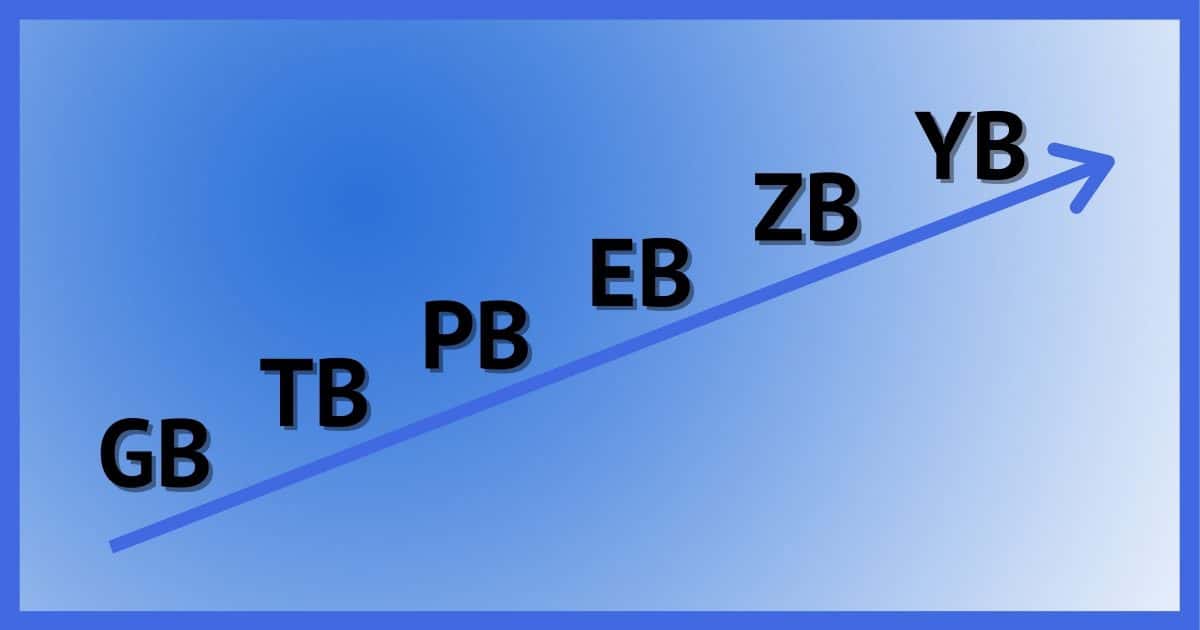
Furthermore, it is worth noting that on average, according to some studies conducted in 2020, global data traffic had already reached 59 Zettabytes , and it is estimated that by 2025 we could be talking about having more than 175 Zettabytes of data generated annually.
The importance of zettabytes
The term zettabyte is not just an abstract number in the world of storage; it has very concrete applications in areas related to technology and information. Due to the exponential generation of data today, especially driven by social media, streaming, and the IoT, understanding and managing this amount of information has become crucial for governments, businesses, and organizations.
To put this in perspective, since 2015 global internet traffic has experienced unprecedented growth, reaching 15,5 zettabytes at that time . In sectors such as astronomy and genetics, it is estimated that the amount of data generated will exceed 25 zettabytes by 2025, giving a clear idea of the impact this volume of data can have on areas such as scientific research.
Furthermore, it is interesting to observe how cities and governments are beginning to leverage this abundant volume of data to improve the quality of life for their citizens. Take Helsinki, for example, where systems are being developed to personalize urban services using information generated daily by its residents, always in accordance with international data protection standards.
Zettabyte vs. binary system
Although the zettabyte is defined in the context of the decimal system , it's important to note that computers don't calculate using this system, but rather the binary system . This means that when discussing large amounts of data in computing, we're referring to the zebibyte rather than the zettabyte.
In binary terms, a zebibyte is equal to 2 <sup>70</sup> bytes , which is approximately 1,180,591,620,717,411,303,424 bytes. While the binary prefix “zebi” is used in more technical contexts, in everyday use people often still refer to the same thing as a “zettabyte.”
Although this binary prefix has not yet become fully established in common language, it is essential for computer scientists and technology companies to know about its existence and apply it in the development of data storage and processing systems.
Impact on technology and big data
The impact of zettabytes on technology isn't limited to the world of storage. The massive generation of data we're seeing is driving advancements in fields like big data analytics , cloud storage , and high-performance computing . For businesses, being able to effectively manage zettabytes of data means improving their operations and analytical capabilities.
Big data, in particular, benefits greatly from this expansion. Analytics tools that work with zettabytes of information enable companies and organizations to optimize processes, predict market trends, and create products and services better suited to consumer needs.
Zettabyte applications in key sectors
Some sectors already generating zettabyte-scale data include streaming platforms like Netflix and YouTube, which collectively generate massive volumes of data from millions of users daily. This data is used to enhance the user experience through content personalization.
Another key sector is social media , where platforms like Facebook or Instagram handle and process zettabytes of information generated by interactions, photo uploads, posts and other activities.
Furthermore, the Internet of Things has been one of the main reasons behind the growth of zettabytes. As more devices connect to the network, such as smart homes and wearables , the amount of data generated continues to increase.
Even in scientific fields such as astronomy or genetics, the amount of data generated in the coming years is expected to reach exorbitant levels. In fact, in astronomical observations, the data generated could exceed 25 Zettabytes by 2025, meaning that both storing and analysing this data will be a considerable challenge.
Ultimately, we are facing a new era where zettabytes are the central axis of both data creation and management. Every day, more sectors depend on the efficient collection and analysis of these volumes of information to improve processes, products and services, which makes zettabytes key allies of technological development.
While we may still be a long way off from measuring all our files in zettabytes, it is clear that this unit of measurement will become increasingly important as we move into the digital age. The ability to manage and analyse these vast volumes of data will be crucial to keeping pace with growth across all industries.

I'm Alberto Navarro and I'm passionate about everything related to technology, from cutting-edge gadgets to software and video games of all kinds. My interest in digital began with video games and continued in the world of digital marketing. I have been writing about the digital world on different platforms since 2019, sharing the latest news in the sector. I also try to write in an original way so that you can stay up to date while having fun.
I studied Sociology at university and completed my studies with a Master's in Digital Marketing. So if you have any questions, I'll share with you all my experience in the world of digital marketing, technology and video games.