- Computer vision combines cameras and sensors with deep learning to interpret images as useful data.
- Convolutional neural networks extract visual features and enable tasks such as classification, detection, and segmentation.
- Its use extends to industry, healthcare, retail, transportation, agriculture and security, automating complex visual decisions.
- Thanks to its accuracy and speed, it has become a pillar of applied AI and automation in multiple sectors.
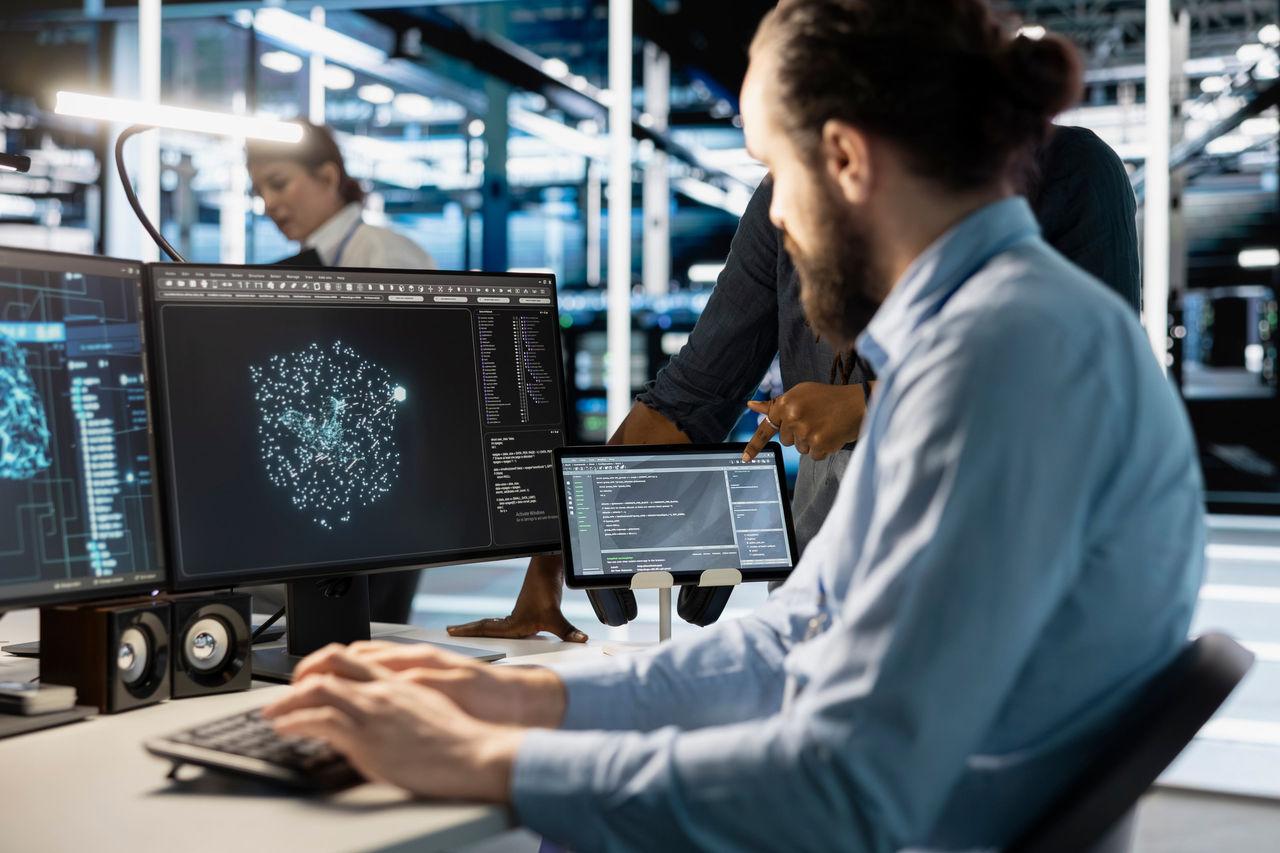
We live surrounded by systems capable of seeing, recognizing, and reacting almost as quickly as a person, though they often go unnoticed. From a mobile phone that unlocks its screen with your face to an industrial machine that detects defective parts on the fly, they all rely on... artificial intelligence-powered machine vision technologies that have left the laboratory to become part of everyday life.
Although it may seem like the latest technological fad, the reality is that artificial intelligence and computer vision have been around for a while. decades developing as scientific disciplinesThe difference is that now, thanks to computing power and the rise of deep learningIts potential is truly being exploited: it is possible to train models without being an engineer, democratize its use in companies of any size and, above all, to automate decisions that previously depended on human vision.
What exactly is computer vision?
Technically speaking, computer vision (or computer vision) is the branch of AI that deals with to capture, process, analyze and understand images and videos from the real world to translate them into numerical or symbolic data that a machine can manage. That is, it converts pixels into structured information: objects, categories, positions, anomalies, patterns, etc.
If artificial intelligence aims to make computing systems reason and make decisions autonomouslyArtificial vision gives them eyes: it allows them to obtain visual information from the environment, interpret it, and act accordingly without direct human interventionIn this way, a system can, for example, decide whether an X-ray shows possible pneumonia or whether a product on an assembly line is out of specification.
In practical terms, implementing machine vision involves automate tasks of detecting, classifying, and tracking images or videos which, if done by one person, would require time, constant attention, and a high degree of specialization. Furthermore, since they are based on mathematical and statistical rules, It reduces subjectivity and biases inherent in the human eye.It minimizes errors and helps to standardize quality or safety criteria.
All of this translates into very tangible advantages for organizations: Lower costs, fewer errors, and faster decisions based on visual dataAnd, as a bonus, it allows you to exploit enormous volumes of images that would be impossible to review manually, something key in the current era of big data and hyperconnectivity.
How machine vision works step by step
Artificial vision attempts to imitate, in essence, the process of human sight.First, it captures the scene, then transforms it into signals that a system can process, then recognizes patterns, and finally generates a response. The key difference is that, instead of a biological brain, it relies on AI algorithms and deep neural networks.
For this process to work, two major blocks are needed: on the one hand, the physical components of the collection (cameras, sensors, lighting, converters) and, on the other hand, the AI models that process and understand the imageThey both work hand in hand to turn a simple photograph or video frame into actionable information.
Data capture: cameras, sensors and digitization
The first link in the chain is the hardware. A modern machine vision system incorporates digital cameras, controlled lighting systems, sensors and frame capture devices who are responsible for taking images of adequate quality for later analysis.
The cameras generate an analog image of the scene, which then passes through a analog-to-digital converterThis component transforms the collected light into a matrix of numerical values that represent the pixels of the image. Each pixel can encode intensity information (in black and white) or color information (for example, in RGB format).
In industrial or advanced automation environments, it is very common to combine this image capture with other automation and motion systems: robots that position the pieces in front of the camera, conveyor belts synchronized with the camera's shutter release, or mechanical systems that adjust the focus and lighting to always guarantee optimal conditions.
This first stage may seem trivial, but it is critical: if the visual data entering the system is poor, noisy, or inconsistentHowever sophisticated the AI models may be, the result will be unreliable. That's why serious machine vision projects invest significant effort in the design and calibration of the optical and data acquisition components. Many lightweight deployments even use devices and accelerators compatible with AI. Raspberry Pi for prototyping and small-scale uses.
Key technologies: deep learning and convolutional neural networks
Once the image is digitized, the "intangible" part comes into play: the algorithms. Today, modern computer vision relies primarily on deep learning and convolutional neural networks (CNNs)which have displaced many classic techniques based on manual rules.
Deep learning is a type of multi-layered neural network-based machine learningDuring training, the model receives thousands or millions of labeled images (e.g., "car", "pedestrian", "defective part", "tumor", "lung with pneumonia") and learns to recognize patterns that differentiate one class from another, without a human having to manually program which edges or shapes to look for.
Convolutional neural networks are specifically designed to work with visual data. Instead of treating the image as a flat list of numbers, They exploit the two-dimensional structure of pixels and apply local filters (kernels) that slide across the image to detect visual features: edges, textures, corners, repeating patterns, etc.
In a typical CNN we find at least three types of layers: convolutional layers, pooling layers, and fully connected layersThe first ones perform feature extraction by applying filters; the second ones reduce dimensionality while maintaining the most relevant information; and the last ones integrate everything learned to produce an output, such as a class probability.
How a CNN “sees”: convolutions, feature maps, and pooling
From a mathematical point of view, a CNN considers the image as a matrix of pixels and applies it. another smaller array called a filter or kernelThis filter moves across the image by calculating a dot product between the filter values and the pixels of the area it covers at each position.
Upon completion of this sweep, a activation map or feature mapThis indicates how strongly that specific filter responds in each region of the image. Each filter is adjusted, during training, to respond intensely to a certain type of pattern (for example, horizontal lines, corners, grainy textures, smooth intensity transitions, etc.).
By stacking many convolutional layers, the network goes building a hierarchy of increasingly complex visual featuresIn the first layers it detects simple edges, in intermediate layers shapes and components, and in deep layers it can recognize complete objects or very specific parts (such as an eye, a wheel or a suspicious lung outline in an X-ray).
Following these convolutional layers usually come the clustering layers or pooling. Its function is reduce the size of feature maps Taking, for example, the maximum or average value within small blocks of pixels. This compresses the information, makes the model more efficient, and provides some invariance to small translations or deformations in the image.
Forward propagation, loss function, and backpropagation
The entire process from the input image to the model's output is known as forward passIn this phase, the network successively applies convolutions, nonlinear activations, pooling operations and, finally, fully connected layers that perform the classification or regression part.
At the end of the forward propagation, the model produces an output: in image classification, this is usually a vector of probabilities associated with each possible class (for example, “normal” or “pneumonia” on a chest x-ray). To assess whether the model has performed correctly, this prediction is compared to the actual label using a loss function that measures the error.
The training process involves iterating this process many times and adjusting the model parameters so that the loss function decreases. This is done using the well-known technique of... backpropagationThis calculates the gradient of the loss with respect to each weight in the network. Using an optimization algorithm, such as gradient descent, the weights are updated in the direction that reduces the error.
Given time and enough well-labeled training data, CNN learns to distinguish very subtle visual patternsIn medical imaging, for example, it can detect asymmetrical lung contours, brighter areas that reveal inflammation or the presence of fluid, cloudy or opaque areas, and irregular textures that sometimes go unnoticed by the human eye, helping in the early detection of diseases.
From basic recognition to advanced machine vision tasks
Computer vision is not limited to saying "what's in the image." Building upon the same foundations as CNNs and deep learning, it has been developed. various specialized tasks that solve specific problems in very diverse sectors.
The simplest task is the image classificationA single label is assigned to the entire image (cat, dog, correct screw, defective screw, etc.). One step further is the object detectionwhere, in addition to identifying the class, each object is located within the image by drawing bounding boxes.
When maximum pixel-level precision is required, the following is used: instance segmentationwhich generates a mask for each individual object, even if they belong to the same class. This capability is vital, for example, in medical image analysiswhere it is important to separate and quantify tumors, tissues or organs accurately.
Another very widespread task is the posture estimationThis technology detects key points (joints, limbs, etc.) in human bodies or other articulated objects. It is used in sports, ergonomics, augmented reality, and safety systems that monitor workers' postures to prevent injuries or accidents.
Computer vision, machine learning and deep learning: how they differ
Many conversations mix concepts like artificial intelligence, machine learning and deep learning as if they were synonyms, which generates considerable confusion. Understanding their relationship helps to correctly situate computer vision within this ecosystem.
Artificial intelligence is the broadest umbrella term: it encompasses any technique that allows a machine to... perform tasks that we associate with human intelligence (reasoning, learning, planning, interpreting language, seeing, etc.). Within this field, machine learning is the set of methods that allow a system to... Learn from data without being explicitly programmed with fixed rules.
Machine learning includes many algorithms (decision trees, support vector machines, regressions, etc.) that can be used for a wide variety of problems: predicting default risk, classifying emails as spam or not, recommending products, etc. In computer vision, these traditional methods have been used for simple tasks or when the volume of data is not very large.
Deep learning is a subset of machine learning characterized by its use of large, multi-layered neural networksThese networks are especially powerful when working with large amounts of data, and in particular, images, since they are capable of extracting the relevant characteristics on their own without direct human intervention.
In modern computer vision, deep learning is usually the preferred option: It allows for a much higher level of detail, generalization, and robustness. compared to classical approaches, provided there is sufficient data and computing power. It is, to a large extent, the driving force behind the qualitative leap in computer vision over the last decade.
Machine vision vs. image processing
Although they are closely related, it is important to distinguish between image processing and computer visionThey are sometimes used interchangeably, but they are not the same. They often work together, but they pursue different objectives.
Image processing focuses on to manipulate the image as such: improve contrast, adjust brightness, reduce noise, apply filters, change size, etc. The result of these types of operations is usually another transformed imageThis is what many photo editing tools do, but it is also the basis for preparing images before passing them to an AI model.
Computer vision, on the other hand, takes an image or video as input and produces information about its contentWhat objects appear, where they are, what type of scene it is, if there are any anomalies, how many people cross a door, etc. The result is no longer just another image, but structured data or automated decisions.
In practice, modern machine vision systems typically include a image processing stage preliminary (to normalize lighting, crop areas of interest, correct distortions, etc.) that facilitates the subsequent work of the deep neural networks responsible for interpretation.
Real-world applications of machine vision in different sectors
The versatility of machine vision means that its applications extend to virtually any field in which there are images or videos to analyzeFrom industrial manufacturing to medicine, including retail, banking, logistics, agriculture, and the public sector, its impact grows year after year.
Many companies no longer ask themselves whether to use machine vision, but how to integrate it strategically to improve their processes, reduce costs, increase security, or better understand their customers' behavior. Below are some of the most representative use cases.
Manufacturing, industry and quality control
In the manufacturing industry, machine vision has become a key tool for automation and quality controlCameras installed on the production lines continuously monitor the parts passing by and detect defects in fractions of a second.
These solutions allow monitor automated workstations, perform physical counts and inventories, measure quality parameters (finishes, dimensions, color), detect residues or contaminants and verify that each product exactly meets the specifications.
In combination with other technologies such as 3D printing or CNC machines, machine vision helps to to replicate and produce highly complex parts with extreme precisionFurthermore, by integrating with IoT sensors, it helps to anticipate maintenance problems, identify anomalies in machine operation, and prevent unexpected downtime.
It not only detects product defects: it can also monitor the correct use of protective equipment, detect risk situations in production plants and generate early warnings to prevent workplace accidents.
Retail, marketing and customer experience
In retail and consumer goods, machine vision is used to closely monitor customer activity in store: how they move, what areas they visit, how long they stop in front of a shelf, or what combination of products they look at before making a decision.
This information, anonymized and processed in aggregate form, allows Optimize product distribution, redesign the store layout, and adjust marketing campaigns with a level of detail impossible to achieve using only web analytics or surveys.
Systems are also being expanded self-checkout assisted by artificial visionThese systems can recognize items without the need to scan barcodes one by one. This improves the customer experience, reduces queues, and paves the way for cashierless store models.
Beyond the physical point of sale, brands are leveraging machine vision to Analyze images on social media, detect visual trends, study how their products are used in the real world and thus adjust their product or communication strategy.
Security, surveillance and the public sector
Machine vision is a fundamental pillar in security and protection systems for facilitiesSmart cameras and distributed sensors monitor public spaces, critical industrial zones or restricted areas and issue automatic alerts when they detect anomalous behavior.
These systems can identify Presence of unauthorized persons, access outside of opening hours, abandoned objects, or patterns that suggest a possible incidentIn some cases, they integrate facial recognition for employee authentication or high-security access control.
In the domestic sphere, computer vision is applied in connected cameras that They recognize people, pets, delivered packages, or unusual movements.sending notifications to the user's mobile phone. At work, it helps verify that employees are using the required protective equipment or complying with critical safety regulations.
Governments and smart cities use it to monitor traffic, dynamically adjust traffic lights, detect violations and improve public safety. It is also being incorporated into customs systems to automate some visual inspections.
Healthcare, diagnosis and analysis of medical images
Medicine is one of the fields where artificial vision is producing a more profound change in clinical practiceMedical image analysis techniques allow for the visualization of organs and tissues with great precision and provide objective support to professionals.
Among the most common uses are the tumor detection through the analysis of moles and skin lesions, The Automatic interpretation of x-rays (for example, to identify pneumonia or fractures) and the discovery of subtle patterns in magnetic resonance imaging or computed tomography scans.
Systems equipped with intelligent vision help to reduce diagnosis times, improve accuracy and prioritize urgent casesThey can also be linked to large databases of medical records to suggest possible differential diagnoses or treatments.
Furthermore, machine vision is applied in assistive devices for people with visual impairmentscapable of reading texts and converting them into speech through optical character recognition (OCR), or of visually describing the environment in a simplified way.
Autonomous vehicles and transport
In the automotive sector, machine vision is an absolutely central technology for assisted driving and autonomous vehiclesMultiple cameras mounted on the vehicle capture the environment in real time and feed AI models that continuously interpret it.
These systems are capable of detect pedestrians, other vehicles, traffic signs, road markings and obstaclesgenerating 3D representations of the environment by combining information from cameras with other sensors such as LiDAR or radar.
In semi-autonomous vehicles, machine vision is also used for monitor driver statusAnalyzing head position, upper body movement, and gaze direction to detect signs of fatigue, distraction, or drowsiness.
When risk patterns are identified, the system can emit audible or visual alerts, activate vibrations in the steering wheel, or even take partial control to reduce speed and mitigate danger. This has proven to be very effective in reducing accidents caused by fatigue.
Agriculture and the agri-food sector
The agricultural sector has found in machine vision a key ally to move forward models of precision and intelligent agricultureImages captured by satellites or drones allow for the analysis of large areas of land with a level of detail unthinkable a few years ago.
With these tools it is possible monitor the condition of the crops, detect diseases early, and control soil moisture and estimate crop yields in advance. All of this facilitates more efficient management of resources such as water, fertilizers, and pesticides.
Machine vision has also been incorporated into systems that They monitor the behavior of the livestock.They identify sick animals, detect births, and control access to specific areas. This automation improves animal welfare and optimizes the overall productivity of farms.
In the food industry, it has also been used for decades to control quality in production linesCheck the appearance of fruits and vegetables, review the packaging and ensure food safety.
Banking, insurance and telecommunications
In the financial sector, machine vision is used to detect visual signs of fraud or anomalous behaviorThis applies both in physical offices and in remote transactions. For example, a user's real-time image can be compared with the photo stored in their documentation.
It also integrates into insurance underwriting processeswhere the inspection of damage to vehicles or buildings can be partially automated from photographs sent by the client, reducing time and costs.
In telecommunications, companies use machine vision to predict and detect customer churn by combining visual information (e.g., use of certain devices or facilities) with other behavioral data, allowing us to anticipate needs with offers and service improvements.
Furthermore, authentication through facial recognition It is becoming widespread as a method of secure access to banking and corporate services, always in combination with other security measures.
Logistics, freight transport and real estate
In logistics, machine vision helps to monitor and track goods in real time No need for intensive manual scanners. Strategically placed cameras are all that's needed to read labels, identify packages, or verify that everything is correctly positioned.
By integrating with technologies such as RFID, these systems allow monitor inventories, manage warehouses, and optimize delivery routes much more efficiently. They are also useful for detecting damage to packages during transport.
In the real estate sector, machine vision is applied to generate virtual and interactive tours of the homes, recognize and label rooms, measure spaces and offer the user detailed information about the characteristics of the property without the need for multiple physical visits.
This combination of high-quality images and intelligent analysis saves time for both agencies and potential buyers or tenants, and helps to close deals more quickly.
Education, trade shows, and personal applications
In education, computer vision is being used to simulate practical environments, virtual laboratories and real-world cases that allow students to experience situations close to the professional world without leaving the classroom.
At trade fairs and conferences, cameras with artificial vision allow Analyze the behavior of attendees: people flows, hot spots, interaction with stands and, in some cases, even estimate general emotional reactions to certain experiences.
On a personal level, in addition to the aforementioned systems for assisting the blind and instant visual translation (such as when you point your mobile phone at a sign in another language), artificial vision drives augmented reality applications, social media filters, and interactive games that depend on understanding in real time what is in front of the camera.
All of this demonstrates that computer vision is not a laboratory curiosity, but a cross-cutting technology with a direct impact on the economy, security, and daily lifewhose potential we are only just beginning to tap into.
Overall, computer vision combines sensors, cameras, and converters with deep learning algorithms and convolutional neural networks to transform images and videos into useful knowledgeAutomating decisions and increasing the accuracy and speed of processes in very diverse sectors. Its ability to learn from large volumes of visual data, reduce human subjectivity, and detect patterns invisible to the eye makes it a key component of artificial intelligence ecosystem modern and as a decisive lever for companies and organizations to gain competitiveness, improve security and provide more efficient and personalized services.


Passionate writer about the world of bytes and technology in general. I love sharing my knowledge through writing, and that's what I'll do on this blog, show you all the most interesting things about gadgets, software, hardware, tech trends, and more. My goal is to help you navigate the digital world in a simple and entertaining way.