- Heavy/Expert for precision and complex tasks; Fast/Grok-4-Fast for minimal latency; Auto balances based on query.
- Real-time web access and native tool usage differentiate Grok from models without these active features.
- Grok-4-Fast provides 2M context tokens, tool-use RL and fewer "thought" tokens, lowering the cost.
- Plans and deployment: Heavy ~$300/month, standard ~$30/month; Grok4Fast in trials for subscribers.
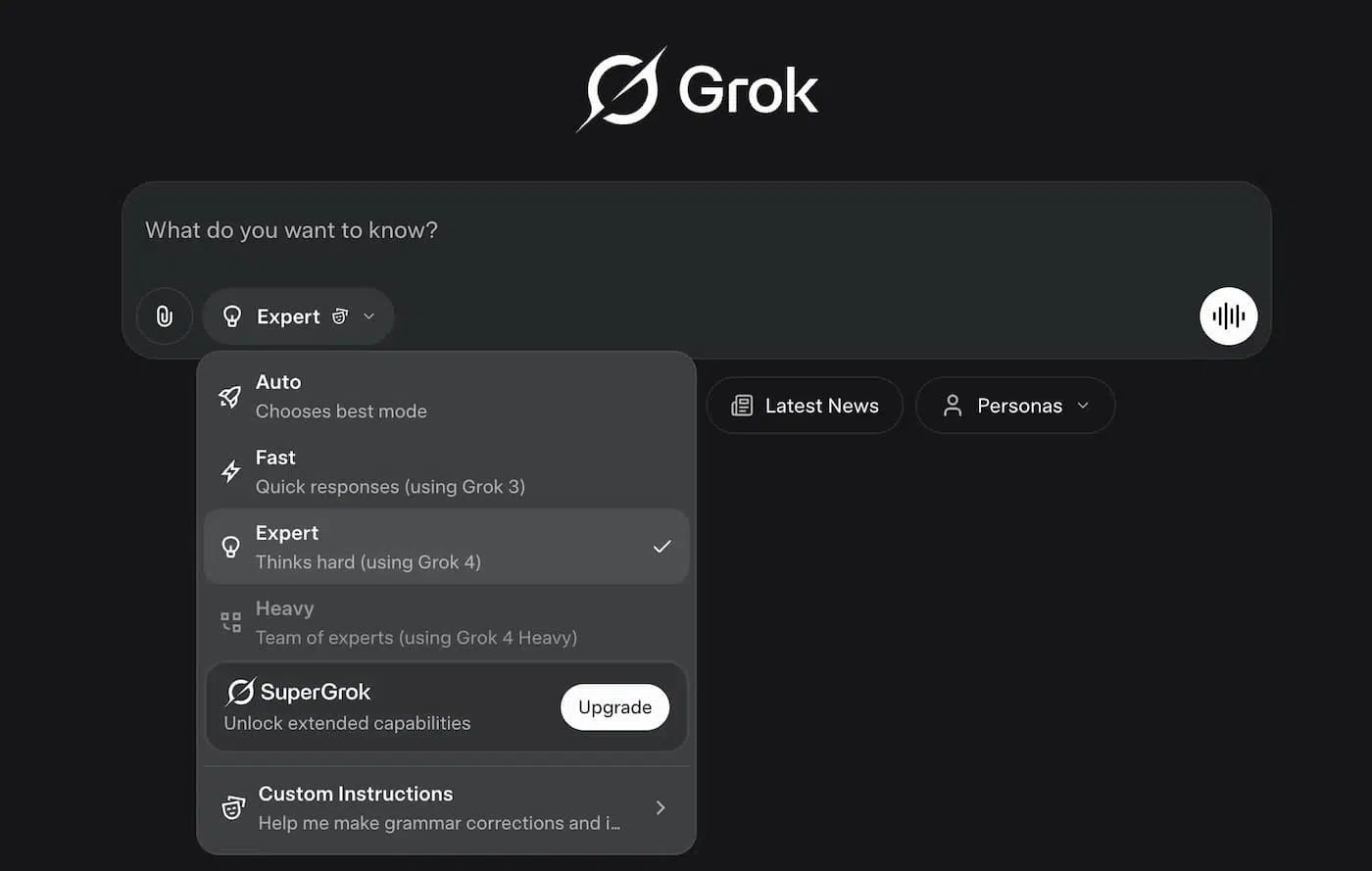
If you've ever wondered how to get the most out of an AI that searches the internet on the fly and reasons with multiple agents simultaneously, here's a complete guide to understanding what Grok's Heavy, Expert, Fast, and Auto modes are for. The key is choosing the right mode based on whether you prioritize speed, depth of analysis, or automatic balancing.
Grok 4, created by xAI ( Elon Musk 's company and integrated with the X platform), arrives with powerful promises: real-time web browsing, native tool usage, and a "Heavy" version with multi-agent architecture. With differentiated pricing and features not typically enabled by default on other models, it's worth understanding the strengths of each mode and when to use it.
What modes does Grok offer and in what situations is each one appropriate?
The Grok family has diversified to cover a wide range of needs, from immediate responses to complex, multi-step reasoning. Heavy, Expert, Fast, and Auto are not just marketing labels, but working modes with real implications for cost, latency, and quality.
- Heavy ModeDesigned for demanding projects involving multiple steps and specialties simultaneously. In Grok 4 Heavy, several internal agents cooperate "behind the scenes" (one agent plans, another verifies, another writes), ideal for engineering, software development, technical research, and extensive analysis. If you need accuracy and deep chains of reasoning, this is the premium profile..
- Expert Mode: geared towards precise and analytical answers without fully deploying Heavy's multi-agent scheme. For questions requiring patience, rigor, and verification, Expert takes a little longer, but it usually refines the result better than an ultra-low latency mode. For complex queries, technical reports, or non-trivial mathematics, Expert often makes the difference..
- Fast ModeFast-paced gameplay, minimal latency. This mode is optimized for "express questions," quick summaries, specific searches, and everyday tasks. When getting an answer is more important to you than extracting every nuance, Fast shines for its immediacy..
- Auto modeAn intelligent selector that decides for you which strategy is best based on the query and cost/time constraints. In practice, it chooses a light approach when the task is simple and activates deeper reasoning if it detects complexity. For those who don't want to manually switch modes, Auto seeks a balance between speed and depth.
Grok 4 vs Grok 4 Heavy: differences that are noticeable in everyday use
Grok 4 "standard" is a very capable and versatile model, but Grok 4 Heavy raises the bar by coordinating several specialized internal agents. This multi-agent approach allows a complex problem to be broken down into subtasks and solved collaboratively.
This internal teamwork translates into better results for coding, technical analysis, research, and tasks with multiple dependencies. If you work with long pipelines (e.g., plan → search → verify → synthesize), Heavy provides greater security and consistency.
Both variants use real-time tools (calculators, web browsing, content extraction, etc.), with a clear focus on up-to-date answers. In Grok 4, the web is not merely decorative; it is consulted live to verify facts and provide recent context.
Real-time web access and tool usage: why they matter
Most LLMs rely heavily on what they "remember," trained on outdated data. Grok advocates for consulting the web while responding. This is invaluable if you need up-to-date data, recent references, or confirmation of something that changed this week.
Furthermore, the use of tools is natively integrated: running code, searching, scraping a page—all within the response flow. For you, this means less copying and pasting between apps and more autonomy for the assistant to retrieve what's needed.
Grok-4-Fast: speed, 2M token window, and less "thinking" per task
xAI has tested a new mode called Grok4Fast (available to some subscribers) that speeds up responses, especially in math or complex questions where the initial setup is usually the slowest part. It feels like it answers almost instantly, which is a welcome feature when you're in a hurry.
What does it offer compared to previous fast modes? Grok-4-Fast blends reasoning and non-reasoning behaviors within the same weight space; depending on the system prompt, one or the other is activated. This allows you to shift gears on the fly, from turbo to precision, without changing models.
Three practical points immediately stand out: 1) extreme context storage of up to 2 million tokens (enough room for massive documentation), 2) training to determine when to use tools (tool-use RL), and 3) fewer "thinking" tokens (approximately 40% less to match Grok-4 accuracy), which lowers costs for high-volume workloads. If you manage autonomous agents or assistants with long memory requirements, this offers significant savings and increased agility.
In community tests, the jump in latency compared to the current Fast setting is noticeable: almost no waiting and a very smooth experience. However, it remains to be seen if its performance consistently matches Expert when the level of detail is critical.
To activate it (if the option appears), go to the Grok web version, tap your avatar → Settings → Grok Subscription and enable “Early preview model”; there you can select Grok4Fast. For now, this feature is not available for free accounts; it is only available to subscribers.
When to choose each mode: clear scenarios to avoid confusion
- Quick questions and everyday tasks: go to Fast or Grok-4-Fast if immediacy is paramount (summaries, clarifications, specific queries).
- Multi-step technical problemsChoose Heavy to divide and conquer, with specialized agents coordinating the work.
- Accurate or sensitive analysis: Expert compensates with rigor and usually "nails" the explanation, although it takes a little longer.
- You don't want to decide every time.It automatically manages the balance and adjusts depth and cost according to the type of consultation.
A simple trick: if the query affects a significant professional or financial decision, try Expert or Heavy; if it's just a quick fix, Fast/Grok-4-Fast eliminates waiting. Auto is your co-pilot if you'd rather forget about the switch.
Performance in benchmarks and real-world use cases
xAI reports strong results in public assessments such as AIME-2025 (92.0% pass@1) and HMMT-2025 (93.3% pass@1), as well as good performance in open competitions (LMArena). These numbers are indicative, but what matters most is how it performs in your real-world workflow with changing data.
Where does it truly shine in practice? In research and search assistants, advanced conversational agents (combining fast responses with long chains of reasoning), cost-effective programming , and multilingual applications with reported improvements in Chinese and search benchmarks. When the context is vast and you need the model to "organize" itself, Grok-4-Fast scores points.
Comparison with GPT-4.5, Gemini 1.5 Pro and Claude 3
If you value real-time web browsing and internal agent collaboration, Grok 4 and Heavy have an advantage over models that don't have these features enabled by default; compared to other options, you can see recommendations for the best AI for each task . Furthermore, Grok integrates signals from X (formerly Twitter), including references to Elon Musk's posts when relevant.
However, GPT-4.5 and Gemini 1.5 Pro continue to dominate many benchmarks and offer extensive ecosystems of plugins and security policies; Claude 3 is another well-established alternative. If you need highly specialized translation or enterprise-level security guarantees, OpenAI and Google still hold the upper hand.
Translation and linguistic metrics: how does Grok 4 perform?
In digital marketing in Spanish, an accuracy rate of approximately 95% has been measured for technical terminology and 90% for grammatical correctness, with 85% contextual retention of the original. There is room to refine phrases and adapt regionalisms (e.g., changing “comercializadores” to “expertos en marketing” improves clarity).
With light human correction, approximately 5% of terminological gaps and approximately 10% of grammatical nuances are covered, raising the overall effectiveness to around 93%. For professional use, it's solid, and with a localization pass, it's finely tuned.
| Córdoba | Fluency (TFFT) | Accuracy | Context retention | Grammatical accuracy |
|---|---|---|---|---|
| Grok 4 | 8,9/10 | 92 % | Excellent | 94 % |
| GPT‑4.5 | 9,2/10 | 94 % | Very well | 96 % |
| Gemini 1.5 Pro | 9,0/10 | 93 % | Excellent | 95 % |
| Claudia 3 | 8,7/10 | 91 % | All right | 93 % |
If your priority is translation with highly refined terminology, a human layer or domain-specific leading models may still be worthwhile. For most workflows, Grok 4 performs adequately and is particularly effective if you require live context.
Prices, plans, and cost per token
The Grok 4 Heavy plan costs around $300/month and provides early access to the latest features; it's geared towards advanced users who fully utilize the multi-agent architecture. The standard Grok 4 is more affordable at around $30/month, and there's a free Grok 3 for X users with limited features.
When used via API, xAI publishes tiered fees per token; for example, about $0,20 per million incoming tokens in contexts up to ~128k, with other tiers for outgoing and larger contexts. With Grok-4-Fast, the reduction of "thought" tokens helps lower the cost per transaction in high-volume scenarios.
The infrastructure that makes it possible: Colossus and energy consumption
Under the hood is Colossus, a supercomputer in Memphis, Tennessee, with over 200.000 GPUs. This raw power allows for real-time web queries and handling thousands of simultaneous sessions with ease.
This strength comes at a price: the debate about the electricity consumption and environmental impact of LLMs remains open. If your company has sustainability goals, it's advisable to monitor usage and offset any excess where necessary.
Launch, integration with X, and hints from Musk
Grok 4 was launched in July 2025, and Elon Musk has described it as "the world's smartest AI." Its integration with X is not superficial: the model can incorporate signals and references from recent publications (including Musk's) when they provide context.
This makes Grok an attractive option for staying up-to-date on breaking news and trending topics on social media. If you're into current affairs content, this connection is a major plus.
How to activate it and availability of Grok4Fast mode
Currently, Grok4Fast is in testing for select subscribers. If you have it enabled, you'll find the option in your website avatar → Settings → Subscription → activate “Early preview model” and select Grok4Fast. Free users won't see it at the moment; it remains to be seen when it will be available to everyone.
In initial tests shared by users, its performance in answering complex questions is remarkable due to the almost nonexistent latency compared to the traditional fast mode. For simple tasks where immediacy is key, the reduction in waiting time is very noticeable.
Professional uses: from marketing and support to code and content
With live search, multi-agent capabilities, and tools, Grok is useful for monitoring trends, providing technical support, conducting academic research, and generating breaking news content. Under development, it offers support with current libraries and frameworks, always keeping a close eye on recent changes.
If you're into automation: Grok-4-Fast allows agents that alternate between instant responses and lengthy reasoning without model jumps. This means the same assistant can switch from a simple "yes/no" to a multi-step strategy if needed.
Business integration and technical recommendations
- Take advantage of the long window of opportunity wisely.Upload only what's necessary (documents, policies, histories) and break it up; don't fill up 2M tokens "just because".
- Orchestration with tools: Let the model decide when to navigate or execute code, but monitor calls to control cost and latency.
- Actual cost: calculates based on average input size, output and proportion of “thought” tokens; Grok-4-Fast helps to reduce them.
- CompatibilityIt fits into pipelines with chatbots, voicebots, and microservices; it clearly defines events and permissions when invoking databases or APIs.
If you're looking for support, firms like Aimoova offer custom agent design and deployment, multichannel customer service integration, automation combining AI and rules, and training on prompts, governance, and metrics. Their approach minimizes tokens and latency without requiring a massive technical team.
Is the high-end plan worth it?
If your daily work involves technical writing, engineering support, or access to real-time data, the highest tier might be an investment, not an expense. For most, the standard plan is sufficient; and if you just want to explore, the free Grok 3 on X works well as an introduction.
A practical tip: start at the bottom and evaluate with a short pilot program (support, internal search, or code assistance). Measuring the real impact over a few weeks will tell you if Heavy is worth the $300/month.
Roadmap: multimodal, project “Eve” and even cars
The next set of features focuses on multimodality: images, video, and voice in the same experience. Furthermore, “Eve” promises more natural interactions, and integration into Tesla vehicles for navigation and voice search is not out of the question.
For those who work with translations, there are platforms that centralize leading LLMs—such as Grok, Claude, ChatGPT , or DeepSeek—in a single location (for example, MachineTranslation.com) for faster and more consistent workflows. It's a way to get answers from multiple sources without switching between accounts.


Passionate writer about the world of bytes and technology in general. I love sharing my knowledge through writing, and that's what I'll do on this blog, show you all the most interesting things about gadgets, software, hardware, tech trends, and more. My goal is to help you navigate the digital world in a simple and entertaining way.