- Adjust Battery Saver, Brightness, Refresh Rate, and Video Playback to reduce screen and system service usage.
- Controls processes: BootBackground permissions, notifications, and indexing to prevent silent spending.
- Choose efficient power profiles and use the iGPU when possible; check Modern Standby if sleep drains battery.
If you use a Windows 11 laptop , you probably want to maximize every minute of battery life when you don't have a power outlet handy. The good news is that there are plenty of system tweaks and small habits that can make a big difference in power consumption. With a few well-chosen improvements, your battery can last significantly longer without sacrificing the essentials.
In this guide, we've gathered the tips and settings that deliver the best results: from enabling Windows 11 battery saver and adjusting the screen, to controlling which apps run when you don't need them. You'll find precise settings and options you might not have known about, such as limiting indexing, adjusting video playback, or even configuring Modern Standby mode to prevent your computer from draining the battery while idle. Everything is explained in a clear and practical way so you can save energy without any hassle.
Activate and adjust Windows 11 Battery Saver
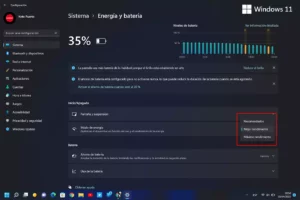
Battery Saver mode is your best friend when you need to extend battery life. When activated, Windows 11 pauses energy-guzzling background tasks, such as automatic email and calendar syncing, tile updates, and certain apps you're not using. Go to Settings > System > Power & battery, expand Battery Saver, and use the switch to turn it on immediately . Your computer will then reduce power consumption until you turn it off (or until you plug it back in if it activates automatically), resulting in a significant reduction in energy usage.
Automatic behavior can also be customized: on the same screen, choose the percentage at which you want it to activate automatically (20% by default, although you can increase it to 30%, 40%, or more if you prefer to be on the safe side). Additionally, there's a "Reduce brightness when using power saving" option, which lowers the brightness by approximately 20% when entering this mode. This feature provides a few extra minutes of battery life, which is especially noticeable since the screen is usually the component that consumes the most power; you'll have a balance between visibility and improved battery life . Keep in mind that Windows 11 may also cut off connections in power saving mode , something to consider depending on how you use your computer.
If you like to be quick, you can activate Battery Saver from the notification area: tap the battery icon and use the corresponding quick setting. This method is useful when you notice your battery drain increasing and you want to take action without opening menus, giving you a shortcut that will help you extend your wireless session on the go.
Screen settings that make a difference: brightness, refresh rate, HDR, and theme
Manually reduce the brightness to the lowest comfortable level. This is the most impactful measure: keeping it between 30% and 50% is usually sufficient indoors and significantly reduces battery life. If you're running low on battery, combine manual adjustment with the dimming option when Battery Saver mode kicks in; the savings are immediate, and visibility remains acceptable except in direct sunlight.
The screen refresh rate also matters. If your panel supports high rates (120 Hz, for example), consider lowering it for general use. Go to Settings > System > Display > Advanced display and choose a lower refresh rate. If the option doesn't appear, it means your computer doesn't allow you to change it; on gaming laptops , the difference in power consumption when switching from a high refresh rate to a standard one is very noticeable, and that translates into extra minutes of work or class time.
Check the options related to HDR and video playback. In Settings > Apps > Video playback, check Optimize battery life. For devices with HDR, go to Settings > System > Display > HDR and turn off HDR video streaming when using battery if your screen isn't HDR or you don't need it. This setting avoids additional processing and reduces power consumption, barely affecting the viewing experience but providing tangible savings while streaming.
If your screen is OLED, a dark theme can help. Go to Settings > Personalization > Themes and choose a dark theme; then, in Personalization > Colors, select Dark mode . On panels where each pixel is individually illuminated, dark backgrounds reduce power consumption. It's not magic, but it's a simple trick that, combined with other measures, gives the impression that the battery lasts a little longer.
Finally, configure aggressive screen lock and sleep settings when you're on battery power. In Settings > System > Power & battery > Display & sleep, reduce the screen timeout and sleep timeout for periods of inactivity. Setting the screen lock or sleep time to 1–2 minutes when you're on the go minimizes power consumption when you're away, which can be a lifesaver for extended use.
Control background apps, startup, and notifications
Many apps continue to run in the background, consuming resources. Start by limiting the ones that run when Windows starts: Settings > Apps > Startup and disable the ones you don't need, especially those marked as having a high impact. Alternatively, open Task Manager (Ctrl + Alt + Delete) and go to Startup Apps to disable anything that doesn't contribute to your system. Fewer background processes mean less CPU and battery usage.
For specific apps, restrict their background activity : Settings > Apps > Installed apps, go into the advanced options for each app, and under Background app permissions, choose Never if you don't need that app to remain active. It's a subtle way to control what runs without your knowledge, a common source of silent resource consumption that's best kept under control.
Another source of energy waste is constant notifications. Go to Settings > System > Notifications and disable anything that doesn't add value. Receiving alerts for everything slows down your screen and system, and reducing them will also improve your concentration; the double benefit is that you save energy and reduce visual noise.
Search indexing can also run at the most inconvenient times. In Settings > Privacy & Security > Windows Search, enable the power-saving indexing option so the system pauses this process when you're using battery power. It's one of those settings you don't see, but it prevents unnecessary spikes in battery usage and helps keep your battery life from draining unnecessarily.
If you spend half the day browsing, enable power saving mode. In Chrome, go to Settings > Performance and enable Power saving, choosing to activate it at 20% battery or whenever the device is unplugged. This reduces activity in background tabs and prioritizes what's visible, lowering the browser's resource consumption, which is usually the app that uses the most resources. You'll notice that, with the same usage, the battery drains more slowly.
Power modes, GPU, and the impact of Game Mode
Choose the power mode that best suits your needs when you're not plugged in: Settings > System > Power & battery, and select Best efficiency if battery life is your priority. This mode reduces peak performance but lets you work comfortably for longer; if you need more power, switch back to Balanced or a higher setting when you plug in. The key is to switch between modes so the system consumes minimal power when you don't need it.
If your computer has both integrated and dedicated graphics, assign apps to the integrated graphics when you want to save power: Settings > System > Display > Graphics, select the app, tap Options, and choose Power saving. This shifts common tasks to the iGPU, which uses less power. When an app requires heavy use, you can switch back to High performance or leave it on Automatic to let Windows decide, maintaining a reasonable balance between smooth performance and efficient power consumption.
Be careful with Windows 11's Game Mode: it's designed to prioritize games, limiting background processes and pausing certain Windows Update tasks during gameplay. While it helps stabilize FPS, on laptops it can impact battery life because it encourages more intensive CPU and GPU usage. Only activate it if you're going to seriously play games and keep battery life in mind, remembering that outside of gaming, it's best to revert to a power-efficient profile.
Another useful lever is visual effects. From Settings > Accessibility > Visual effects, disable animations and transparencies. And in System > About > Advanced system settings > Performance, check Adjust for best performance if you need to squeeze every last minute out of your system. You lose some visual flourishes, but the system feels more responsive and resource consumption drops slightly; it's not a huge difference, but it can give you the margin you need to finish your session.
Screen and sleep, laptop lid and airplane mode
In Settings > System > Power & battery > Display & sleep, define short timeouts when you're using battery power. If you're getting up to get water, set the screen to turn off after 1-2 minutes and then go into sleep mode a few minutes later. You'll end the day with a less drained battery because during short breaks the device won't continue consuming power at full capacity, and the feeling of total battery life will be much more pleasant.
Adjust what happens when you close the lid. In Control Panel > Power Options, you'll find the lid setting: choose to have the computer go to sleep when you close it. This setting is often incorrect after an update, and if the lid doesn't do anything, the computer might remain active in your backpack, draining the battery quickly. A simple change here prevents problems and helps conserve power without you even noticing.
Activate Airplane Mode when you don't need connectivity. Wi-Fi and Bluetooth networks constantly search for and maintain connections, which drains battery life. From the system tray, disable these radios with a single click if you're taking notes, reading PDFs , or editing documents offline. This not only saves battery but also helps you focus by avoiding notifications and distractions, slowing down battery drain and allowing you to work more efficiently . You can also check the battery life of Bluetooth devices if you want to monitor their impact.
For offline or streaming video playback, remember to optimize it: in Settings > Apps > Video playback, select Optimize battery life. If your device has an HDR section, disable HDR streaming on battery power when you don't have an HDR panel or don't need it. These settings reduce image processing and prevent spikes, positively impacting battery life, especially during long viewing sessions, while maintaining more than acceptable quality for watching movies or classes.
Keep your system and apps up to date, and clean up your system.
Windows 11 and its drivers receive patches that fix bugs and optimize performance. Go to Windows Update to install updates and, under Advanced Options, check the Optional Driver Updates . Also, run a battery health check to detect degradation or abnormal power consumption. It's also a good idea to update your apps, either from the Microsoft Store or through their respective app managers. With everything up to date, your computer will run more smoothly and, generally, consume less power to perform the same tasks, resulting in more predictable battery life.
Uninstall what you don't use: Settings > Apps > Installed apps, or from Control Panel > Uninstall a program if not everything appears. Removing unnecessary software frees up resources and prevents background processes. Complement this with a desktop cleanup: having dozens of icons slows down the initial boot time and doesn't help with organization. A clean desktop and a system free of bloat make startup and daily use lighter and more efficient.
Use the Cleanup Recommendations: Settings > System > Storage > Cleanup Recommendations. Delete temporary files and empty the Recycle Bin. A less full disk works better, and some background tasks end up taking less time, which indirectly translates into less energy consumed by regular processes. These are small improvements that, added together, give you the feeling that your battery lasts much longer.
You can also reduce the number of items on your taskbar: Settings > Personalization > Taskbar, and disable anything you don't use (widgets, standalone search, apps you don't need pinned). Each component is minimal on its own, but again, adding small optimizations reduces overall system noise and marginal resource consumption.
Modern Standby: When the suspension drains more than expected
Some laptops use Modern Standby to resume almost instantly from sleep, but in return, they maintain some connectivity that can drain the battery even when idle. If you notice your laptop losing a lot of power while supposedly asleep, you can try adjusting this feature. The first step is to expose advanced power options through a registry entry, and then disable Network Connectivity in Standby mode for your power plan; the goal is to make standby mode truly energy-efficient when you close the lid.
Typical steps used: Open Command Prompt with permissions and add the registry value to show the advanced standby connectivity setting. Then go to Control Panel > Power Options > Change plan settings > Change advanced power settings, find Network connectivity in standby mode, and disable it. With this change, the laptop will no longer remain partially awake in sleep mode, so after several hours, the battery life will be significantly longer than before.
Common scenario: gaming laptop and external battery
If you have a gaming laptop, you'll likely find that connecting it to an external battery will cause it to enter high-performance mode and drain the battery very quickly. As a general rule, Windows 11's Battery Saver only works when the computer isn't charging, so it's best to use other methods: enable Power Mode in Best Efficiency mode even when connected, lower the refresh rate, reduce screen brightness, and assign apps to the integrated graphics whenever possible. If your laptop supports it, you can limit charging to 80% to extend battery life and battery life. With these changes, the power consumption is reduced, and your power bank will easily last more than an hour.
If your device manufacturer offers its own power profiles, choose Silent or an equivalent when using an external battery, and close launchers and resource-intensive apps that start automatically. Activate Airplane Mode if you don't need internet access in class, and limit video playback to less impactful options. With these coordinated settings, the system avoids power spikes and your external battery performs better, allowing you to attend more classes without recharging and without having to lug the charger from one outlet to another.
More practical tips that add up
Remove animated backgrounds or carousels: use a solid color or a single static image for your background. It's a modest improvement, but when battery life is limited, every little bit helps, and it also reduces the constant graphical load that accompanies certain desktop animations. Along with the reduction of visual effects, this adjustment makes the interface cleaner and less battery-intensive.
If an app is too resource-intensive, look for lighter alternatives. Browsers, media players, and utilities with a large footprint often have replacements that do the same thing with fewer resources, which makes a noticeable difference during sustained use for several hours. Switching a single critical app to a more efficient version usually results in greater perceived battery life, especially on devices with limited battery capacity.
There are third-party tools for optimizing Windows 11 without manually tweaking too many system settings. One well-known tool in the community is the open-source Optimizer, which offers options to disable unnecessary services, telemetry, and unused native apps. Use it wisely, only enabling what you understand, and always keeping in mind that the most important thing for battery life is reducing background processes and tasks. When applied correctly, this extra layer of optimization can help reduce power consumption.
As a last resort, you can always reset your PC to factory settings if the system is cluttered with junk files and nothing seems to fix it. Back up your data, reinstall only what's necessary, and then follow the guidelines in this guide. Starting from scratch restores the system's lost responsiveness and establishes a clean slate for power settings to work properly, resulting in noticeably longer battery life.
With all of the above properly implemented, Windows 11 can go from draining the battery by mid-afternoon to lasting until the end of the day without any issues. The winning combination involves enabling Battery Saver, lowering screen brightness and refresh rate, optimizing video playback, reducing background processes, choosing the appropriate power mode, configuring sleep and lid settings, and disabling Modern Standby if necessary. By adding up these micro-saving measures across the board, the laptop uses less power for the same tasks, and your battery life ceases to be a gamble, becoming much more predictable and longer-lasting.

Passionate writer about the world of bytes and technology in general. I love sharing my knowledge through writing, and that's what I'll do on this blog, show you all the most interesting things about gadgets, software, hardware, tech trends, and more. My goal is to help you navigate the digital world in a simple and entertaining way.