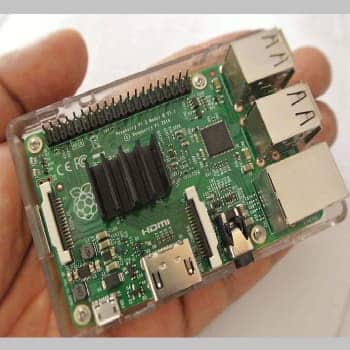
The plate Raspberry Pi It is not designed to be a mini-computer for users. The board has much more to offer. In professional terms, we would call it a tablet. This means that it comes with all the basic configurations of hardware.
Despite this preliminary hardware configuration and the board being closed hardware, The various models still have expandable hard integration with other hardware modules such as displays and even electronic boards such as the ArduinoThe goal of all these pre-configurations and extensible features is to make life less complicated for the programmer or developer.
If you want to use a Raspberry Pi board, you should expect pre-installed hardware modules such as GPU, CPU, and RAM. Unfortunately, the Raspberry Pi board cannot be built and configured so perfectly that it automatically meets all our design goals.
This statement does not mean that there is no cure for this problem. The stated purpose of the project may be to run X86 applications. In this case, the only possible solution is to use Raspberry Pi emulators.
You can also read: 7 Best GBA Emulators for PC
What is an emulator?
In the computer world, An emulator can be hardware or software. It is used to give a computer system the same performance characteristics as another computer system. In this case, the computer system is a mounted Raspberry Pi unit.
If we want it to behave like an operating system architecture Windows 32-bit, we need to run and install a 32-bit system emulator to give it that performance. Think of the emulator as a power supply for your system unit.
5 Best Raspberry Pi Emulators
This article discusses the useful effects of emulators for users who want to run certain applications on their Raspberry Pi system. Now that you know that buying a Raspberry Pi may require the use of emulators, these are essential to make your projects more flexible. We are going to introduce you to some of these great Raspberry Pi emulators.
1. RetroPie Emulator
This Raspberry Pi emulator is winning the popularity contest in the Raspberry Pi community. As a computer program, This emulator offers excellent performance to its users. It adapts very well to the OS open source like Ubuntu OS, which is based on Linux.
Since the Raspberry Pi is more focused on the Linux community, the excellent performance of the RetroPie emulator also applies to the Linux community. The EmulationStation application on the Raspberry Pi was the main development base for creating this emulator. The EmulationStation application was RetroTech's emulator that served as a front-end before that function was abandoned.
Thanks to continuous development and expansion of functionalities, RetroPie has become much more extensible, which makes it easy to integrate into larger projects. It adapts very well to ARM-based architectures or devices.
Other details
When it comes to RetroPie's user experience indicator, you'll find features that make up the user interface, making it user-friendly and customizable. Setting up or implementing the necessary user settings through the system settings ensures a smooth transition.
With the RetroPie emulator you can have all your classic games under one roof, as it supports them all. This support is taken from the EmulationStation application interface. So if you are familiar with the interface of older console emulators, your experience with the RetroPie emulator will be perfect.
Features of the RetroPie emulator
- RetroPie Emulator's shaders and overlays are used to fine-tune the game's graphical filter settings. They are also useful when game customization preferences require adding or inserting translucent layers.
- The flexibility of the RetroPie emulator extends to system ROMs as well. Whenever a new ROM is introduced or installed, RetroPie assigns and configures a default emulator compatible with each available or installed ROM.
- The RetroPie emulator also has a debugging feature. It provides several useful functions for system ROMs. This includes taking screenshots and describing the system ROM. In short, it just takes a push of a button to make it happen.
- RetroPie also automates its flexibility when working with external controllers. Once connected, this emulator automatically makes the appropriate settings and configurations. This ensures a smooth and seamless gaming experience.
2. RecalBox Emulator
Mathieu, a French programmer, is responsible for the development of this emulator created from scratch. RecalBox is an open source emulator for the Raspberry Pi board mountedThe main objective that has led to the development and creation of this emulation distribution is the need to satisfy the desire of the user community to have a platform that supports retro games.
A RecalBox distribution Contains more than 40 emulatorsThe external part of this emulator mimics the EmulationStation application to meet operational needs. Read more about what RecalBox offers in relation to Raspberry Pie packages.
If you need access to these packages and their updates, you can follow them via a link on GitLab. Additionally, the official RecalBox website has some interesting DIYs to help you get used to the emulator. You can also check out the RecalBox blog for upcoming updates and new features that might interest you.
Installing the RecalBox Emulator It is easy and usually done in a few steps.. Hardware support is so wide that it can be easily set up with a native controller. The emulator ensures a gaming experience identical to that of the real console.
RecalBox Emulator Features
- As a user, you have the ability to customize your collection of retro playlists. This may seem like an obvious feature, but until you experience the difficulty of customization on all retro gaming platforms, you won't be able to praise this feature of the RecalBox emulator.
- With the RecalBox emulator you can flexibly customize the look and feel of your system ROM. This can be achieved by flattening or bending shaders.
- Most gaming platforms don't give you a second chance when it comes to improving your gaming experience. The RecalBox emulator, on the other hand, is the perfect genius to fulfill this desire. Imagine a game that leads you to failure. With RecalBox you can rewind and resume the game at a point where everything was working fine.
- There is no need to manually update the RecalBox emulator. The software itself has an automatic update system. While you focus on creating the perfect gaming experience or platform, the RecalBox emulation system automatically takes care of all necessary software updates.
- Creating the necessary system images in RecalBox is a piece of cake. It's quick and easy to perfect.
- The flexibility of the RecalBox emulator also extends to your preferred game theme. If you want, you can change it at any time.
3. Lakka Emulator
Another ideal Raspberry Pi emulator to consider is the Lakka emulator. It is suitable and attractive for users in the field of retro games.Being an open source Linux distribution, the constant contributions and feature updates from the user community make it a complete package for retro gamers.
Thanks to its functional design, any available RetroArch front-end can be designed for easy emulation. As part of a standalone RetroArch system, this emulator Lakka allows us to implement an additional core if needed.
The ability to do so is only possible with the support and customization provided by the Libretro API. The emulation features included in Lakka are defined once and for all. Among the most important are the function multiplayer online and automatic recognition of controls USB.
Working with the Lakka emulator is simple, from installation to driver configuration. It is also a stable software that you can use in your Raspberry Pi projects.
Features of Lakka Emulator
- Depending on the chosen system architecture, Lakka provides a Libretro-compatible kernel. This is a modular emulation program that provides plug-in functionality when it meets the desired emulation goals.
- It extends its functionality with a USB flash drive, allowing users to add system ROMs from there.
- The Lakka emulator user interface allows users to customize their own background image and save other dynamic features.
- The Lakka emulator package is also expected to include drivers, netplay, memory and shaders.
4. MAME emulator
MAME stands for Multiple Arcade Machine EmulatorThis Raspberry Pi emulator is free and open source. The MAME emulator software is the perfect gift for users who love classic games.
It can hold hundreds of classic playable games, which can also be played with computers or Raspberry Pi boards. Its purpose is to preserve old games. It's the perfect archive of games you won't want to forget.
The MEME emulator also uses the basic Libretro features described in the chapter on the Lakka emulator. The only additional implementation required for this basic Libretro functionality is to consider RetroArch as a suitable frontend. If you can meet these basic functionality requirements, you will have an excellent Raspberry Pi gaming console.
Features of MAME emulator
- Provides a basic, non-binding interface.
- MAME support extends to home theater and arcade consoles. This support requires the implementation of an advanced user interface.
- It is a multi-emulator and can host multiple emulation components or instances simultaneously.
- Between the MAME game platform and the original game launch platform, the MAME emulator positions itself as a software wall between these two system instances.
- Using MAME makes it easier to troubleshoot issues related to refresh rate, resolution, and display settings as it has a built-in help module.
5. QEMU Emulator
The unified nature of the QEMU software does not prevent it from being the perfect operating system emulator for the Raspberry Pi. QEMU is specific to the Raspberry Pi virtualization processor. Pi which supports. In QEMU, the software processor is emulated using dynamic translation.
The emulator also offers the ability to manage device models and hardware during this dynamic translation. With QEMU Emulator, the machine you use for emulation allows you to control other existing guest operating systems.
QEMU Emulator Features
- The QEMU emulator does not need a host kernel driver, as it does not affect its excellent performance.
- QEMU is very portable, because it uses the full functionality of the MMU (Memory Management Unit) in software.
- If you need to start and move processes from one processor to another, the special functionality of QEMU takes care of that. Cross-compiling and successfully running a PLC emulator is also no problem when the system requires it.
Final note
Currently, Raspberry Pi emulators are available both in the form of games and emulation software packages. These emulators will always solve the missing piece of the puzzle for Raspberry Pi developers and programmers who need to access certain software features and functionality.
There are many software emulators available online these days. While most of them will catch your eye, you should focus on their compatibility with your Raspberry Pi board. The compatible Raspberry Pi emulators presented in this article will be a good buy for you.
You won't have to scour the Internet like a madman and try out all the emulators that you instinctively think are right for you. We've done the hardest part of the job for you: finding and gathering the necessary information about the emulators. Raspberry Pi EmulatorsWe've done the hardest part of the job for you: installing and testing the emulators once your software or system requirements have been met. Good luck on your Raspberry Pi emulation journey.
You can also read: 5 Best PS4 Emulators for PC

My name is Javier Chirinos and I am passionate about technology. Ever since I can remember, I have been interested in computers and video games, and that passion has turned into a job.
I have been publishing about technology and gadgets on the Internet for over 15 years, especially in mundobytes.com
I am also an expert in online marketing and communication and have knowledge in WordPress development.