- A SOC integrates people, processes, and technology to monitor, detect, and respond 24x7.
- Its tiered structure (1-3) and specialized roles optimize classification and research.
- Tools like SIEM, EDR/XDR, and SOAR consolidate telemetry, automate, and provide context.
- KPIs (MTTD/MTTR), best practices and models (internal, hybrid, SOCaaS) align security and business.
In today's digital world, organizations need more than just antivirus and firewalls: they need a team capable of continuously monitoring, detecting, and responding to cybersecurity incidents . That's where the SOC comes in, combining people, processes, and technology to safeguard assets and business continuity.
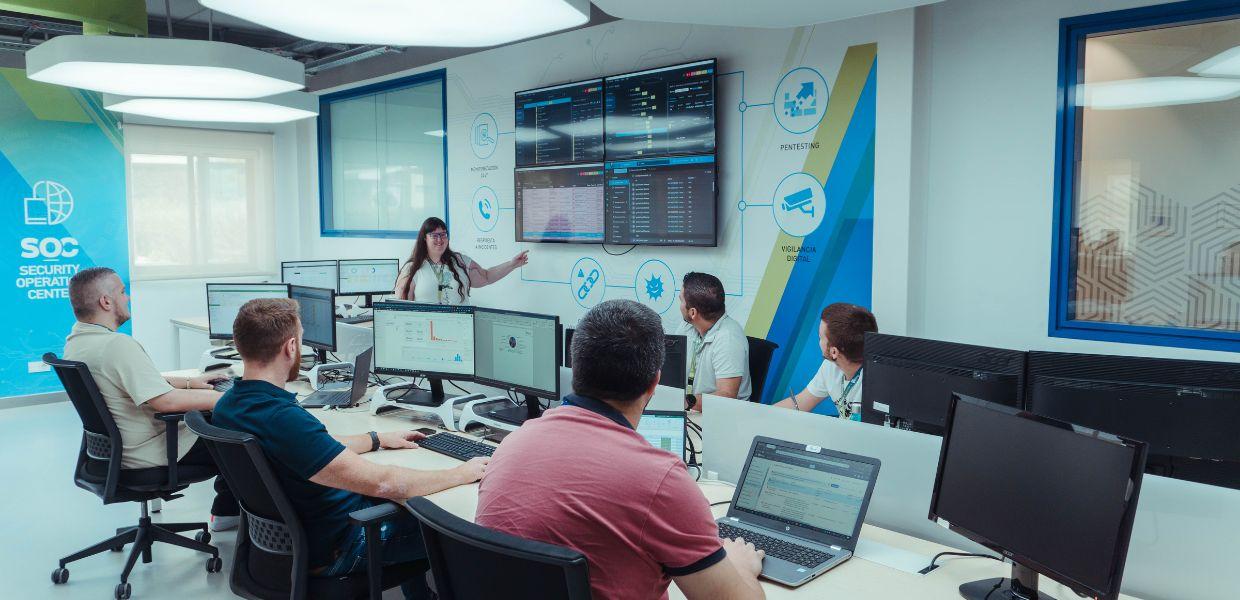
More than just a room with screens, a SOC is an operational service that combines continuous monitoring, advanced detection, and threat intelligence with a coordinated response. A well-designed SOC integrates telemetry from the entire infrastructure (on-premises, cloud, and third-party), provides context, and orchestrates actions within minutes when there are signs of an attack.
What is a SOC (Security Operations Centre)?
A Security Operations Center (SOC) is a centralized function that brings together people, processes, and technology to prevent, detect, analyze, and respond to cybersecurity incidents around the clock. Its mission is to protect systems, networks, and data through 24/7 monitoring, event correlation, and predefined response procedures.
Regarding its implementation, there are two main approaches: the in-house SOC , managed internally by the organization (infrastructure, tools, and personnel), and the SOC as a Service (SOCaaS), where an external provider takes over operations, platforms, and intelligence with continuous coverage. Both models pursue the same goal: reducing risk and exposure time to threats.

Structure, hierarchy and profiles
To operate 24/7, SOCs operate in shifts and by experience levels. The most common structure starts with a Level 1 analyst layer that monitors and classifies alerts, a Level 2 layer that investigates thoroughly and recommends containment, and a Level 3 expert layer that resolves complex incidents and hunts for threats.
Alongside these levels, there are usually specialized roles: SIEM correlation and management specialists , intelligence analysts who study adversary tactics and techniques to feed detections, and DFIR (Digital Forensics & Incident Response) teams with forensic and response experience.
In organizational terms, a SOC includes a manager who oversees daily operations, security engineers/architects who design and maintain the defensive architecture, analysts at various levels who monitor and respond, proactive threat hunters , and forensic experts for post-incident analysis. In many companies, the CISO acts as a liaison between the SOC and senior management.
The SOC's placement within the organizational chart can vary: it depends on whether it's integrated into IT/Operations, a Security group, the NOC, or reports directly to the CIO/CISO office. There's also the radial architecture model : a central core that coordinates strategy and several "radius" units focused on specific domains (e.g., networking, cloud, OT), improving scalability and coordination.

Key functions and day-to-day processes
The SOC doesn't just look at screens: it applies a continuous cycle of discovery, monitoring, detection, response, and improvement . Broadly speaking, these are its essential functions.
Continuous monitoring and detection
The core function is to monitor the extended infrastructure (applications, servers, endpoints, networks, cloud workloads) 24/7 to detect anomalous activity. To achieve this, SIEM and other platforms unify real-time alerts and telemetry, enabling the correlation of signals to identify attack patterns.
Log management is key: simply collecting logs isn't enough ; they must be analyzed to establish baselines and detect deviations. Many attackers rely on companies not thoroughly reviewing their logs, creating windows of vulnerability that can last for weeks or months if the breach isn't addressed.
Classification and research
Separating the wheat from the chaff is crucial: the team reviews alerts, discards false positives, and prioritizes threats by severity and scope. Modern solutions incorporate AI/machine learning to assist in classification and improve over time based on data.
In the investigation, analysts verify legitimacy and impact, reconstruct the chain of events, assess the blast radius , and prepare containment actions, relying on network, endpoint, and cloud telemetry, and intelligence on adversary TTPs.
Incident response
Once a threat is validated, the SOC takes action to contain and eradicate it. Typical measures include isolating endpoints or network segments, stopping compromised processes or services, removing malicious artifacts, and redirecting traffic when necessary.
- Investigate the root cause to find technical vulnerabilities and process or hygiene failures (e.g., weak passwords or unsafe Office macros).
- Disconnect or shut down compromised devices temporarily.
- Isolate affected areas of the network or apply containment rules.
- Pause or stop applications/processes at risk.
- Delete malicious files or infected.
- Run anti-malware controls and additional checks.
- Revoke or reset credentials internal and external affected.
After containing the incident, the SOC coordinates recovery and return to normal with IT: restorations, reinstallations or use of backups in incidents such as ransomware, ensuring that the environment is clean.
Threat hunting and forensic analysis
Proactive threat hunting seeks subtle clues that don't trigger conventional alerts, relying on hypotheses, advanced queries, and historical telemetry. It complements reactive detection and reduces dwell time.
Digital forensics allows us to reconstruct what happened, when, how, and with what impact. This practice provides evidence, lessons learned , and hardening requirements to prevent similar attacks.
Awareness, vulnerabilities and patches
The SOC also conducts employee awareness sessions , promoting safe practices and early reporting. In parallel, it orchestrates vulnerability management and patching programs to prioritize and address weaknesses based on risk criteria.
Collaboration with other areas (IT, Legal, HR, management) is essential for a unified response and to align security with business objectives and compliance.
SOC Technologies and Tools
In technology, typical pillars include SIEM (event aggregation and correlation), EDR for endpoints and XDR capabilities that extend visibility to network and cloud, plus automation and orchestration (SOAR) to accelerate responses.
An effective SOC would inventory IT assets, deploy intrusion detection mechanisms , proactively analyze VMs, containers, and serverless functions, apply behavioral analytics to detect anomalies, and connect threat intelligence platforms (internal/external sources) to gain context.
Many organizations operate with more than 25 disconnected tools, increasing complexity and operational burden. Trends point to consolidating controls, cross-visibility, and automation to reduce alert fatigue and improve MTTD/MTTR.
In addition to SIEM/EDR/XDR and SOAR, common features include network probes , log collection and normalization tools , cloud-based Detection/Response (CDR/CNAPP) solutions, and suites that integrate AI analytics , hunting, and intelligence to increase accuracy and shorten investigations.
SOC and outsourcing models
There are three main models: in-house (using internal resources), outsourced (SOCaaS with a security provider), and hybrid (a mix of in-house capabilities and managed services). Market preference leans toward hybrid approaches, which combine control and 24/7 expert scale.
SOCaaS offers monitoring, log management, intelligence and detection, investigation, response, reporting, and compliance, with the provider contributing processes, personnel, and technology . In contrast, an in-house SOC provides complete control and proximity to the business at the cost of investment and operational maturity.
When choosing a model, it's important to consider asset criticality, budget, operating hours, team maturity, cloud dependency, and compliance requirements. A phased approach with hybrid solutions is often the most practical way to accelerate capabilities while maintaining governance.
Good practices and metrics (KPI)
A SOC must execute a clear strategy, with documented processes and continuous improvement. Best practices include: defining policies and procedures, implementing technical controls, training employees, monitoring and analyzing logs, assessing vulnerabilities, and responding quickly to incidents.
Measurement is vital. Some relevant KPIs are MTTD (mean time to discover), MTTR (mean time to respond), and MTTC (mean time to containment). False positive/true positive ratios, vulnerability remediation percentages, and efficiency/ROSI metrics are also important.
To align the SOC with the business, it's necessary to identify critical assets , quantify risk (operational, reputational, and financial impact), and communicate value using the language of avoided costs, continuity, and compliance. This alignment facilitates investment and prioritization.
Finally, it is essential to maintain an up-to-date technological base: patches, hardening , configuration reviews and access controls, always with evidence of compliance with applicable frameworks and regulations.
Common challenges and how to address them
The threat landscape is growing in number and sophistication. Three challenges stand out: the shortage of specialized talent , alert overload (fatigue, noise), and tool fragmentation (operational overhead and limited interoperability).
To mitigate these challenges, the most advanced SOCs consolidate platforms, integrate intelligence sources , implement automation in triage and response (SOAR), enrich alerts with context, and improve end-to-end visibility (endpoint, network, and cloud). Continuous training and playbook documentation also make a difference.
Another lever is strengthening log management: a well-orchestrated log pipeline with high-quality data increases detection reliability and lowers the false positive rate. Adding recurring hunting and TTP-based hypotheses reduces attackers' dwell time.
Finally, alliances and collective intelligence models (exchange of indicators and signals with other centers and communities) enable proactive alerts and coordinated responses to ongoing campaigns.
Benefits for the organization
Having a SOC offers tangible advantages: it improves early detection , shortens response times, enables proactive defense, and optimizes costs by preventing major impacts. It also strengthens data protection and the trust of customers and stakeholders.
Furthermore, it offers transparency and control over security operations, reduces exposure time, and accelerates recovery after incidents. It provides industry-specific risk insights and enables the creation of targeted and customized correlation cases for each individual context.
From a business perspective, a well-aligned SOC drives operational continuity, facilitates regulatory compliance, and sustains a strong security culture. In hybrid and distributed environments, its role is critical for managing expanding attack surfaces.
Relationship with SIEM, XDR and other capabilities
SIEM remains the core monitoring, detection, and response technology for many SOCs: it gathers data from diverse sources and applies analysis and correlation to identify threats. XDR capabilities extend telemetry (endpoint, network, and cloud) and enable automated detection and response.
The suite is complemented by SOAR (Orchestration and Automation) platforms , which accelerate repetitive tasks and playbook-guided responses. In parallel, AI-powered intelligence and hunting tools provide extended visibility and high accuracy, helping to expose, investigate, and shut down attacks with less friction and a better ROI.
Additional functions and specialization
Many SOCs incorporate advanced capabilities to cover specific needs: vulnerability management , threat intelligence, fraud closure, recovery of credentials exposed in illicit markets, malware analysis , and network architecture design.
These functions enhance the value of the SOC by connecting detection and response with prevention and resilience , strengthening the entire incident lifecycle and organizational learning.
Compliance and regulatory frameworks
The SOC contributes to compliance with regulations such as GDPR, NIS2, and ISO 27001 by providing evidence of control, event traceability, and response processes. Maintaining consistent policies, audits, and reporting is essential to meeting regulatory and industry requirements.
It also helps to implement governance and control frameworks, align security with corporate objectives, and design processes and technologies in accordance with compliance and risk principles.
All of the above makes the SOC a strategic asset: by uniting technology, processes, and people, it offers total visibility, reduces the window of opportunity for attackers, and enables smarter, more automated security that, over time, learns and improves to stay ahead of threats.


Passionate writer about the world of bytes and technology in general. I love sharing my knowledge through writing, and that's what I'll do on this blog, show you all the most interesting things about gadgets, software, hardware, tech trends, and more. My goal is to help you navigate the digital world in a simple and entertaining way.