- The Final Fantasy saga has gone from simple 8-bit stories to mature, ensemble plots with very complex characters.
- Spin-offs and prequels like Crisis Core, Type-0 or the remakes of FFVII expand and enrich already known universes.
- The most highly rated installments in terms of story and characters are usually FFVI, FFVII, FFIX and the MMORPG Final Fantasy XIV.
- The latest titles, such as FFXV and FFXVI, focus on action and spectacle without abandoning the narrative.
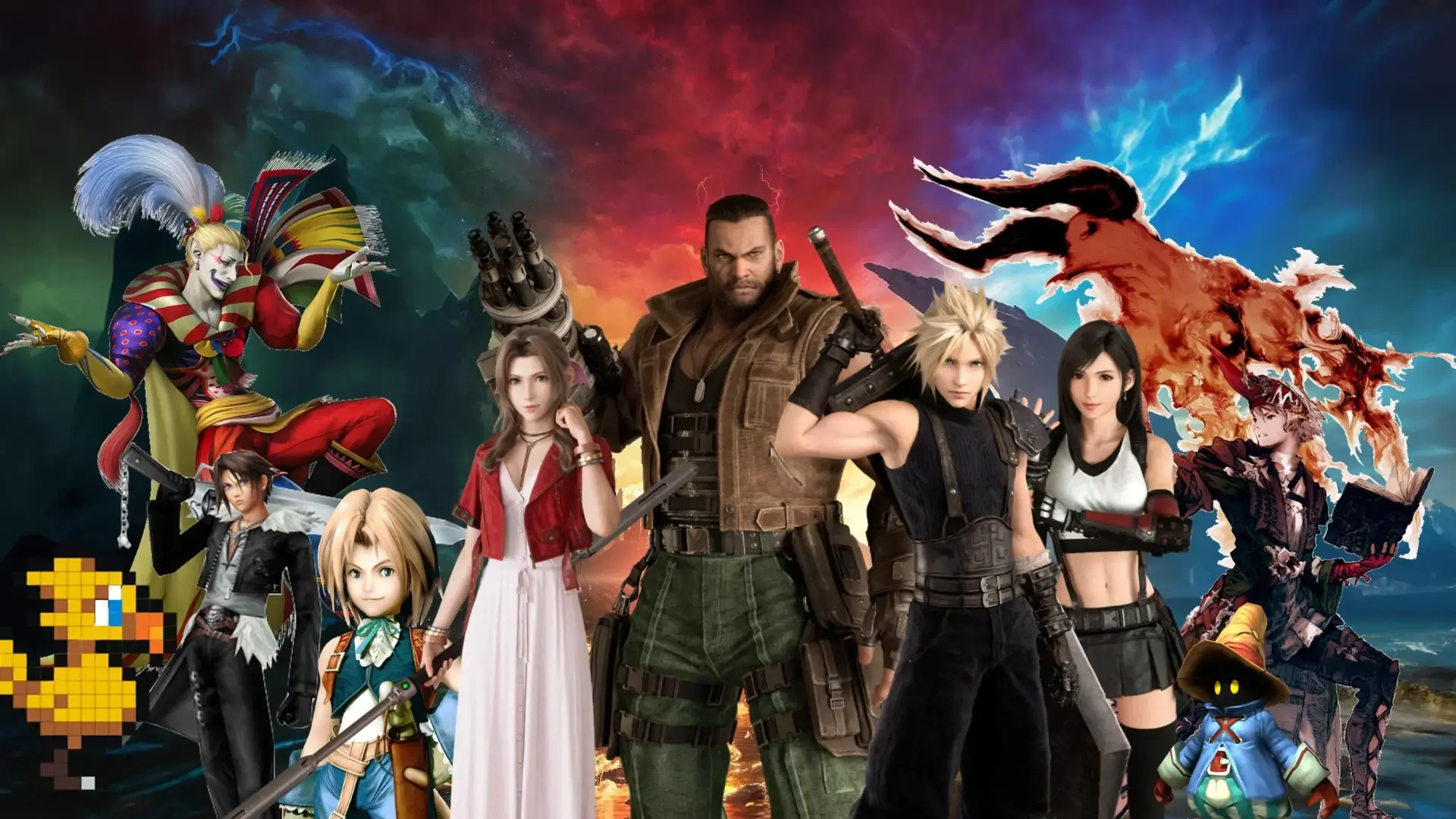
La saga final Fantasy Since the late 80s, it has been one of the absolute pillars of Japanese role-playing games. In over three decades, it has grown from that humble NES cartridge into a vast universe, with numbered installments, prequels, sequels, remakes, spin-offs, MMOs, bizarre experiments, and even music games. And, of course, with so much variety on the table, the big question inevitably arises: What are the best and worst Final Fantasy games if we only look at story and characters?
In this article we're going to do just that: review the main installments, sequels, prequels and most important spin-offs and rank them from worst to best in terms of plot, universe, and character development. This isn't a list of "best gameplay" or "most revolutionary," but rather how much their scripts, protagonists, villains, and supporting characters resonate with us. You'll see everything from heavily criticized titles that still contain interesting ideas to true masterpieces whose narrative impact continues to define the medium.
Final Fantasy games with weaker stories
Within such a vast universe, it's understandable that some games fall short in terms of plot. Many of these games are born as... playable experiments or derivative products who seek to exploit the world of the saga without focusing on the script.
Such is the case with proposals like Final Fantasy: Mystic QuestOriginally conceived as an "entry-level RPG," it features simple first-person combat, no random encounters, and a node-based map, reminiscent of Dragon Quest and later Final Fantasy X. The problem is that its The story is flat, clichéd, and lacks memorable characters., so today it feels like just another run-of-the-mill JRPG.
Something similar happens with Monster of the Deep: Final Fantasy XVA curiosity for PlayStation VR that works well as a small fishing game with spectacular final bosses, but, speaking of narrative, It contributes very little to the universe of EosIt's entertaining, yes, but it's clear that it's more of an experience than a complete game.
This group also fits Final Fantasy Explorers For Nintendo 3DS, a toned-down “Monster Hunter” with a Final Fantasy skin. It focuses on cooperative hunts, gathering, and equipment farming, with the added bonus of being able to recruit iconic monsters as allies. However, its The story is merely functional and the characters are completely forgettable.What matters here is the mission loop, not the story.
Spin-offs and derivatives that expand the universe… with ups and downs
Beyond the main saga, Square Enix has released multitude of parallel products that expand specific worlds, especially that of Final Fantasy VII. Some are small experiments; others, key pieces of the lore.
At the weakest end are Dirge of Cerberus: Final Fantasy VII y Before Crisis: Final Fantasy VIIThe first one tries to be a shooter/hack & slash starring Vincent Valentine, but between its clunky controls and poor design choices, it ends up being a tedious title. Story-wise It adds details about the Deepground organization and Vincent's past.But it does so without much subtlety. Before Crisis, meanwhile, is a mobile RPG focused on the Turks that was never released outside of Japan; its greatest value is filling in gaps in the FFVII timeline, but its plot feels slow and lacks memorable moments.
Instead, Crisis Core: Final Fantasy VII – Reunion It clearly stands above the rest. This prequel, focused on Zack Fair, reimagines the entire beginning of the FFVII story and builds upon it. one of the most beloved characters in the franchiseHis arc, from the idealistic SOLDIER to his ultimate fate, is told with an emotional depth rarely seen in a spin-off. Despite its somewhat repetitive mission structure, the script shines when exploring Zack's relationships with Aerith, Cloud, and Shinra itself.
Another derivative that is often undervalued is Final Fantasy Type-0 HDOriginally released on the PSP, it takes us to a bloody war between nations with a darker tone than usual. “Class Zero” functions as a tragic ensemble castAnd the game doesn't shy away from showing the consequences of war on young soldiers. It's true that the environments are austere and reused, but in terms of story and wartime atmosphere, Type-0 takes a bold step forward for the franchise.
On a radically different note is World of Final Fantasy Maximawhich is almost a parodic love letter to the entire saga. It uses a light, almost fairytale-like tone, with monster capture and constant cameos from classic heroes and villains. Its value lies not so much in a deep plot, but in how It humorously and affectionately reinterprets icons from the entire series.resulting in a very enjoyable celebration for veteran fans.
The first installments: playable foundations and simple stories
The early Final Fantasy games were more notable for their systems and design concepts than for their elaborate narratives. Even so, several had already established a foundation. key elements of the franchise's identity.
final fantasy i It's the seed of it all. A group of four anonymous Warriors of Light, crystals, classic dungeons, and a time paradox with the final boss as a surprising twist. Its characters barely speak, and the script is very simple, but its basic epic structure still works, especially in modern versions like the pixel remaster, which introduce improvements in pace and quality of life.
Final Fantasy II It took a step forward in history by mounting a resistance against an oppressive empire, with major deaths in the main cast and a somewhat more dramatic tone. However, its famous progression system—raising stats based on actions, including the ability to "farm" by attacking your own allies—felt so broken and strange that it overshadowed some of the narrative advancement, and even the remasters haven't completely corrected that feeling.
With Final Fantasy III The real boost to the job system arrived: a group of chosen young people who obtain interchangeable classes and mechanics that would later be refined in FFV. Its plot remains fairly archetypal, but It opens the door to playable customization that would influence the tone of the saga., more focused on the journey than on characters with proper names.
The leap to powerful stories: from FFIV to FFVI
The true narrative maturity of the series begins with Final Fantasy IVHere we are already talking about a complex protagonist, Cecil, who begins as a dark knight in the service of a questionable kingdom and embarks on a a very well-worked journey of redemptionThe plot unfolds with betrayals, sacrifices, and twists, while delving deeper into characters like Kain, Rydia, Rosa, and Edge. It was also the first game to use the Active Time Battle (ATB) system, which added tension to the combat.
FFIV grew with a direct sequel, Final Fantasy IV: The After YearsStarring Cecil and Rosa's son, this sequel ties up loose ends and shows the future of that world, although its Relatively short duration and some playable decisions, like the lunar phases that alter abilities, make it look more like a complement than a great standalone work.
En Final Fantasy V The narrative takes a backseat to the job system, which here reaches an almost obsessive level of complexity. The story is engaging, with comedic moments and a striking villain, Gilgamesh, but the protagonists lack the dramatic force of FFIV. In return, the player can experiment with dozens of combinations of trades and skills, something that many fans consider one of the playable peaks of the saga.
F It's a title that many place at the top not only of the franchise, but of 2D JRPGs. Here we have one of the largest and best-developed casts in the history of the genrewith characters like Terra, Locke, Celes, Sabin, and Edgar, each with their own past, traumas, and evolution, which even serve as inspiration for apps to create charactersThe figure of Kefka, a villain who manages to destroy the world and establish himself as a "god," redefines what an antagonist can do in a video game. The game dares to divide its narrative into two halves—a world of balance and a world in ruins—and uses this division to explore loss, guilt, and rebuilding.
Version pixel remaster It updates its visual and sound presentation without touching its heart: a A multi-layered plot that combines humor, tragedy, and epic storytelling better than almost any other JRPGIt's not surprising that in many rankings it appears tied with FFIX or even above it.
The PlayStation era: from the FFVII phenomenon to the charm of FFIX
The arrival on PlayStation marked Final Fantasy's definitive leap into the mainstream Western audience. From then on, the stories and characters of each installment became cultural icons that transcend video games and serve as a reference for anyone who wishes create an AI character.
Final Fantasy VII It was a true revolution: the biggest blockbuster of its time, with polygonal 3D graphics, stunning cinematics, and a vast world. More importantly, its story about the struggle of Cloud, Tifa, Aerith, Barret, and company against the Shinra Corporation and the charismatic Sephiroth resonated deeply. The combination of environmentalism, psychological trauma, identity and sacrifice It turned the game into a legend. Today it may look dated, but its soundtrack, key scenes, and Materia system remain a benchmark.
This story has expanded with multiple pieces, including Final Fantasy VII Intergrade Remake y Final Fantasy VII RebirthThe remake reimagines Midgar with a much more detailed approach, expanding both the characters' backstories and their relationships, and even plays with the very idea of a "remake" within the narrative. Its combat system blends real-time action with tactical pauses, allowing for... a very dynamic treatment of the group in battleRebirth, which spans the world beyond Midgar, raises the scale, offers more freedom of exploration, and delves even deeper into figures like Sephiroth, cementing itself for many as one of the best storylines in the entire modern series.
Final Fantasy VIII He lived in the shadow of his predecessor, but with There It has earned a place among fans. Its story of witches, time travel, and military academies revolves around Squall, an introspective protagonist whose emotional evolution with Rinoa becomes the heart of the game. It is true that the The "junction" system and magic theft can break the balanceBut it also allows for very powerful configurations. Narratively, it plays with memory, destiny, and responsibility in a more complex way than FFVII, but equally compelling.
Lastly, Final Fantasy IX For many, it's the perfect balance between classicism and modernity. It returns to a fantastical medieval aesthetic, revives archetypes like the black magician and the thief, and blends them with a more contemporary sensibility. Zidane, Garnet, Steiner, Vivi, and company form one of the most endearing groups in the saga, and their conflicts—Vivi's identity, Garnet's burdened destiny, Zidane's vitalistic philosophy—build a compelling narrative. on the meaning of life, death, and memory It's thrilling from beginning to end. Its "big-headed" visual style and cheerful tones conceal one of the franchise's most profound stories.
The transition to action and the controversial sequels
With the arrival of PlayStation 2 and later consoles, Square Enix began to experiment more with the tone, structure, and combat system itself, which led to much-loved releases and others that were highly debated in terms of history and characters.
Final Fantasy X It is the clearest example of success. Its linear narrative serves to focus on the relationship between Tidus and Yuna, the pilgrimage journey to defeat Sin, and the critique of oppressive religious structures. The sphere system allows players to shape the role of each party member, while the story progresses with powerful scenes—including the famous To Zanarkand—and an emotional climax that has moved half the world to tears. Despite criticism of its linearity and some annoying minigames, such as dodging 200 lightning bolts to obtain Lulu's weapon, it is still considered one of the most well-rounded JRPGs of the generation.
its sequel, Final Fantasy X-2It opted for a much lighter tone and a trio of female protagonists (Yuna, Rikku, and Paine) wrapped in J-pop aesthetics. In terms of plot, it's criticized for being superficial and diluting some of the impact of X's ending, but in terms of gameplay, it introduces one of the Best job and combat systems in the entire sagaThe game also features the Dresspheres, along with a huge number of minigames and side content. Its HD remaster allows you to rediscover that duality between a questionable story and brilliant mechanics.
Final Fantasy XII The focus shifted: it took us to Ivalice, a world of political intrigue with a space opera feel, and a group of characters who, in many cases, act more as plot devices than traditional heroes. Balthier, Ashe, and Basch sustain a plot reminiscent of Star Wars in its portrayal of empires, alliances, and resistance. Vaan, criticized as one of the weakest characters in the saga, functions almost as an observer. His gambit system allows configure the tactical behavior of alliesgiving the combat an almost MMO feel. The Zodiac Age edition refines the pacing, introduces jobs, and accelerates exploration, enhancing the journey without altering its political backdrop.
With Final Fantasy XIII This led to one of the strongest divisions within the community. On one hand, its paradigm-based combat system, a distant descendant of ATB, is praised, becoming dynamic and strategic once unlocked. On the other hand, its excessive linearity and an unempathetic castWith characters that many perceive as archetypal or contrived, Lightning, Snow, Hope, and company move through a fascinating world, Cocoon and Gran Pulse, but the way the story is told and the absence of classic elements like towns or minigames weigh down its overall rating.
Its sequels, Final Fantasy XIII-2 y Lightning returnsThey try to correct course. The first introduces time travel, greater freedom of exploration, and the capture of allied monsters, sacrificing narrative coherence in favor of variety. Many consider it the most well-rounded installment of the trilogy in terms of gameplayAlthough its plot becomes convoluted, Lightning Returns focuses on a countdown to the end of the world, with missions that affect the passage of time and a system of interchangeable costumes (roles) for the sole protagonist. Its premise, heavily inspired by Majora's Mask, is divisive: it has one of the most fitting endings in the series, but a structure that's difficult for those looking for a classic JRPG to grasp.
MMOs and the explosion of the online universe
You can't talk about the history and characters of Final Fantasy without mentioning its forays into the MMO genre, as they have generated some of the longest and most complex stories in the franchise.
final fantasy XIReleased on PC and consoles in the early 2000s, Vana'diel pioneered the franchise's move to a persistent world. It built a universe, Vana'diel, where cooperation was practically mandatory for progress. With multiple expansions—Rise of the Zilart, Chains of Promathia, Treasures of Aht Urhgan, Wings of the Goddess, and Seekers of Adoulin—it wove together a rich tapestry of storytelling. a solid mythology, elaborate raids, and long-running storylinesMany veterans remember it as a demanding but unforgettable experience.
However, if we're talking about narrative excellence in MMO format, the throne goes to Final Fantasy XIV and, specifically, its reincarnation as A Realm Reborn and subsequent expansions: Heavensward, Stormblood, Shadowbringers, and Endwalker. What began as a launch disaster In 2010, it was reborn as one of the best-written MMORPGs in history. Its story arcs explore themes such as sacrifice, redemption, the struggle against fate, and coexistence between peoples, all supported by a cast of memorable NPCs and a spectacular soundtrack. Although its online nature and the enormous time investment required might deter those seeking a purely single-player experience, many fans consider it one of the best complete stories from the entire saga.
The most recent stage: from the FFXV experiment to the adult turn of FFXVI
In recent years, Square Enix has continued to search new ways of telling stories within the Final Fantasy universe, with mixed results.
Final Fantasy XV It is one of the most controversial cases. Its troubled development, changes in direction, and the need to rely on a film (Kingsglaive) and animated episodes to fully understand the context took their toll. For many players, its The story feels fragmented and poorly explained.And its combat, too simplified. However, others see in Noctis and his friends' road trip one of the most human portrayals of friendship in the saga, with very powerful emotional moments and a villain, Ardyn, who could have been one of the best in the franchise with a more integrated development in the base game.
In addition to the main game, FFXV spawned spin-offs such as A King's Tale, a retro-style beat 'em up that tells a past story recounted by King Regis to his son, and Final Fantasy XV Pocket Editionwhich condenses the entire plot into a simplified version for mobile phones and consoles. Both have a certain charm when recounting the main events of Eosalthough they obviously cannot compete in depth.
For its part, Stranger of Paradise: Final Fantasy Origin It functions as a dark and self-aware reinterpretation of the first Final Fantasy. Jack Garland and his obsession with "chaos" spawned countless memes, but beneath that layer lies a brilliant combat system and a very peculiar approach to the founding myth of the saga, telling the origins of the villain from FF I from a tragic perspective. Its script is unconventional, but it gains strength when viewed as a meta reinterpretation of classic tropes.
The most decisive turn, however, is made Final Fantasy XVITemporary exclusive of PS5It abandons any vestige of a turn-based system and opts for a Pure action with a strong cinematic componentWith Eikon (summoning) battles that look like they're straight out of a Hollywood blockbuster, its story, inspired by adult fantasy works in the vein of Game of Thrones, explores the weight of power, kingdom wars, and the oppression of marginalized groups. The protagonist, Clive, is considered by many to be one of the best in the recent series. The supporting cast and Soken's music reinforce this mature tone, although it suffers from repetitive side quests and the absence of classic elements like airships or a true open world.
In strictly role-playing terms, some fans miss altered states, well-exploited elementary weaknesses, and deep group managementBut as an epic and emotional story, FFXVI has restored some of the prestige the brand lost after years of ups and downs.
Looking at this entire journey, from the 8-bit beginnings to online epics and the latest action experiments, it's clear that Final Fantasy has always been, above all, a saga about stories and charactersEven when the result hasn't lived up to its own ambitions. There are installments that shine for their gameplay but falter in their script, spin-offs that are born to expand specific universes and end up delivering some of the most emotional moments, and MMORPGs that hide behind the barrier of time and subscriptions plots worthy of novels. It is precisely this diversity—from the brutal warfare of Type-0 to the existential tenderness of FFIX or the ensemble drama of FFVI—that makes it impossible to find a universal ranking of games from worst to best in terms of story and characters, but also what keeps the debate alive among fans generation after generation.


Passionate writer about the world of bytes and technology in general. I love sharing my knowledge through writing, and that's what I'll do on this blog, show you all the most interesting things about gadgets, software, hardware, tech trends, and more. My goal is to help you navigate the digital world in a simple and entertaining way.