- An agentic operating system transforms computer use by executing complete goals through autonomous AI agents that orchestrate apps, data, and services.
- Its adoption brings great gains in productivity and accessibility, as well as agent companies capable of automating complex processes from start to finish.
- The model concentrates power and data in the suppliers, generating risks of lock-in, opacity, hyper-profiling and loss of control if strong safeguards are not put in place.
- The combination of good governance practices, "local first" options, and an agentic rights charter allows for convenience without sacrificing digital sovereignty.

The idea of a agent operating system It's completely changing the way we use computers and mobile phones. Instead of going app by app clicking nonstop, we're entering a stage where you tell the system what you want to achieve and a set of AI agents takes care of it. plan, decide and execute On your behalf. It's a leap similar to the one that occurred when moving from the command line to Windows, but this time with artificial intelligence involved.
This change brings a lot of opportunities, but also a good number of doubts: Productivity vs. dependenceComfort versus loss of control, business efficiency at the cost of increased surveillance, and near-perfect user profiles. Understanding these factors is crucial. pros and cons of an agent operating system This is key before embracing it blindly, whether you're an everyday user or you run a company that wants to automate half its business with AI agents.
What is an agent operating system and how does it differ from a traditional one?
A classic operating system is responsible for manage resources and serve as a bridge between hardware and applications. You open programs, move files, fill out forms, and jump from one window to another. In an agent operating system, the order is reversed: you select a target and the system decides which tools to use, in what order, and with what data.
Instead of “open the email, download the invoice, save it in such and such folder and write it down in the spreadsheet”, you tell them something likeClaim the April invoice and file it in my tax folder"And an agent orchestrates all the steps: enters your email, locates the message, downloads the file, renames it, saves it where it belongs, and even updates your expense control document."
This behavior is based on three very clear technical pillars that give the system autonomous behavior:
- Language models with contextual memorycapable of understanding complex requests, remembering preferences, and maintaining the thread between multiple interactions.
- Orchestration of toolswhich allows the agent to connect to applications, APIs, local files, cloud services, and physical devices.
- Sensors and actuators: access to email, calendar, notifications, clipboard, location, as well as the ability to write in forms, press virtual buttons or call system functions.
With that combination, the operating system stops simply displaying windows and becomes a kind of diligent shadow who observes, decides, and acts. And that's where the delicate part begins: when the agent can buy, delete or send Things done without your explicit confirmation require a complete rethink of the permissions model, responsibility, and accountability.
Furthermore, agentic AI doesn't just reside in the operating system. In the business world, there's already talk of agent companies y agent entities: organizations where a network of autonomous agents is responsible for executing processes from beginning to end, from managing a refund to processing a customer registration, integrating with CRMs, payment gateways or support systems.
Why agent operating systems are so appealing to the industry
For software manufacturers, large cloud platforms, and companies in any sector, an agent operating system is almost the holy grail of automationIt allows a shift from rigid scripts and constrained RPA to agents that perceive, reason, plan, execute, and learn over time.
On an individual level, the promise is clear: Fewer repetitive tasks and more time for what truly adds value. A well-configured agent can reconcile invoices, move data between applications, prepare daily summaries of your email, or remind you of pending tasks, without you having to perform each action individually.
For groups such as the elderly or users with disabilities, this approach represents a huge improvement in the accessibilityInstead of having to struggle with complex interfaces, simply formulate a command in natural language and let the system navigate through screens, forms, and menus.
In companies, agentic AI is perceived as a kind of RPA with brainAgents that not only follow predefined steps, but also interpret the context, anticipate problems, document their actions, and request human assistance when something goes astray. This logic is already being applied in:
- Customer serviceAgents who autonomously resolve most incidents, check inventory, process returns, and only escalate complex cases.
- Marketing and salesSystems that qualify leads, personalize messages, automate follow-ups, and optimize campaigns in real time.
- Finance and riskAgents that reconcile movements, detect anomalies in transactions, generate reports, and help comply with regulations.
- Operations and logistics: supply chain orchestration, inventory readjustment or order redirection in the event of incidents.
The deployment of NPU and “on-device” models It adds another advantage: some processing can be done locally, reducing latency and improving privacy by not having to send everything to the cloud. This combination of autonomy, efficiency, and convenience explains why agentic AI has become a cornerstone of many digital transformation strategies.
Windows, Apple, Google and the race for the agent operating system

The big tech companies haven't been standing still. Each one is pushing its own vision of agent operating system, with important nuances that directly affect how power and data are distributed.
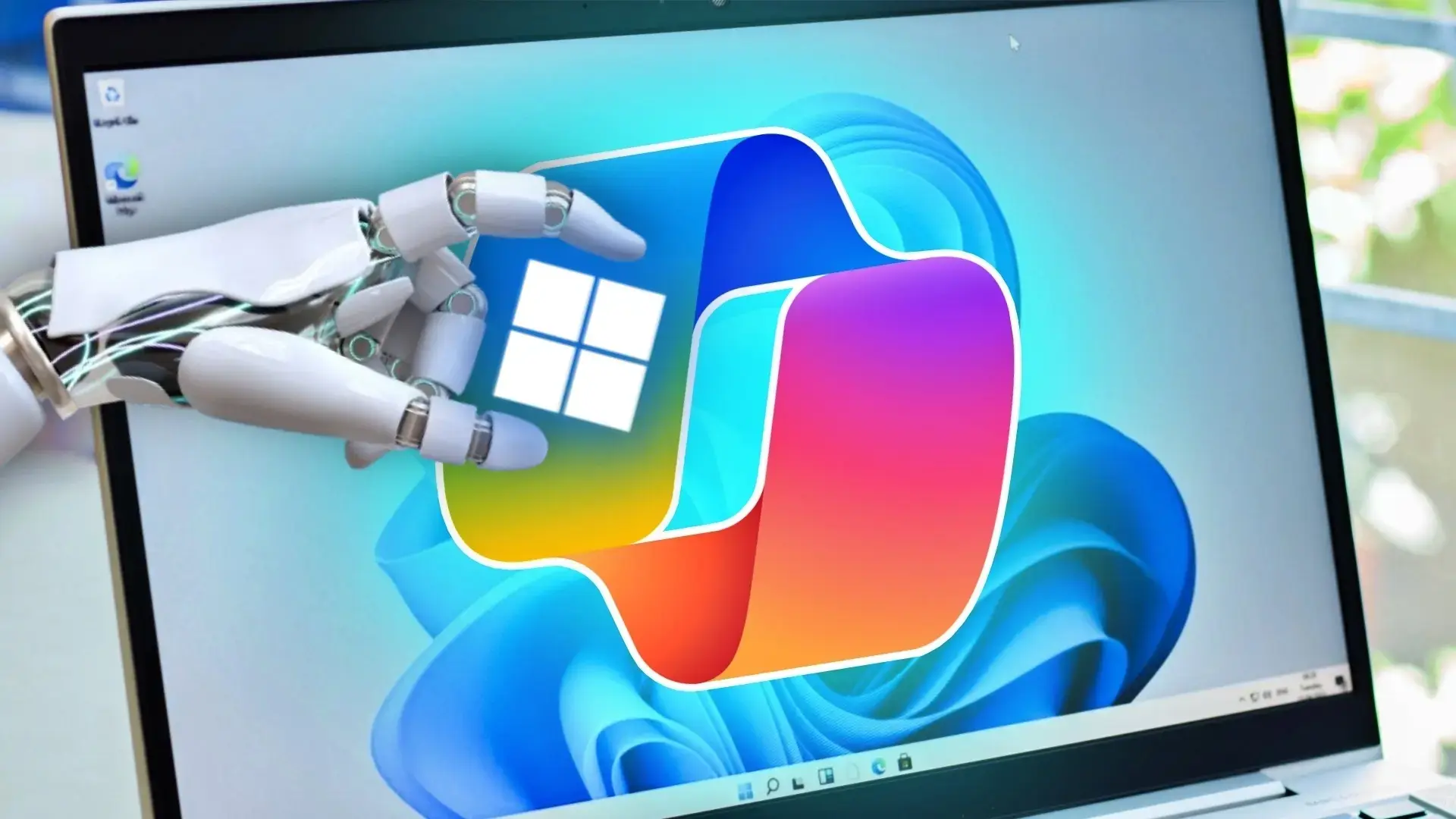
In the case of MicrosoftWindows 11 is becoming the perfect laboratory. Copilot It's no longer just a chatbot like ChatGPT or Gemini, but a component that integrates seamlessly across the entire desktop, including Outlook, Teams, Excel, Explorer, and the browser. The official focus is on the user experience.Hey Copilot”, with three clear axes:
- Voice: receiving and understanding voice commands.
- Vision: ability to “see” the screen in real time and understand the context.
- Stocks: execution of the appropriate actions on the system and applications.
Together they form the triad of perception, context, and execution that brings Windows 11 closer to a true Agentic Operating System (AOS)This allows you to request that it save a specific file in a specific folder, run programs, or automate lengthy processes, provided you have granted the appropriate permissions.
The bright side is clear: productivity increaseThe advantages include the ability to automate heavy tasks and a low barrier to entry thanks to natural language processing. However, the downside worries many users: perceived forced integration (as happened with some Meta AI experiences), and doubts about the Windows 11 stability to endure so many layers of intelligence and fear that Copilot will become an even bigger gateway to data collection.
En Apple , the focus revolves more around the “on-device first“: prioritize local processing, send as little as possible to the cloud, and when it is sent, use private clouds and anonymization mechanisms. AI is distributed among Siri, Photos, Mail, Notes, and other apps in the ecosystem, with a ironclad curatorship what each agent can do and a permissions design that is very visible to the user.
This offers consistency, a reduced surface attack, and a highly polished experience, but reinforces the typical Apple fenced garden: less room for experimentation, a closed ecosystem, and a very strong dependence on a single provider for everything.
For its part, Google He sees Android as the great testing ground for agentic orchestration. His idea is for the mobile device to become the central hub It understands your context (location, habits, notifications), invokes “intents” between apps, and reasons what you need “here and now” using Gmail, Maps, Drive, Calendar, and the rest of its galaxy of services. It is the most service-centric player, with a massive data domain that serves both to enhance usability and to multiply questions about who really benefits of that reduced friction.
In all three cases, the same underlying tension is repeated: the more fluid and capable the agent, the more Power and data are concentrated in the hands of the operating system owner. Moving from using apps to delegating objectives implies shifting the center of gravity towards the platform provider.
Agent companies: when AI autonomy becomes a competitive advantage
Beyond the operating system, agentic AI is redefining how companies are organized. agency company It doesn't just put a friendly chatbot on the website, but integrates autonomous AI agents into its critical workflows to act as digital collaborators capable of managing complete cycles.
These agents no longer react only when the user asks a question, but they become proactiveThey detect opportunities for improvement, anticipate customer responses, prepare documentation, or trigger maintenance processes before a serious incident occurs. The result is an ecosystem where humans handle strategic decisions and AI takes on the bulk of transactional and repetitive tasks.
By adopting this model, companies gain several key capabilities:
- Autonomous execution of complex processesFrom handling a refund to coordinating a delivery or processing a registration, the agent goes through all the stages and documents what he does.
- Real-time reasoning and decision-makingThanks to advanced language models and rule engines, AI can evaluate alternatives, prioritize tasks, and choose the best path in each case.
- Persistent omnichannelThe agent maintains the customer's context even if they change channels (chat, email, phone), avoiding the frustration of always repeating the same story.
- Synchronization with existing infrastructure: API integration with CRMs, ERPs, payment gateways or other systems, so that every conversation becomes a direct execution opportunity.
- Greater reliability through RAGThe use of Retrieval Augmented Generation (RAG) allows responses to be based on official company data and documents, minimizing the infamous AI "hallucinations".
This combination multiplies the productivityHuman teams can focus on strategy, creativity, and high-value customer relationships, while agentic AI handles much of the mechanical work. Furthermore, agentic AI integrates with other enterprise technologies (cloud, IoT, BPM, RPA, digital twins) to complete cycles: from event detection to concrete action, including simulation and verification.
However, it's not all advantages. Giving AI so much autonomy requires a extremely careful risk management: data integrity control, clear governance, comprehensive auditing, well-defined limits of action, and a robust cybersecurity layer to prevent information leaks or serious operational failures.
Agentic AI versus generative AI and “classical” agents
To avoid mixing concepts, it is helpful to distinguish between generative AI, agentic AI, and individual AI agentsGenerative AI, as popularized by large language models, focuses on creating original content (text, images, video, code) in response to a prompt. It is powerful, but essentially reactive: it waits for your request and returns output.
La Agentic AI It adds several layers on top: autonomy, objectives, multi-step planning, persistent memory, the ability to trigger tools, and continuous closed-loop learning. It not only responds, but decides what to do, executes the necessary actions, and evaluates whether the result matches the intended outcome, correcting its course if needed.
A mature agent system coordinates several of these specialized agents, shares memory among them, defines points where human intervention is required, and measures the impact on business indicators (resolution time, revenue recovered, cost per transaction, etc.). In contrast, a simple scripted chatbot or a limited generative assistant remains at the stage of question-answer, without any real capacity to pilot end-to-end processes.
The key is in the Goal orientation with governed autonomyAgentic AI not only generates beautiful text, but also orchestrates systems, replans when something fails, maintains an auditable record of what it does, and works side-by-side with people and other agents to achieve complex goals.
Advantages, risks, and safeguards of agent operating systems
When an operating system becomes agentic, the potential benefits are enormous, but so are the risks if they are not implemented. strong safeguards. Among the main advantages are:
- Governed autonomyLess friction between intention and execution, with agents acting within margins defined by policies, permissions, and trust thresholds.
- Productivity and lower process latency: waiting times between steps are eliminated, tasks are parallelized, and critical events are responded to in real time.
- deep customizationWorking memory allows for decisions tailored to the context of each user or client, improving the experience and efficiency.
- 24/7 CoverageAgents work tirelessly and scale with demand without costs needing to grow at the same rate.
- Integrated governanceFrameworks such as the NIST AI RMF or the European AI Act are pushing towards systems with telemetry, traceability and human supervision at sensitive points.
In response, a number of significant risks arise if the design of the agent operating system is geared solely towards the provider's business and not the user's interests:
- Lock-inThe more you delegate to the system agent, the harder it is to migrate. Your workflows, shortcuts, and memory don't transfer well between platforms, and you end up locked into the current ecosystem.
- OpacityIf AI makes decisions in the background, you lose traceability. You don't know what data it has cross-referenced, why it chose a particular provider, or what information has left your device.
- Commercial biasesThe agent can prioritize its own services or those of strategic partners, repeating what has already been seen with search engines and app stores.
- HyperprofiledAn all-seeing agent can reconstruct your tastes, habits, finances, and relationships with an unprecedented level of detail.
- Skills impoverishmentIf you never do tasks manually, you lose skills, and when the AI fails, it will be much harder for you to solve problems on your own.
To balance the scales, many experts propose a kind of agent's bill of rights with minimum requirements expected in any serious agent operating system:
- Copilot mode by defaultThe agent suggests and you confirm; full autopilot should always be opt-in.
- Visible, editable and erasable memory: easy access to "what the agent knows about you", with the option to export and delete.
- Centralized permissions panel: a clear whitelist of which apps and services the agent can use and with what privileges.
- auditable record of actions: human-understandable historical account of what has been done, when, and with what data.
- Dry runBefore executing something delicate, the agent displays the plan so you can review and modify it.
- “Local first” as a real option: possibility of forcing local execution (model and data) and having the system explicitly notify when something needs to go to the cloud.
- Red button: ability to globally pause the agent and revoke its capabilities at once, in case something goes wrong.
Without these minimums, comfort easily becomes a kind of “live rent"inside your own computer, with a landlord who decides more things than you'd like."
Practical recommendations for users and organizations
Those who are already starting to live with an agent operating system can take some simple steps to take advantage of the good without losing controlAt the individual user level, it is recommended to:
- Activate the agents whenever possible in copilot mode, with confirmation before performing sensitive actions.
- Review monthly memory and permissions: what data is stored, what apps the agent can use and with what level of access.
- Choosing models “on device” when the option exists, especially for tasks involving sensitive information.
- Demand that the system display the execution plan When you are going to do something important: what steps you will follow, what data you will touch and where it will be processed.
In organizations, the bar must be higher, as business continuity and regulatory compliance are at stake. Some useful guidelines are:
- Treat the operating system agent as critical softwareImpact analysis, risk assessment, DPIA when necessary, and alignment with internal policies.
- Define whitelists by roleWhat an agent can do in the position of a financier should not be the same as in the position of a salesperson.
- Demand signed logs and proper retention, integrable with observability tools, SIEM or SOAR.
- To set from the beginning a data policy for agent memory: what is learned, for how long that data is kept and on what legal basis.
- Carefully evaluate the total cost of ownershipIntensive use of generative AI can trigger high bills, and it is advisable to properly model local inference scenarios, open models, and external services.
For those seeking an alternative less dependent on the giants, the so-called “third way"It goes through free operating systems like Linux, desktops like KDE or GNOME and Android variants without Google (GrapheneOS, /e/OS, LineageOS) where to mount local agents with open models (Llama and company) and auditable orchestrators. They are not as convenient or as integrated, but they strengthen the digital sovereignty and transparency.
Taken together, the evolution towards agent operating systems and agent companies points to a horizon where AI not only responds, but also takes over a good part of the daily execution; the key is that this autonomy is deployed with clear guardrails, memory under user control and real options of choice, so that the technology expands our capabilities without taking the helm away from us.


Passionate writer about the world of bytes and technology in general. I love sharing my knowledge through writing, and that's what I'll do on this blog, show you all the most interesting things about gadgets, software, hardware, tech trends, and more. My goal is to help you navigate the digital world in a simple and entertaining way.