- Magnetic refrigeration uses the magnetocaloric effect in solid materials to cool without polluting gases.
- This technology reduces environmental impact and energy consumption thanks to its high efficiency and the use of recyclable materials.
- Its applications range from domestic refrigerators to industrial systems and electric vehicle air conditioning.

In the world of refrigeration, technological advancements and environmental concerns are driving the search for more efficient and sustainable alternatives . One of the technologies generating the most excitement in recent years is magnetic refrigeration, a solution that promises to fundamentally change the way we cool our food, beverages, spaces, and even certain industrial processes.
Understanding what magnetic refrigeration is, how it works, its advantages, and potential applications is essential for understanding the present and future of air conditioning and refrigeration . Below, I explain everything you need to know about this disruptive technology in a clear and detailed way, so you can assess its true potential for yourself.
The principles of conventional refrigeration
To appreciate the innovation of magnetic refrigeration , it's essential to understand how conventional refrigeration works. Traditional refrigerators and air conditioning systems extract heat from the objects or environments we want to cool and expel it to the outside through a cycle based on gas compression. This cycle relies on a compressor and a refrigerant that changes state (from liquid to gas and vice versa) at different stages of the circuit, utilizing the heat absorbed or released during these changes.
The conventional cycle follows the well-known Carnot cycle and requires electrical energy to power the compressor. Furthermore, it uses refrigerants that can damage the ozone layer and contribute to the greenhouse effect if released, both during operation and at the end of the appliance's lifespan. These machines operate efficiently but are quite noisy, and their energy consumption is not low.
What is magnetic cooling?
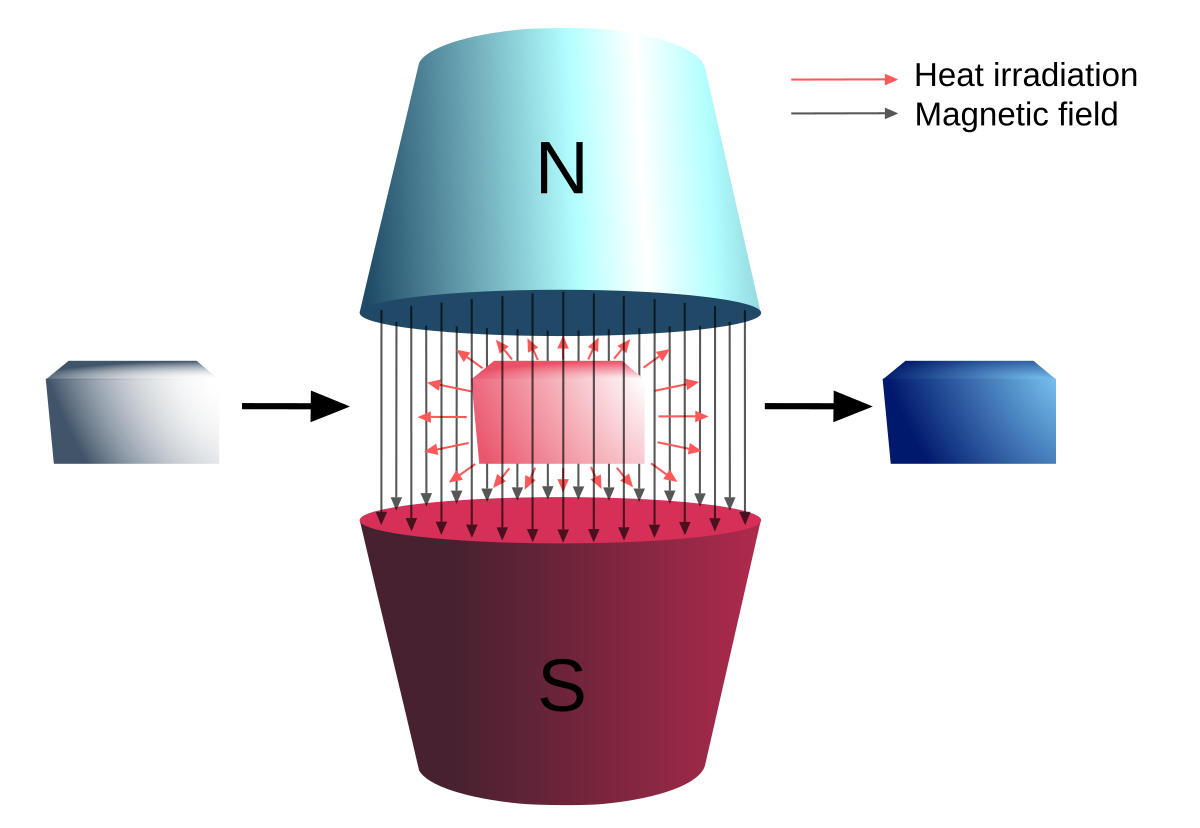
Magnetic refrigeration is a technique that does away with traditional refrigerants and compressors . Instead, it relies on a phenomenon called the magnetocaloric effect , which is the property of some solid materials to change their temperature when exposed to a magnetic field.
The magnetocaloric effect is not a recent discovery . As early as the beginning of the 20th century, physicists Pierre Weiss and Auguste Piccard observed this phenomenon in European laboratories. However, the possibilities of applying it to everyday life have only begun to materialize in recent decades, thanks to the development of advanced materials and improvements in energy efficiency.
The essence of magnetic refrigeration is to replace harmful gases with solid magnetocaloric materials , which, when magnetized and demagnetized, absorb and release heat. This not only helps protect the atmosphere but also allows for more precise temperature control and a considerable reduction in noise and mechanical wear.

The thermomagnetic cycle explained step by step
Magnetic refrigeration operates based on a thermomagnetic cycle , which harnesses the magnetocaloric effect for cooling. The process is described below in a simplified but accurate way:
- Adiabatic magnetization: A magnetocaloric material is subjected to an external magnetic field within a thermally insulated environment. When the material's magnetic dipoles align with the field, an internal temperature increase occurs.
- Isomagnetic heat transfer: Once the maximum temperature is reached, the magnetic field is removed. The material retains its magnetization and therefore maintains its high temperature.
- Adiabatic demagnetization: The material is abruptly demagnetized, causing a significant drop in temperature. In this state, it is ready to absorb heat from the environment or the object being cooled.
- Heat absorption: Now the magnetocaloric material absorbs heat from the surrounding environment, returning to its starting point to restart the cycle.
This process is completely reversible and can be repeated continuously , allowing for constant and efficient cooling cycles without the need for polluting fluids. Furthermore, variations of this cycle exist depending on the material used and the specific application.
Materials and technological advances in magnetic refrigeration
The advancement of magnetic refrigeration has been closely linked to the discovery and development of new magnetocaloric materials . Early research focused on pure metals, but today experiments are being conducted with metallic alloys, crystalline materials, and even nanocrystalline materials , capable of providing more intense and controlled thermal changes with less powerful magnetic fields.
Institutions such as the Potosino Institute of Scientific and Technological Research (IPICYT) in Mexico have made significant contributions to this field, developing low-cost, high-efficiency alloys that improve the industrial and commercial viability of the system . Furthermore, multinational companies like General Electric have expressed interest in producing magnetic refrigeration equipment for domestic, commercial, and automotive applications.
Advantages of magnetic cooling over traditional cooling
The advantages of magnetic cooling are extensive and remarkable , and can be summarized in the following key points:
- Superior energy efficiency: The magnetization and demagnetization processes are almost thermodynamically reversible, unlike the traditional cycle. Studies suggest that magnetic refrigerators can be between 20% and 30% more efficient than gas vapor at similar temperatures.
- Drastic reduction of environmental impact: By eliminating refrigerant gases, the system prevents harmful emissions into the atmosphere and the ozone layer. Furthermore, magnetocaloric materials are often solid and low toxicity, completely recyclable after their useful life.
- Virtually noise-free and low maintenance: By eliminating compressors and bulky moving parts, the Operating noise is reduced to a minimum and mechanical wear is virtually non-existentThis considerably extends the lifespan of the devices.
- Pioneer in recyclability and sustainability: Components of magnetic equipment can be easily separated and recycled, with a reuse rate even higher than that of conventional solar panels.
- Technological and application flexibility: The magnetic system can be adapted to different uses (domestic, industrial, automotive, etc.), and the technology is Versatile enough to cool or freeze different substances without major modifications.

Current challenges in magnetic refrigeration
Despite the numerous advantages of magnetic cooling, some obstacles still hinder its widespread implementation . The main challenges include improving material efficiency and reducing magnet production costs.
- Cost of magnetocaloric materials and magnets: The best thermal results are obtained with high-quality superconducting magnets or electromagnets, which currently have a high cost and limited production.
- Limitations on temperature range: Although magnetic cooling is promising, the The achievable temperature range is still lower than that of certain gas-based systems.Research is still being done to improve this aspect and adapt it to specific applications.
- Technological development in progress: The technology has not yet reached mass commercial production in most applications, although advances in materials and cost reduction are expected to enable the development of affordable products in the coming years.
Experts are confident that these challenges will be mitigated as research and development of materials, magnets, and processes continues to advance. Experience shows that the initial costs and limitations of new technologies are usually overcome over time , and all indications are that magnetic refrigeration will follow the same path.
Actual and potential applications of magnetic refrigeration
The applications of magnetic refrigeration go far beyond simply preserving food in refrigerators . Its potential ranges from household appliances to large industrial sectors and even climate control in the transportation industry.
- Efficient and sustainable appliances: Are developing domestic refrigerators and freezers that do not require refrigerant gases and consume less electricity, reducing both the bill and the ecological footprint.
- Air conditioning of electric vehicles: Traditional cooling in electric cars consumes a lot of energy, affecting range. Magnetic cooling could offer a much more efficient and environmentally friendly solution.
- Industrial and scientific refrigerators: Chemical laboratories and companies demand precise, quiet, and low-maintenance systems. Magnetic cooling is one of the key solutions. also has a lot to contribute.
- Advanced cooling of electronic equipment: Devices such as high-performance computers and gas liquefaction systems (e.g., hydrogen and helium) can benefit from quiet, adjustable and efficient cooling technologies.
In some of these areas, functional prototypes already exist, demonstrating the technology's viability . Specialized companies continue to experiment with new materials and configurations to manufacture affordable and reliable equipment suitable for the general public.
Environmental impact and sustainability
One of the greatest advantages of magnetic refrigeration is its alignment with international sustainability and environmental protection goals . By eliminating polluting gases and reducing energy consumption, it helps to meet agreements such as those in Montreal, Kyoto, and Paris.
Furthermore, the ease of recycling the materials used ensures a low environmental footprint even at the end of the equipment's useful life . The metals and alloys used can be recovered and reused in new equipment or in different industries, increasing the circularity of the economy.
Current status and future of magnetic refrigeration
Magnetic refrigeration is currently in the research and development phase, but the first practical applications are already emerging . Scientific institutions, universities, and large multinational corporations are investing resources in improving materials, increasing the temperature range, reducing costs, and facilitating mass production. As these barriers are lowered, the technology is expected to first reach the industrial and automotive sectors before being implemented on a large scale in our homes.
There is no doubt that magnetic refrigeration represents one of the biggest advances in energy efficiency and sustainability in the sector in decades . Although there are still challenges to overcome, its potential is so great that, in the coming years, many of our refrigerators, air conditioners, or electric cars could run on it.


Passionate writer about the world of bytes and technology in general. I love sharing my knowledge through writing, and that's what I'll do on this blog, show you all the most interesting things about gadgets, software, hardware, tech trends, and more. My goal is to help you navigate the digital world in a simple and entertaining way.