- ISO/IEC 27701:2025 establishes a standalone privacy management system, applicable to any organization that processes personal data.
- The new version reinforces the risk-based approach, the data lifecycle, and integration with other management systems such as ISO 27001.
- For organizations already certified in 2019, the transition is based on restructuring the PIMS, incorporating new security controls, and improving evidence of compliance.
- The ISO/IEC 27701:2025 certification is consolidated as a strategic proof of trust, responsibility and maturity in the protection of personal data.
La Privacy and cybersecurity These have become two of the biggest headaches for any organization that handles personal data. Between GDPR, local laws, cloud services, AI, and auditors demanding evidence, it's increasingly difficult to demonstrate that things are being done correctly and consistently year after year.
In this context, the ISO/IEC 27701:2025 standard It has become the international benchmark standard for managing information privacy. The 2025 update represents a significant leap forward from the 2019 version: it is no longer simply an “appendix” to ISO 27001, but has become a fully independent management system, designed to allow any organization to certify how it protects the personal data it processes.
What is ISO/IEC 27701 and what role does it play in privacy?
ISO/IEC 27701 is a International Standard that defines the requirements To establish, implement, maintain, and continuously improve a privacy information management system, known as a PIMS (Privacy Information Management System). In other words, a structured framework that governs all aspects of personal data processing within an organization.
This standard is intended to controllers and processors of personally identifiable information (PII, equivalent to the GDPR personal dataIts objective is for these entities to be able to demonstrate, with verifiable evidence, that they manage privacy in a manner aligned with the law and with international best practices.
In addition to mandatory requirements, ISO/IEC 27701 includes practical guidelines to help implement and operate the management system on a daily basis. In this way, it clearly differentiates between what will be audited and what serves as a guide for applying controls effectively.
The standard applies to organizations of any size and sectorPublic or private companies, public administrations, NGOs, cloud service providers, AI startupsSaaS companies, etc. As long as personal data is processed, it fits.
Why ISO/IEC 27701 is so important for 2025 and beyond
Today Personal data is one of the most sensitive assets from any organization. Citizens, regulators, and business partners are no longer satisfied with declarations of good intentions: they want to see evidence that privacy is managed in a serious, systematic, and verifiable way.
ISO/IEC 27701 provides precisely that framework: a globally recognized privacy management system It helps manage risks, define responsibilities, and demonstrate proactive accountability. It is particularly aligned with the GDPR, which in countries like Spain fits very well with the LOPDGDD and, in public settings, with the National Security Framework.
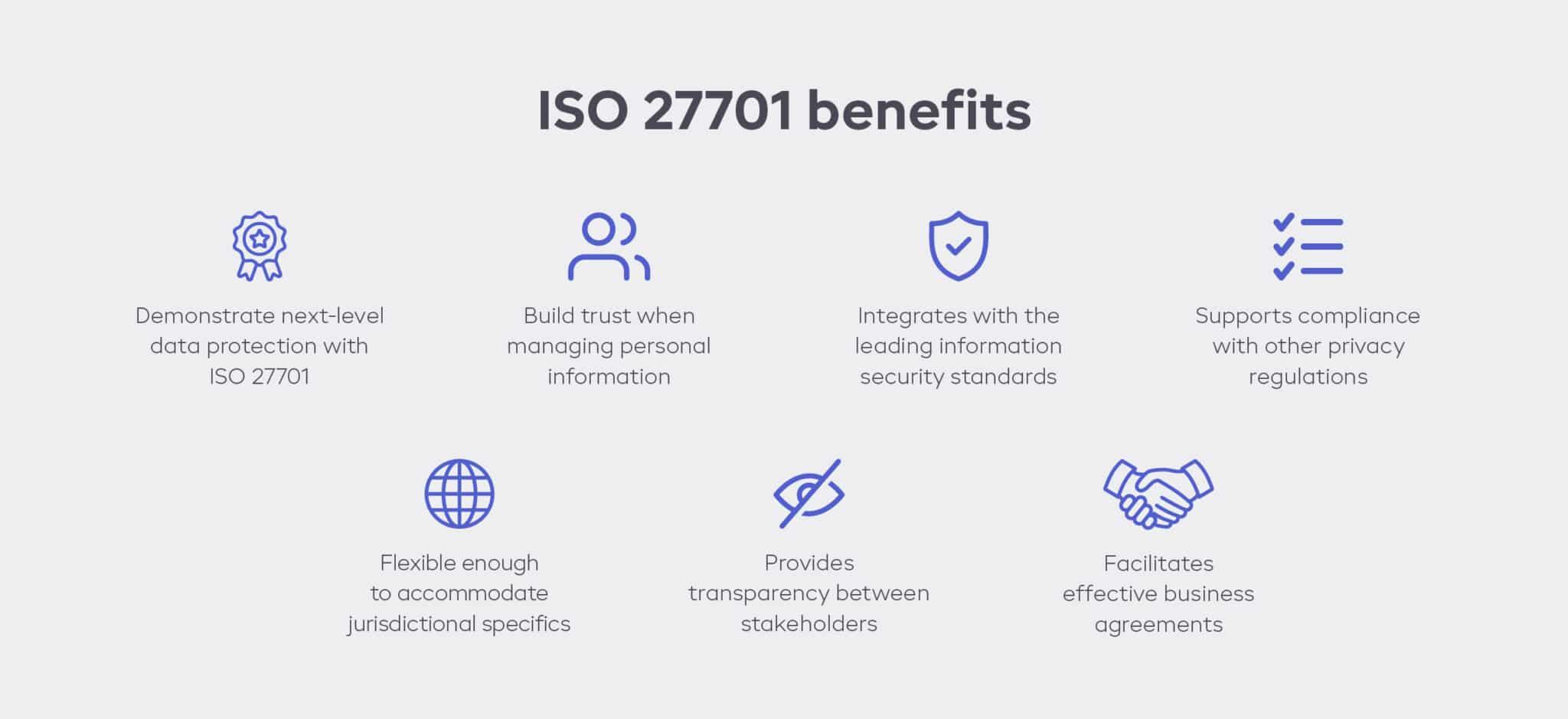
Among the main advantages of implementing and certifying a PIMS according to ISO/IEC 27701, the following very clear benefits stand out: strengthen data protection capabilities, facilitate the demonstration of regulatory compliance, instill confidence in customers, collaborators and regulators, and create a solid foundation for integrating privacy into the corporate culture.
The 2025 update also comes at a time when the advanced analytics and cloud services They have radically changed how information is collected, processed, and shared. The standard adapts to this new technological and regulatory ecosystem, incorporating explicit references to AI, multicloud environments, automated decision-making, and cross-border data processing.
In short, ISO/IEC 27701:2025 makes privacy a strategic component of the businessAnd not just as a legal or technical obligation. It serves as a mark of maturity and credibility with clients, partners, investors, and authorities.
From ISO 27001 extension to stand-alone standard
One of the most radical changes in the new version is that It ceases to be a mere extension of ISO/IEC 27001. The 2019 edition required first having an Information Security Management System (ISMS) certified under ISO 27001 and then adding the privacy layer of ISO 27701.
This scheme created a significant barrier to entry for privacy-focused organizations that did not need or could not implement a full ISMS. Companies with a strong focus on data protection, public sector entities with limited resources, or data-driven businesses already covered by other security frameworks such as SOC 2, were forced to adopt ISO 27001.
From 2025, ISO/IEC 27701 becomes a independent management system standardwith its own high-level structure (clauses 4 to 10) in the style of the other ISO standards. This means that it is possible to certify a PIMS without prior ISO 27001 certification, although the two standards remain fully compatible.
This change opens the door to several very interesting scenarios: organizations that only want a privacy certification, SaaS companies that combine SOC 2 for security and ISO 27701 for privacy, NGOs or public administrations with a high volume of personal data but few resources to deploy a complete ISMS, or companies that prefer integrate privacy and security under two rules that communicate with each other but can be managed with different scopes.
In parallel, ISO/IEC 27706:2025 appears, a complementary standard that It sets the rules of the game for certification bodies. that audit PIMS, replacing the previous ISO TS 27006-2:2021 and updating the certification infrastructure around ISO 27701.
Structure and principles of the 2025 version
ISO/IEC 27701:2025 adopts the high-level structure (HLS) which is already used in other management system standards such as ISO 27001, ISO 9001 or ISO 37301. This greatly facilitates integration when an organization has several certified systems at the same time.
The main clauses cover aspects that are very recognizable to anyone familiar with the ISO family: from the context of the organization and stakeholders, from leadership, risk-based planning, resources, operations, performance evaluation, and continuous improvement. All of this specifically applied to privacy management.
In detail, the standard addresses, among others, the following blocks: analysis of the context and legal and contractual requirements regarding personal data; commitment of senior managementPrivacy policies and role assignment; privacy risk assessment and goal setting; resources and skills; operational controls over processing; audits, indicators and management reports and continuous improvement mechanisms.
A key aspect of the 2025 version is that rearranges and enriches The annexes. Annex A retains the controls applicable to controllers and processors of PII, but with clearer language and references to current environments such as the cloud, AI, and cross-border processing. Annex B becomes a more practical implementation guide, with recommendations tailored to different sectors and organizational sizes.
The list of normative references is also simplified. The 2025 edition takes ISO/IEC 29100, the ISO privacy framework, as its main reference and no longer relies directly on ISO 27001 or ISO 27002 as before, thus underscoring its independence as a standard without losing coherence with the information security ecosystem.
In environments where technical security is key, it is advisable to complement privacy controls with practical measures to protect assets and endpoints; for example, Key strategies to protect your devices They help reduce the operational risk that supports the PIMS.
Most relevant changes compared to ISO/IEC 27701:2019
Beyond the leap to a standalone standard, ISO/IEC 27701:2025 introduces a series of profound adjustments in structure and detail of its requirements and annexes, without breaking with what already existed for organizations that were certified in 2019.
First, the following are incorporated: management clauses 4.1 to 10.2 aligned with the ISO 27001 framework: context of the organization, leadership, planning, support, operation, performance evaluation, and improvement. A specific clause on performance evaluation (monitoring, measurement, internal audit, and management review) and another dedicated to the continuous improvement of the PIMS are also added.
The former sections describing specific PIMS requirements in relation to ISO 27001 and ISO 27002 are replaced by a fully ISO-compliant structure, in which clause 4 addresses context, clause 5 leadership, clause 6 planning, clause 7 support, clause 8 operation, clause 9 performance, and clause 10 improvement. An additional clause is even included that provides information for a better understanding of the Annexes C, D, E and F, where the guide on controls and mappings is expanded.
The privacy annexes are renamed and reorganized, consolidating the controls for PII controllers and processors (previously separated into different tables) into a single Annex A. Although the organization changes, the Privacy requirements remain virtually unchangedThis makes life easier for those who already had a certified PIMS.
The big news lies in a set of 29 new information security controls integrated into Table A.3, which complement privacy controls with essential security elements: security policies, information classification, identity managementThese controls include access rights, security in agreements with suppliers, security awareness and training, and incident management, among others. They replace the former clause 6 of ISO 27701:2019 and are directly aligned with the requirements of ISO 27001:2022.
Risk-based approach and data lifecycle
The heart of ISO/IEC 27701:2025 is a privacy risk management approach clearly defined. The standard requires identifying, analyzing, and evaluating the risks that the processing of personal data may generate regarding the rights and freedoms of individuals.
This analysis is integrated with information security risk management, generating a two-level vision: one organizational (impact on the entity, business continuity, reputation, sanctions, etc.) and another focused on stakeholders (affecting people, discrimination, loss of control over their data, economic or emotional damage, etc.).
Based on this analysis, appropriate controls are deployed, resources are prioritized, and action plans are established, both preventive and for incident response. All of this follows the PDCA (Plan-Do-Check-Act) cycle common in ISO standards, which drives the continuous improvement and adaptation when technological or regulatory risks change.
The 2025 edition takes a further step by expressly adopting a data lifecycle approachThis encompasses everything from the collection of PII to its deletion, anonymization, or pseudonymization. This ensures that privacy is integrated into all phases of processing, in line with principles such as Privacy by Design and Privacy by Default.
In environments where AI, IoT, blockchain, or multicloud services are already commonplace, the standard introduces specific guidelines for managing risks arising from automated decision makingprofiling or the combination of large volumes of data, including cross-references with the future ISO/IEC 42001 on artificial intelligence governance.
Integration with other management systems and compliance frameworks
One of the greatest strengths of ISO/IEC 27701:2025 is its ability to fit within an integrated management ecosystemThanks to the HLS structure, it can be combined with ISO/IEC 27001 (information security), ISO 31000 (risk management), ISO 37301 (compliance), ISO 9001 (quality) or the future ISO/IEC 42001 (AI) standard, sharing common processes such as document management, management reviews and internal audits.
For organizations that already have a mature ISMS, the update makes it easier to maintain Integrated ISMS and PIMSThis optimizes efforts and reduces duplication of evidence. Those who prefer to go it alone can also deploy a standalone PIMS, which is especially useful for organizations whose main headache is GDPR and other data protection laws.
The standard aligns very well with global regulatory frameworks: in the EU, it serves as solid evidentiary basis for the principle of proactive responsibility of the GDPR; in other territories, it helps demonstrate compliance with frameworks such as the CCPA, LGPD, or other privacy regulations. Furthermore, it can be complemented with SOC 2 reports, national security schemes, or sector-specific certification schemes.
In practice, implementing ISO/IEC 27701:2025 allows for a clear definition of the privacy governance (who decides what, who assumes risks, what functions the DPO has, how legal, security, IT and business are coordinated), introduce a continuous risk assessment framework and strengthen transparency with stakeholders through clear policies, notices and mechanisms for exercising rights.
This integrative approach drives the transition to a model of Privacy as Culturewhere it's not just about having the documents in order, but about ensuring that staff understand their role, receive training, participate in risk detection, and embrace privacy as an integral part of service quality.
Specific impact for Data Protection Officers and compliance officers
For Data Protection Officers (DPOs) and compliance teams, ISO/IEC 27701:2025 becomes a very specific roadmap on how to demonstrate that the GDPR is being applied effectively. The regulation incorporates Annex D, which maps controls and requirements to the articles of the Regulation, making it easier to link each legal obligation with operational evidence.
For example, in the event of a review by the Spanish Data Protection Agency (AEPD) on the management of data subject rights, controls A.1.3.7 and A.1.3.10 allow for demonstrating the existence of documented procedures to receive, register, process and respond to requests for access, rectification, deletion, opposition or portability, with defined deadlines, responsible parties and traceability.
The good news is that the specific controls for data controllers (Table A.1) and for data processors (Table A.2) remain virtually unchanged since 2019. This means that, for already certified organizations, the Transition does not require rebuilding the entire systembut rather adjust the structure, strengthen the privacy risk component, and better document the information security program that supports the PIMS.
In complex environments where multiple entities coexist (joint controllers, sub-commissioners, cloud providers, processors in third countries), the new version helps to refine contracts, responsibility matrices and monitoring mechanisms, reducing blind spots and ambiguities that often cause problems in auditing.
In practice, the standard becomes an ally in moving from "I comply in theory" to "I have objective and auditable evidence that I fulfill", which reduces scares in the event of inspections, claims or relevant security breaches that require notification of authorities and those affected.
Transition from ISO/IEC 27701:2019: deadlines, steps and common mistakes
Organizations that are already certified under ISO/IEC 27701:2019 have a three-year transition period From the publication of version 2025, i.e., until October 2028, to adapt their management systems and complete the transition audit with their certification body.
There's no need to start from scratch: the bulk of the work already done remains valid. The key is to refit the system into the new structure, incorporating the new information security controls, strengthen privacy risk management and review the governance documentation, roles, and operational processes to ensure they comply with the updated clauses.
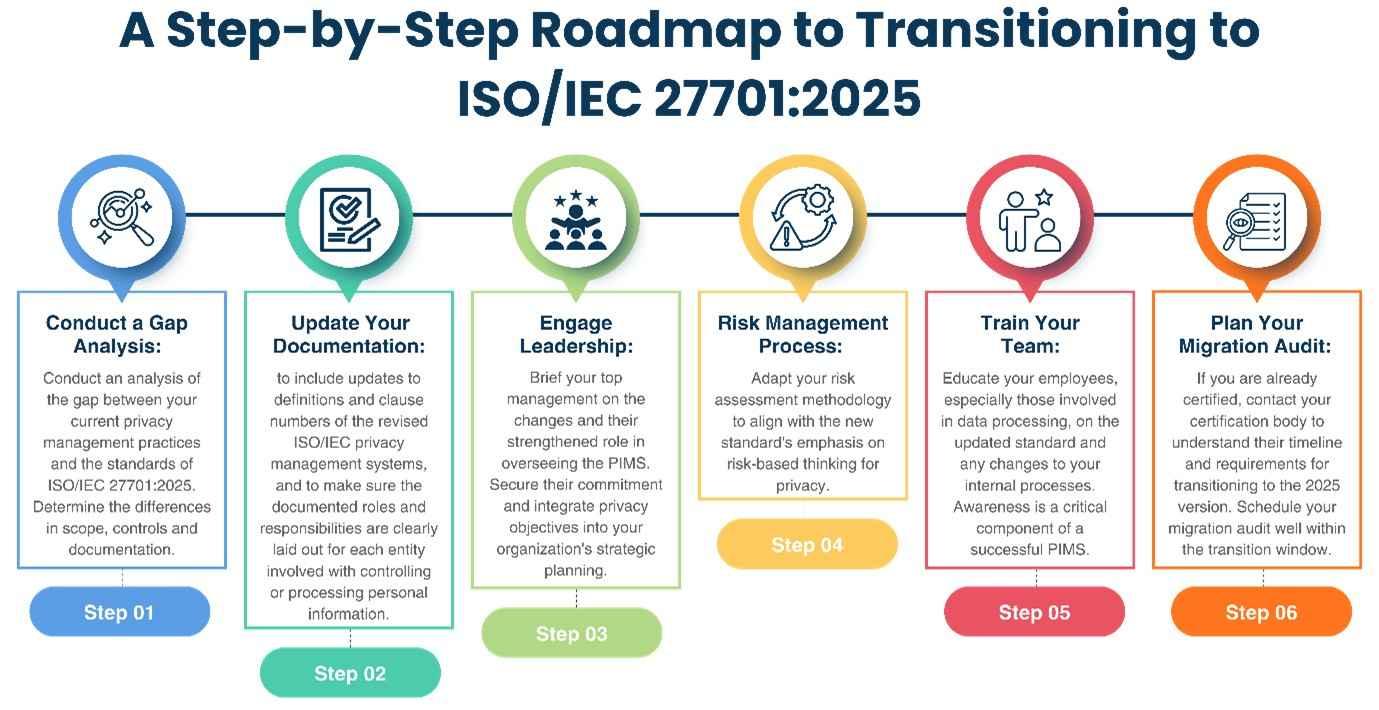
Reasonable steps for an orderly transition typically include a gap analysis comparing the current PIMS with the 2025 version, updating the Statement of Applicability to reflect the restructured annexes, reviewing the privacy risk matrix (including AI, cloud, and international flow scenarios), adapting policies, records, and internal audit programs, training key personnel, and planning the transition audit with the certification body.
Among the most common mistakes in this transition, three stand out: waiting until the last minute trusting that "there is plenty of time"; limit yourself to updating documents without verifying that actual practice has been aligned (auditors ask for evidence, not just PDFs); and overlooking the relevance of automated and AI processing, which is no longer a marginal issue but a specific focus of assessment.
For organizations already operating ISO 27001:2022 integrated with ISO 27701:2019, the change should be relatively straightforward, as many of the structural concepts of the new 27701:2025 are based on elements that 27001:2022 introduced in its own revision: greater emphasis on context, risk-based approach, leadership, and continual improvement.
ISO/IEC 27701 as a trusted tool and competitive advantage
Beyond regulatory compliance, the main contribution of ISO/IEC 27701:2025 is its ability to Build and sustain trust Regarding the processing of personal data. In an environment where leaks, opaque uses of AI, and scandals involving the misuse of information are commonplace, being able to demonstrate a mature management system makes all the difference.
A well-implemented PIMS allows you to show clients, partners and authorities that the organization takes privacy seriously: there are clear policies, roles and responsibilities are known, risks are assessed periodically, there are up-to-date records of processing, indicators are monitored, internal audits are carried out and action is taken when deviations are detected.
This has a direct impact on corporate governance, compliance, risk management and internal cultureThe standard encourages privacy to move beyond being solely a "DPO" issue and become a cross-cutting matter affecting marketing, IT, product development, human resources, purchasing, customer service, and general management.
For many organizations, especially in data-intensive sectors (finance, healthcare, technology, public administration, online education, etc.), ISO/IEC 27701:2025 certification is already becoming a requirement or differentiating factor when closing contracts, participating in tenders or passing due diligence processes by investors.
Adopting this standard is not just a matter of “protecting information”, but of managing trust as a strategic asset: offering solid guarantees that personal data is under control, that automated decisions are made with respect for people's rights, and that the organization is prepared to respond effectively if something goes wrong.


Passionate writer about the world of bytes and technology in general. I love sharing my knowledge through writing, and that's what I'll do on this blog, show you all the most interesting things about gadgets, software, hardware, tech trends, and more. My goal is to help you navigate the digital world in a simple and entertaining way.