- Delivery of precompiled shaders (SODB→PSDB) via app Xbox PC to reduce loads and avoid stuttering.
- Up to 85% faster startup time and improved battery usage by moving builds to the cloud.
- Debuting on ROG Xbox Ally/Ally X and expanding via AgilitySDK to more games, engines, and stores.

Microsoft has unveiled DirectX Advanced Shader Delivery as one of its key features for PC and mobile gaming , designed to drastically reduce loading times and eliminate the annoying stuttering that often occurs the first time you launch a game. The announcement came during Gamescom week, in a presentation on August 20, 2025, and is part of the improvements to the Xbox app for PC and the Windows ecosystem for gaming laptops.
The key to this approach is simple yet powerful: precompiling the shaders and sending them with the game itself , so your computer doesn't have to do that heavy lifting on the first boot . Microsoft claims that, in internal tests with Avowed running on hardware with AMD RDNA 3 GPUs, startup time was reduced by up to 85%. Furthermore, by shifting this workload to the cloud, battery life is used for gameplay rather than compilation , which is especially relevant for the new ROG Xbox Ally and ROG Xbox Ally X handheld consoles, where the feature will debut.
What is DirectX Advanced Shader Delivery?
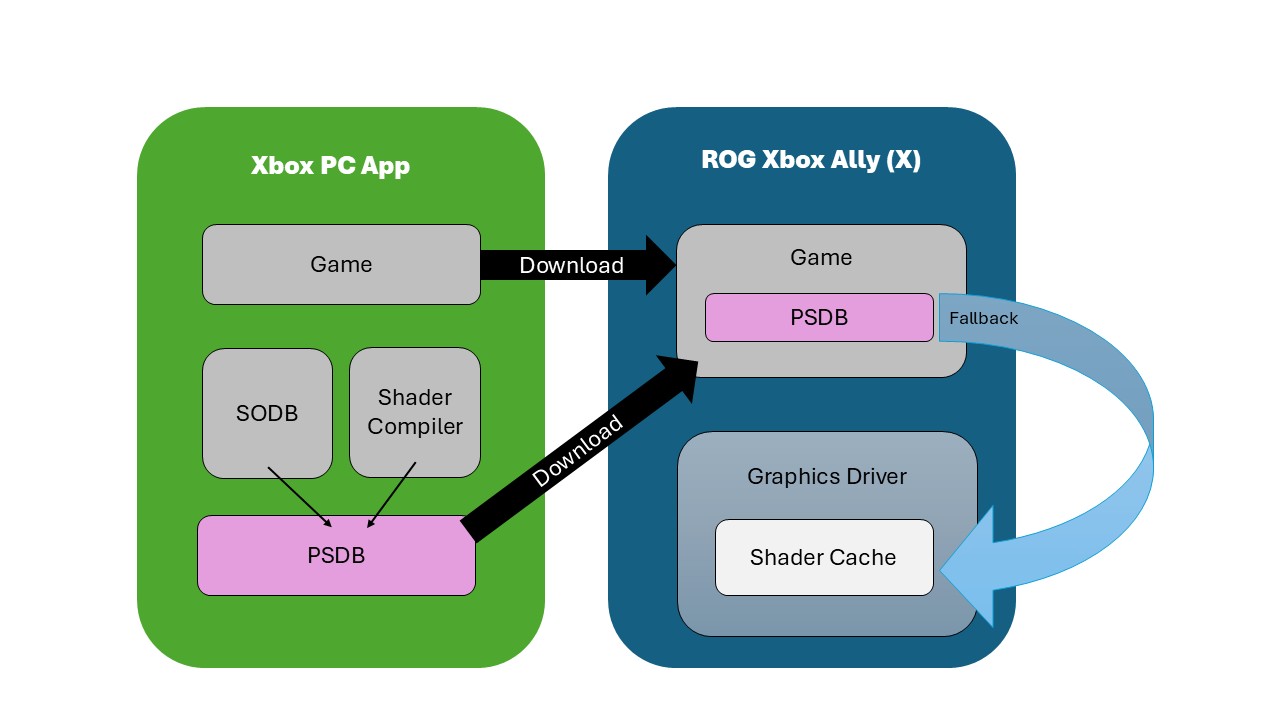
DirectX Advanced Shader Delivery (ASD) is a DirectX platform capability that pre-compiles and distributes a game's shaders at download time, using the Xbox app on PC as the delivery channel. The idea is that when you launch the game for the first time, Windows already has a shader cache ready , allowing the game to bypass the compilation phase that typically introduces delays and performance drops.
To make this possible, the DirectX team has standardized how the shader data a game needs is captured and packaged. This data is gathered in a format called a State Object Database (SODB), and then combined with a cloud-based shader compiler —which Microsoft and its partners have decoupled from the graphics driver—to produce a Precompiled Shader Database (PSDB). This PSDB is distributed with the game through the Xbox Store and supplements the system's shader cache.
If the system detects that the GPU driver has been updated , the service automatically regenerates and updates the cache, so you don't have to go through full builds again or experience a clumsy first boot after changing drivers.
Why shaders lengthen loads and cause stuttering
Shaders are small programs that the GPU runs for tasks like lighting, texturing, and effects . Before you can use them, the game must convert them to a format specific to your GPU and driver combination. Historically, this compilation process has occurred on the game's first launch—or even on the fly, right when it's needed—hence the wait times and shader stuttering at the start.
Pre-compiling wasn't trivial because the final shader depends on the game, the GPU, and the driver , making the distribution of universal binaries impractical. In practice, studios have resorted to longer loading screens or on-demand builds that cause micro-pauses. Yes, caches exist, but when you update the drivers, those caches are invalidated , and you have to start over.
How Advanced Shader Delivery works step by step
ASD changes the rules by separating the compiler from the driver and moving the heavy lifting to the cloud , then delivering the result along with the game. The simplified workflow is as follows:
- Game Data Collection: Extracts the state objects and shader metadata of a given title and packages them into a standardized SODB.
- Cloud Build: The SODB is combined with a shader compiler decoupled from the graphics driver, running on servers to generate a PSDB with the pre-compiled shaders.
- Distribution with the game: The PSDB is published alongside the title in the Xbox store and downloaded at the same time as the game itself via the Xbox app for PC.
- Caching in Windows: On first boot, the game finds the necessary shaders already present in the system cache and avoid local compilation.
- Update after drivers: If the computer receives a new driver, the service detects the change and refreshes the cache automatically.
In practical terms, this removes a costly task from each device and performs it only once in the cloud , then securely and controllably distributes it to all users. The immediate benefit is clear: less waiting and no more boot-up delays.
Measured results: improvements of up to 85% and improved battery life
Microsoft has shared a concrete example with Avowed , Obsidian's RPG, where its engineering teams observed boot time reductions of up to 85% on hardware with AMD RDNA 3 GPUs. This figure not only puts the impact on the experience into context, but also reflects energy savings : if your device isn't compiling, the battery is dedicated to gaming and not to background CPU/GPU work during the first boot.
This qualitative leap is especially noticeable in gaming laptops and PC consoles , where battery life is paramount. Desktop computers also benefit from improved comfort, as the stuttering typical of the first few minutes is minimized and initial wait times are reduced.
Where it will arrive first and how you can use it
Advanced Shader Delivery will debut on the new ROG Xbox Ally and ROG Xbox Ally X handhelds , devices developed by ASUS in collaboration with Microsoft designed for gaming on the go. During Gamescom, it was announced that the global launch is scheduled for October 16, 2025. Regarding pricing, European estimates ranged from €549,99 for the base model to €899,99 for the advanced model , while other sources cited $549.99 and $899.99 USD ; the final price, as always, may vary depending on region and taxes.
In addition to debuting on these laptops, ASD will be integrated into the Xbox app for PC and will also be available on desktop computers. However, initially it will be limited to titles distributed via the Xbox app on Windows . Platforms like Steam , Epic Games Store , GOG, and Ubisoft Connect will not support it at launch , although Microsoft has indicated that other stores may integrate it later.
What role do the AgilitySDK, studies and engines play?
In its initial rollout, Advanced Shader Delivery requires no additional work from developers for compatible titles to benefit from the system through the Xbox app. However, the medium-term vision involves integrating the capability directly into game engines , so that releases can take advantage of ASD from day one without any extra steps.
To facilitate this expansion, Microsoft will launch an AgilitySDK —scheduled for September—with initial tools and APIs for developers and stores . Within this same framework, the company promises to detail how existing titles can be added and how to extend support to more devices. Collaboration with hardware partners will continue to grow to expand the list of compatible devices.
The alliance with AMD and the decoupling of the compiler
Microsoft emphasizes that this initiative was made possible through collaborative work with Xbox teams and AMD . A key technical milestone was separating the shader compiler from the graphics driver , enabling centralized cloud compilation without reliance on a specific client driver and generating PSDBs that are compatible with the Windows cache . This partner-supported architecture paves the way for early shader delivery.
The SODB format standardizes how to package the state information a game needs for its graphics pipeline. The cloud compiler then converts this description into pre-compiled, ready-to-use shaders and publishes them via the Xbox Store alongside the game, supplementing the cache and reducing bottlenecks on first launch.
Practical advantages for PC and laptop gamers
Less time staring at loading screens and more time playing . That's the number one benefit. But there's more: much smoother boot times , with fewer micro-stutters, and a more consistent experience when you reinstall or update drivers, since the cache is automatically regenerated.
On portable devices, the impact on battery life is tangible . Compiling shaders involves CPU and GPU peaks; by offloading this work to the cloud and pre-downloading it, battery power is saved during the critical boot time . On desktop computers, while not directly related to battery life, the improvement in comfort and access time is equally clear.
Short-term limitations and considerations
Initially, Advanced Shader Delivery will only be available for key titles on the Xbox app for Windows . This means that if you primarily play games on other stores, you probably won't see the benefit at first . Microsoft has already stated that the AgilitySDK will pave the way for further integrations, including with other platforms , but this expansion will be gradual.
Per-game support will also grow over time . While the initial rollout doesn't require developers to make changes to their apps, the best experience will come when game engines integrate native support . Microsoft plans to collaborate with developers to make this adoption easy.
Context of the Gamescom announcement and new devices
ASUS's presentation coincided with Microsoft's focus on gaming for Windows, and particularly on portable devices . One of the most anticipated announcements was the official unveiling of the ROG Xbox Ally and ROG Xbox Ally X , aiming to deliver a portable experience capable of running your favorite titles . ASUS confirmed the global launch date of October 16, 2025 , on August 20, 2025 (15:00 PM CET), and announced prices of €549,99 and €899,99 depending on the model, equivalent to $549.99 and $899.99 USD.
ASD is precisely the kind of improvement that makes sense in this new generation of portable hardware . By reducing wait times and compiling in the cloud, users experience faster boot times and more stable performance, enhancing the experience on battery-powered devices without sacrificing image quality or modern effects that rely on complex shader pipelines.
What's next: SDKs, engines, and more devices
Microsoft has announced that it will release an AgilitySDK in September, providing the first set of tools and APIs for developers and retailers to expand the functionality of AgilitySD . At that time, more details will also be offered on integrating AgilitySD into existing , published titles.
The company will continue collaborating with hardware partners to expand the list of devices compatible with Advanced Shader Delivery. While the initial rollout prioritizes ROG Xbox Ally/Ally X and the Xbox app on Windows, the goal is to grow the catalog and reach as more engines and showcases adopt the support.
Why this approach can be a game changer
Centralizing shader compilation solves a long-standing PC pain point : variability due to hardware and drivers. With a PSDB aligned with the Windows cache and regenerated when drivers change, friction between updates is reduced and the first-boot experience is standardized.
For developers, delegating this work to a common infrastructure can simplify launch and post-launch logistics, especially if the engines natively integrate ASD. And for retailers, incorporating support via AgilitySDK opens the door to delivering better first-runs without additional processes for the end user.
For the player, the value is immediate and tangible : less waiting, fewer lags, and more gameplay from minute one. Add to that the trend toward portable gaming, and the improved battery life and smoother startup times can make all the difference in the overall perception of the device.
Advanced Shader Delivery outsources the heavy lifting to the cloud for a fast and smooth first boot ; with its debut on ROG Xbox Ally/Ally X, initial support on the Xbox app for PC, a proven reduction of up to 85% in boot times in games like Avowed, and an AgilitySDK on the way, it all points to increasing adoption that will improve the experience across more games and devices.
Table of Contents
- 1 What is DirectX Advanced Shader Delivery?
- 2 Why shaders lengthen loads and cause stuttering
- 3 How Advanced Shader Delivery works step by step
- 4 Measured results: improvements of up to 85% and improved battery life
- 5 Where it will arrive first and how you can use it
- 6 What role do the AgilitySDK, studies and engines play?
- 7 The alliance with AMD and the decoupling of the compiler
- 8 Practical advantages for PC and laptop gamers
- 9 Short-term limitations and considerations
- 10 Context of the Gamescom announcement and new devices
- 11 What's next: SDKs, engines, and more devices
- 12 Why this approach can be a game changer
