- Denuvo is an anti-tampering protection layer that is integrated into the game's executable and works alongside the DRM of platforms like Steam or Origin.
- Its main objective is to delay piracy during the initial sales window, although almost all protected titles end up being cracked.
- Numerous cases and comparisons have shown negative impacts on performance and stability, which has generated strong rejection among PC gamers.
- While some publishers continue to use it for economic reasons, others are opting to eliminate it over time or sell their games without DRM, prioritizing the user experience.
If you've been a PC gamer for a while, you've probably seen the phrase "includes Denuvo" on a Steam game's page, in a review, or on a forum. For many, the term is synonymous with controversy: it's accused of lowering performance, causing technical problems, and, to top it all off, not being as effective as promised against piracy. But what's really behind all this? What exactly is Denuvo DRM, and why has it become the focus of so many complaints?
In the following lines, we'll break down, in great detail, what Denuvo is, how it works, its relationship to "classic" DRM , its potential impact on your gameplay, why companies still use it even knowing it will eventually be compromised, and what alternatives exist for protecting (or not protecting) games. We'll also review the extensive list of titles that have used this technology, those that have removed it over time, and its new applications as an anti-cheat system and protection for mobile games.
What is DRM and how does Denuvo fit into all of this?
Before we delve into Denuvo, it's worth clarifying what exactly DRM is . The acronym stands for "Digital Rights Management." In the world of video games, this means that when you buy a digital game, you don't actually get "the game" itself, but rather a license to use it on a specific platform (Steam, Epic Games Store, Origin, PlayStation Store, Xbox, etc.).
The DRM is responsible for verifying that your license is valid every time you try to play . Typically, the system checks your account and certain local files or keys: if everything matches, the game starts; if not, you can't play. This process can be done only once at the beginning or it can remain active throughout the entire session via a constant internet connection, which is a nuisance for those with a poor connection.
On consoles, the environment is highly controlled and closed, making piracy quite difficult . Sony, Microsoft, and Nintendo control the hardware, the operating system, and updates. On PCs, however, there are countless combinations of components, operating systems, and configurations, making the ecosystem much more flexible… and also easier for crackers to exploit. This is where specific solutions like Denuvo come into play.
DRM and Denuvo are not exactly the same : DRM on platforms like Steam or Origin manages licenses and access, while Denuvo focuses on securing the game's executable file itself to make it as difficult as possible to manipulate, debug, or reverse engineer. It's an additional layer on top of the store's base DRM.
What exactly is Denuvo DRM (Denuvo Anti-Tamper)?
Denuvo Anti-Tamper, usually shortened to Denuvo, is an anti-tamper and anti-piracy protection technology created by the Austrian company Denuvo Software Solutions GmbH, which emerged from the former Sony DADC Digital Works division. The company was founded in 2013, and the software was released in 2014, quickly becoming the standard for protecting major PC releases.
A key point: the company itself insists that Denuvo is not a DRM in itself . Its official position is that it's a security layer that integrates with existing DRM (such as Steam's or Origin's), hardening and protecting the executable so that the store's protection cannot be easily removed or bypassed.
The inner workings of Denuvo are a closely guarded secret . Its CEO, Reinhard Blaukovitsch, has openly stated that they cannot explain in detail how it operates because "it's part of our magic." What they have revealed is that the system locates non-critical areas of the executable (parts of the code that shouldn't affect performance or framerate) and uses them to insert its protection, attempting, in theory, to go unnoticed by the user.
For years, reports circulated claiming that Denuvo continuously encrypts and decrypts data , making it virtually impossible to crack. The company has repeatedly denied this, stating that its technology does not constantly encrypt and decrypt data on the storage medium , and that doing so would not provide much additional security but would impact performance.
What is known, thanks to groups in the "warez" scene like 3DM and CPY, is that Denuvo implements a complex "encryption machine" with keys tied to each computer's hardware, making each installation unique in some way. This seriously complicates the analysis of the binary and the creation of a universal crack that works for everyone.
How it integrates and how it differs from other systems
Unlike other protection systems that are installed as separate programs or background services , Denuvo is integrated directly into the game's code . You won't see a "Denuvo.exe" or a clearly identifiable service; it's attached to the executable and runs as part of it.
The idea is to prevent crackers from simply deleting a few files or easily modifying an executable . Protection is spread across different points, interwoven with the game's logic, and includes multiple internal checks. Denuvo is often combined with other tools like VMProtect, which virtualizes parts of the code, as was the case with Assassin's Creed Origins , creating a particularly robust security system.
The Steam page for many games explicitly mentions "Denuvo Anti-Tamper" . Valve requires that users be informed if this type of technology is used, so it's common to find a clear reference to its use in the DRM section of the game's page.
Denuvo is designed to work in tandem with systems like Steamworks or Origin : the store's DRM validates that you actually own the license, while Denuvo tries to prevent someone from bypassing or removing that validation by manipulating the executable or related files.
This hybrid approach has led many major publishers (EA, Ubisoft, Square Enix, Capcom, SEGA, Bandai Namco, etc.) to embrace it, especially in 2016 and 2017, when it really frustrated cracking groups by delaying the appearance of pirated versions of some titles for months.
To what extent does Denuvo actually protect games?
The real goal of Denuvo has never been to make a game permanently unpiratable , but rather to buy time . Official statements themselves acknowledge this: "all protected games eventually get cracked." The aim is to hold out, especially during the first 30 days after launch , when the bulk of sales occur.
In some cases, Denuvo has more than fulfilled that objective . One classic example is Rise of the Tomb Raider : after its PC release, it took about seven months for the system to be compromised. For the publisher, this means that a significant portion of potential sales occurred before a fully functional pirated copy appeared.
However, over time, the cracking scene figured out how to exploit Denuvo . Cases like Resident Evil 7: Biohazard (cracked by CPY in just five days), Total War: Warhammer II , and FIFA 18 (broken in a matter of hours or a couple of days) demonstrated that the newer versions of the protection no longer offered the "month-long barrier" they once boasted.
Generations of the system have come and gone (v3, v4, v5, etc.) , and each new wave of games seemed to hold out a little longer… until a group found a way to circumvent it. The speed at which many titles are cracked with Denuvo today has led some in the community to seriously question its effectiveness.
Despite everything, Denuvo still has clear economic value for publishers : even if it "falls" within a few days, it increases the difficulty of piracy and discourages less experienced users . Furthermore, in titles with a strong multiplayer component or intense advertising campaigns, even a week's delay in the appearance of pirated copies can make a significant difference in sales.
Does Denuvo affect performance and the gaming experience?
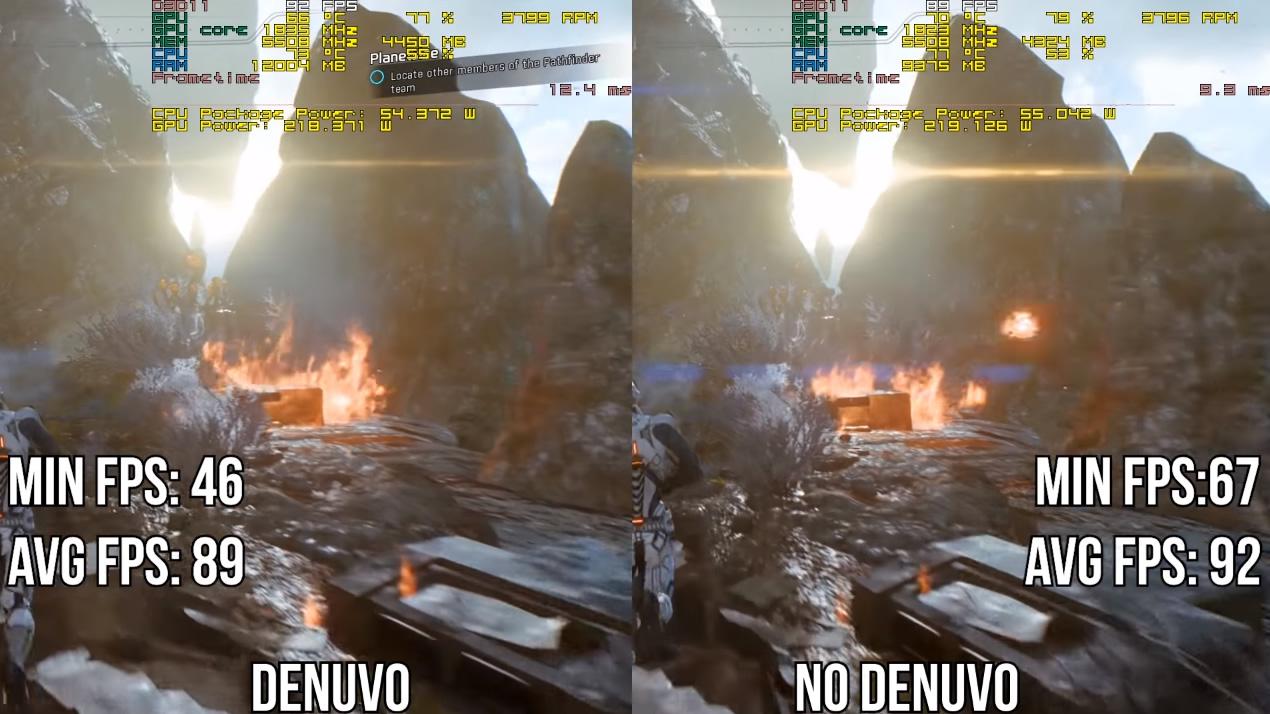
This is the point that raises the most eyebrows among PC gamers . On paper, Denuvo insists that its impact on performance is minimal, especially if it's been properly integrated. However, empirical tests, comparisons, and specific cases tell a much more nuanced story.
Several areas where Denuvo can negatively impact the user experience have been documented :
- FPS dropsespecially in the lows (those stutters you notice even though the average frame rate doesn't seem so bad).
- Increased loading timesespecially on PCs that still use traditional HDDs instead of SSDs.
- Higher CPU usagereaching alarming rates in some cases.
- Micro-cuts, stuttering, and synchronization problems in frame generation.
One of the most notorious examples was Assassin's Creed Origins , which combined Denuvo with VMProtect. Users and specialized media observed that a processor like the Intel i7-3770 @ 3,4 GHz could reach around 90% usage, and more modest CPUs like an i5-4590 @ 3,3 GHz reached 100% load quite easily. Much of this excessive usage was attributed to the copy protection layers , rather than the game itself.
Another clear example was Devil May Cry 5 : comparing the version with Denuvo and another build without the protection, some players reported differences of up to 20 FPS . Conversely, in titles like Final Fantasy XV, tests indicated that performance was virtually identical with and without Denuvo, suggesting that the specific implementation in each game plays a significant role.
Sometimes the problem isn't just FPS , but much more serious malfunctions : games that won't start for an entire weekend due to validation server outages, incompatibilities with certain hardware components, or intermittent crashes that only affect versions with Denuvo while "clean" versions work perfectly.
All of this has generated enormous distrust : a portion of the community directly associates "it uses Denuvo" with "it will perform worse" or "it might cause problems," even though in some specific titles the actual impact is small or nonexistent. The mere fact that there are high-profile negative examples has been enough to create a clearly hostile general perception.
Why companies continue to invest in Denuvo
If Denuvo is so unpopular and often ends up being bypassed within days , it's logical to wonder why major publishers insist on including it in every important release. The answer lies primarily in economic calculations and managing the risk of piracy during the release window.
The vast majority of sales for a AAA game are concentrated in its first few weeks on the market . This is the time of hype, of intense marketing campaigns, and of reviews in the media and on social networks. If the protection manages to keep the cracking scene at bay even during this period, it has already fulfilled its purpose from the publisher's point of view.
Denuvo is, above all, a way to technically "make piracy more expensive ." It doesn't make it impossible, but it raises the barrier to entry , both in terms of the necessary knowledge and the time and effort required. While games with simpler protections can be cracked in hours, with Denuvo, even in its "modified version," there are still titles that take days or weeks to become available online.
On the other hand, the decision doesn't always rest solely with the studio developing the game . Often, it's the publisher (EA, Ubisoft, Warner, etc.) that mandates the use of Denuvo as part of its global release policy, even if the development team is aware of the potential performance or public image issues it might cause.
The cost of licensing and integrating Denuvo isn't exactly low , but for a large production, it's part of the agreed-upon "security" budget. Some argue that this money could be used to lower the game's final price or strengthen its development , instead of spending resources on a technology whose actual benefit against piracy is debatable.
Games that have used Denuvo (and those that have removed it)
The list of PC games that have incorporated Denuvo is immense and encompasses virtually all major modern franchises . Since its arrival in 2014, we've seen it in sports, action, adventure, strategy, RPGs… A brief year-by-year overview gives an idea of its reach.
In 2014, Denuvo entered the scene with high-profile titles like Dragon Age: Inquisition , FIFA 15 , and Lords of the Fallen . It was its official launch, and it was already clear that, although games eventually cracked, the cracking process took longer than anything seen before on PC.
In 2015, the technology became established in major productions : Batman: Arkham Knight , Battlefield Hardline , FIFA 16 , Mad Max , Metal Gear Solid V: The Phantom Pain , and Star Wars Battlefront , among many others. Some of these games received harsh criticism for their performance and bugs, further fueling the debate about whether protection helped or hindered things.
2016 was one of the peak years for Denuvo adoption.. games like Rise of the Tomb Raider, Unravel, plants vs. Zombies: Garden Warfare 2, Far Cry Primal, Need for Speed, Total War: Warhammer, Mirror's Edge Catalyst, Sherlock Holmes: The Devil's Daughter, Abzu, F1 2016, Deus Ex: Mankind Divided, Pro Evolution Soccer 2017, FIFA 17 coins, Battlefield 1, Dishonored 2 o Watchdogs 2 They had the system integrated. By this point, practically any self-respecting AAA PC game came "protected" with Denuvo.
In 2017 and 2018 the list skyrocketed even morewith titles of the caliber of Resident Evil 7, NIER: Automata, Tekken 7, Prey, South Park: The Fractured But Whole, Assassin's Creed Origins, Sonic Forces, Middle-earth: Shadow of War, Dragon Ball FighterZ, Final Fantasy XV, Monster Hunter: World, Yakuza 0, Shenmue I & II, Shadow of the Tomb Raider o Assassin's Creed OdysseyDenuvo was already a virtually omnipresent feature in major PC productions.
Between 2019 and 2020 the trend continued with Metro Exodus, Mortal Kombat 11, Octopath Traveler, Heavy Rain, Beyond Two Souls, Wolfenstein: Youngblood, FIFA 20 coins, Planet Zoo, Need for Speed Heat, Borderlands 3, Total War: Three Kingdoms, Madden NFL 20, Anthem, Ace Combat 7: Skies Unknown, Monster Hunter World: Iceborne, Zombie Army 4: Dead War and so on. Even more recent titles like Dragon's Dogma II They've been using Denuvo since day one.
Meanwhile, many games have decided to remove protection once the "critical window" of sales has passed. Some examples are: DOOM (2016), Hitman, Life is Strange: Before the Storm, Mass Effect: Andromeda, Mad Max (on certain platforms), Abzu, Syberia 3, The Climb, Homefront: The Revolution, Two Point Hospital, Resident Evil 2 Remake, Resident Evil 3 Remake, DOOM Eternal, Yakuza Kiwami, RANGE 2 o Dishonored 2.
In many of these cases, the removal came after the game had been cracked and following numerous complaints about performance or simply image issues. There have also been peculiar situations, such as Yakuza Kiwami , where Denuvo was removed before the PC release itself.
Denuvo as an anti-cheat system and its arrival on mobile phones
Over the years, the company behind Denuvo has expanded its product range beyond basic anti-piracy measures . Under the Irdeto umbrella, the brand now offers solutions focused on online fair play and mobile game protection , two particularly sensitive areas in today's industry.
On one hand, there's Denuvo Anti-Cheat , a technology designed to detect and stop multiplayer cheats such as aimbots, wallhacks, and modifications to sensitive game data. The tool monitors client behavior and manipulation patterns to prevent cheaters from ruining the experience for legitimate players.
Irdeto boasts that approximately 77% of players abandon a game when they detect too much cheating . For publishers, this poses a significant risk to monetization and the long-term health of their communities. That's why integrations like the one implemented through Steamworks —which allows Denuvo Anti-Cheat to be added to Steam games with relative ease—are so appealing to many studios.
Denuvo's expansion has also reached the mobile market with Mobile Game Protection . In this case, the protection is integrated directly into the final APK uploaded to Google Play, adding features such as detection of vulnerable points, anti-debugging , root detection, integrity verification, and mechanisms against reverse engineering.
The goal here is to curb common practices in the Android world , such as the use of tools like Lucky Patcher, APK mods with unlocked microtransactions, or hacks that alter game parameters to gain an advantage. According to Irdeto, the solution has a minimal impact on performance, although previous PC experience has led many players to view these promises with some skepticism.
Alternatives to DRM and other ways to combat piracy
In contrast to the "protect everything" philosophy that Denuvo represents, there are diametrically opposed positions . The best-known in the video game world is that of platforms like GOG , a subsidiary of CD Projekt, which sells completely DRM-free titles.
When you buy a game on GOG, you download the files and they're yours without restrictions : you can make backups, move them between computers, save them wherever you want, and run them without constant license checks or mandatory internet connections. Humble Bundle and itch.io also often offer DRM-free versions (although Humble frequently distributes Steam keys, which do include platform DRM).
CD Projekt Red has openly argued that it's possible to achieve high sales without resorting to intrusive systems . The Witcher 3 is a prime example: one of the most pirated games in history, but also one of the best-selling on PC. The company maintains that a high-quality, well-optimized product at a reasonable price, combined with a user-friendly policy , is a very effective way to reduce the negative impact of piracy.
This stance aligns with the idea that the best "protection" is offering real value : finished games, no monetization abuse, good post-launch support, and transparent communication. Many players who might otherwise pirate prefer to pay when they feel the company respects their time and money.
A growing segment of the community views Denuvo as an unnecessary burden that only serves to penalize legitimate buyers, while pirates, sooner or later, end up accessing versions without the inconvenience of protection. For these individuals, the solution lies more in improving the product offering and value for money than in piling on layers of DRM and copy protection.
At the opposite end of the spectrum, some companies continue to invest in new generations of systems like Valeroa , a technology that promises to guarantee that the store's DRM cannot be removed, even without an internet connection and without affecting performance. It remains to be seen whether they will truly deliver on these promises or if the cycle of controversies seen with Denuvo will repeat itself.
Looking at the big picture, Denuvo has become a key element in the debate between security and user experience : on the one hand, it offers publishers a tool to protect their revenue in the short term, but on the other, it generates resistance among many players, can degrade performance, and ultimately doesn't prevent titles from ending up on the piracy scene. In the end, each studio and each user ends up taking a side based on how much they value convenience, performance, and the idea of real "ownership" of the games they buy.

Passionate writer about the world of bytes and technology in general. I love sharing my knowledge through writing, and that's what I'll do on this blog, show you all the most interesting things about gadgets, software, hardware, tech trends, and more. My goal is to help you navigate the digital world in a simple and entertaining way.