- The V16 SIM is soldered (MFF2), uses a private APN and NB-IoT; it is not reusable in mobile phones due to design and regulations.
- Connectivity is included for 12 years and only links to DGT 3.0; it does not offer internet access.
- From 2026 onwards, only connected and approved V16 vehicles are valid; no data plan is required. apps for them to work.
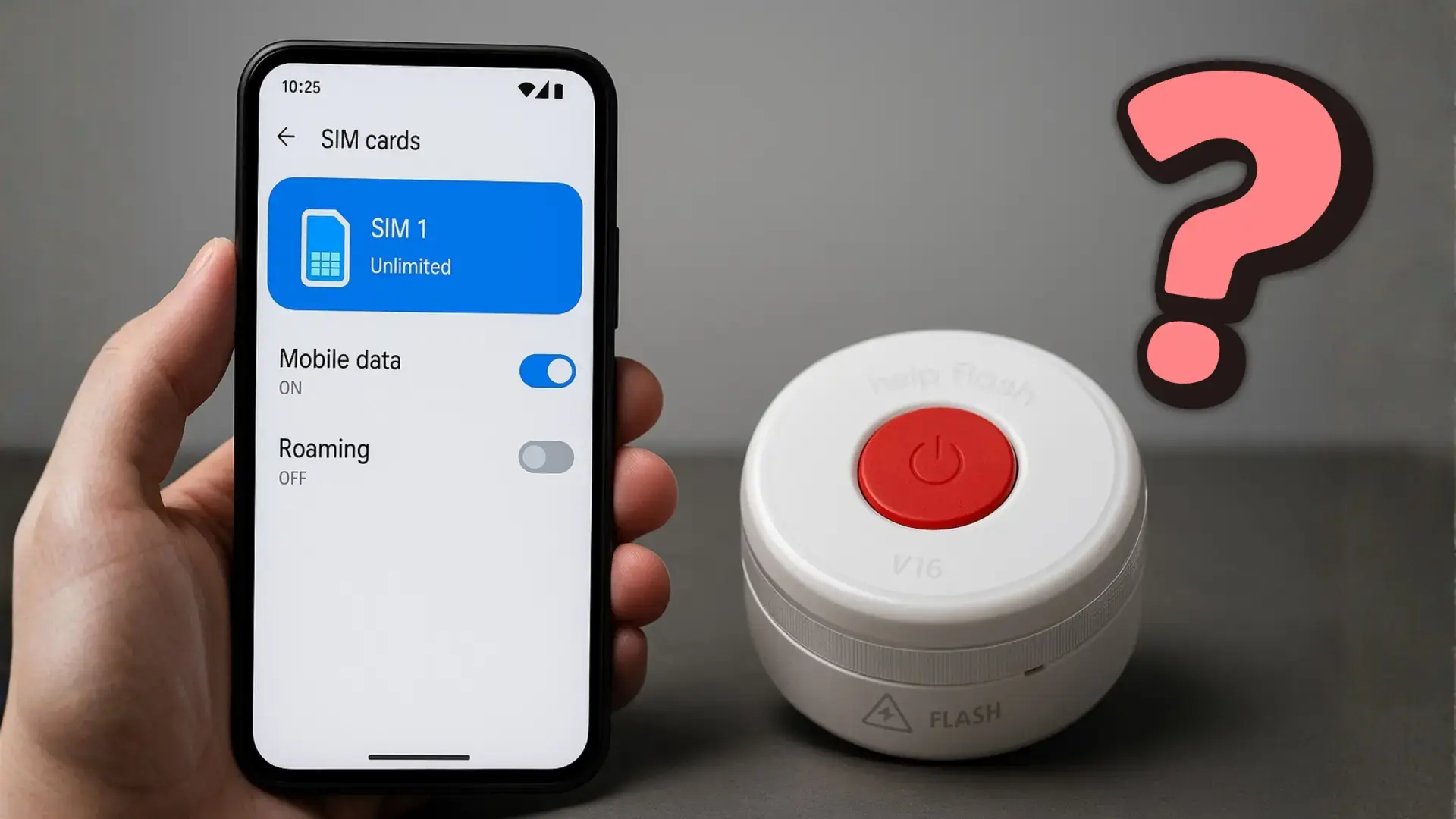
Since it became known that connected V16 beacons would be mandatory, many people have had the same idea: to take advantage of the beacon's "free" SIM card to use in their mobile phones and browse the internet at no cost. It sounds tempting when you consider that the service is included for at least 12 years and that in some cases, connectivity is advertised as guaranteed until 2038.
The reality, however, is far less glamorous: you can't use the V16 beacon's SIM card in your phone , and if you try, you'll most likely damage the beacon and be left without an emergency device. There are hardware , cybersecurity , and network reasons preventing this, in addition to very clear regulatory requirements from the DGT (Spanish Directorate General of Traffic).
Can the V16 beacon SIM be used in a mobile phone?

The short answer is no. As much as it may seem feasible on paper to "remove the card" and place it in a smartphone , in practice the V16 beacons integrate a SIM chip soldered to the electronic board (industrial MFF2 format), without a slot or extraction tray.
Even assuming someone skilled could desolder the component, the attempt would be futile: that SIM is not designed to access the Internet like a normal line, but to connect to a private network of the manufacturer which in turn connects to the DGT 3.0 platform.
Furthermore, all communication is encapsulated with specific profiles and parameters (such as a private APN dedicated to the service ) that a consumer mobile phone cannot use. This is not an arbitrary limitation: it responds to cybersecurity regulations and the critical nature of the service.
Even if you were able to circumvent the two previous points, there's still another barrier: the network used is NB-IoT , designed for low-power devices and very lightweight communications. A phone "talking" over that network would generate anomalous traffic, and the operator would cut it off without hesitation.
How the beacon is constructed: the SIM is neither removable nor reusable
When you open a connected V16 beacon (if you manage to do so without breaking it), you won't find a SIM card like the one in a mobile phone; what you'll find is an MFF2 (SIM-on-Chip) SIM module soldered to the board. It's part of the circuitry, not an interchangeable accessory.
This assembly has two objectives: to prevent tampering and to increase durability . Being welded, it better withstands vibrations, temperatures, and the passage of time, which is essential when guaranteeing service for twelve years.
Furthermore, some manufacturers add solder points or physical seals to protect access to the electronics . This is no coincidence: the DGT (Spanish Directorate General of Traffic) requires that connectivity be reliable and not lost due to tampering or attempts to reuse the device outside its original environment.
Wanting to use "what you've already paid for" on your mobile phone is understandable, but the device is designed as emergency equipment, not a portable router . The beacon's engineering prioritizes its critical function (warning of danger) over any other use.
Triple layer of protection: physical, logical, and network
To prevent the SIM card from being misused outside its designated beacon, the system has several well-defined barriers. It's not a single obstacle, but rather three layers of protection that reinforce each other.
- Physical protection: the MFF2 SIM chip goes soldered to the board and encapsulated inside the device. There is no socket, so it cannot be removed "with a needle".
- Logical lock: SIM connectivity is anchored to a private manufacturer's network, with a specific APN that only accepts traffic intended for DGT 3.0.
- Network control: the beacons use NB-IoT over 4G/5GIt's an ultra-lightweight profile that transmits only a few kilobytes. If anomalous traffic is detected, the operator can cut off access.
The operators themselves who provide the connectivity service for these beacons explain that the design is intended so that only what is necessary works: positioning and activation event , without navigation, calls or conventional data use.
This scheme complies with the cybersecurity requirements demanded of devices connected to the Traffic platform, including those imposed by European regulations (such as the aforementioned EN-18031 on cybersecurity for this type of solution).
What the DGT requires: twelve years of service and connectivity included
From a legal standpoint, the connectivity of the connected V16 beacon depends not on the user , but on the manufacturer. The Resolution of November 30, 2021, specifies that each device must incorporate a communications service contracted for a minimum of 12 years.
This means that when you buy the beacon, the cost of connectivity is already included in the sale price . You don't have to register it with any operator or pay monthly fees or additional charges for it to communicate with DGT 3.0.
Royal Decree 159/2021 established that, from January 1, 2026, connected V16s will be the only legal advance warning system, replacing warning triangles. Royal Decree 1030/2022 reinforces the certification and verification framework for connectivity with the Traffic Authority's platform.
In practice, the message is simple: if your beacon is certified and connected, it works on its own . Turn it on, place it, and you're done; there's no need to "sync" it with your phone or have a separate SIM card.
DGT 3.0: how data is sent and what information travels
When you activate the light, the beacon initiates a very brief and efficient data communication. It sends its geographic position , a device identifier, its status (active/deactivated), and a timestamp to DGT 3.0.
There is no transmission of personal or license plate data; the platform requires only the bare minimum to disseminate the alert to other users and management systems. It is operational information designed for road safety, not for marketing.
The transmission continues for a limited time (usually around half an hour) or until you turn off the beacon. Therefore, there is no permanent geolocation , and the trace is strictly limited to the incident.
By integrating with DGT 3.0, the signal can appear on variable message signs, navigation systems, traffic apps, and other connected systems. The goal is to warn those approaching the incident in time , even before it is physically visible.
Do you need to purchase a data plan for the beacon?
No. Approved V16 connected beacons have their own integrated connectivity, contracted by the manufacturer. You don't need to pay for a separate line , activate a service, or change providers for it to work.
Your role as a user is simple: buy an approved model , always keep it in the car, keep the charge or batteries in good condition, and place it correctly in case of emergency.
However, if your V16 light is not a connected one, it will no longer be valid from January 1, 2026. You will have to replace it with a connected and certified one to avoid penalties and, above all, to improve your own safety.
If you already have a certified connected V16, you don't need any extra management: connectivity comes "from the factory" with a minimum commitment of 12 years of service.
Mobile apps: not mandatory, but useful in some cases
The DGT (Spanish Directorate General of Traffic) is clear: the beacon does not need an app to function, as it has integrated GPS and a SIM card and connects automatically to DGT 3.0 upon being switched on. That said, there are apps that can provide additional services.
For example, some models allow registration with partner apps to facilitate roadside assistance. A beacon from a major operator integrates with SOS Alert to expedite assistance via TIREA (an organization that connects with insurance companies), and another multinational allows linking with MyIncidence, compatible with companies like Reale, Mapfre, and Axa.
There are also third-party beacons that can be linked to similar platforms; not all carriers offer their own app. In any case, these apps are optional and their purpose is to improve service, not to make the beacon function.
It's best to be selective: as the DGT (Spanish Directorate General of Traffic) emphasizes that the beacon does not transmit personal data or track you continuously, use apps with guarantees and recognized support, avoiding dubious solutions that ask for more permissions than necessary.
V16 vs V16 connected: why the landscape changes
The "classic" V16s emit light, but until now they coexisted with the connected variant. From 2026, the connected version will be the only legal one because it offers added safety : it not only makes you visible, but also automatically warns of danger.
Large-scale deployment requires millions of devices to communicate efficiently and reliably, hence the use of NB-IoT and 4G/5G networks with specific profiles. This design is not intended for general consumption , but rather for IoT scenarios with minimal power consumption and high availability.
If you're getting equipped now, it makes sense to buy a connected and approved model now, as this will ensure its validity for years. Make sure it appears on the official DGT list and has the corresponding conformity mark.
As a reminder, using an unconnected light beyond the specified timeframe can result in penalties and, more importantly, causes you to lose the benefits of automatic notification. Connectivity saves precious minutes in a context where visibility and time are of the essence.
Homologation and how to recognize a valid beacon
For a connected V16 device to be valid, it must be certified by the DGT (Spanish Directorate General of Traffic) and listed on its official registry. It is common to find accreditation references such as LCOE or IDIADA with the code G1 on the device itself.
If you're going to buy one, check the documentation, the label, and the manufacturer's website. Without homologation, there's no guarantee that it will connect to DGT 3.0 or that it will meet the visibility, range, and cybersecurity requirements.
It's also advisable to purchase it from reliable distributors, especially now that the deadline is approaching and offers that sound too good to be true are appearing. Be wary of promises of "free internet" or uses that don't align with the emergency function.
Remember: connectivity is included for the beacon, not your mobile phone. They are separate services with different networks, profiles, and contracts.
Common myths: “free internet”, removing the SIM card and using the mobile phone as a beacon
First myth: “If the beacon has paid data for 12 years, I can transfer it to my mobile phone.” False. The SIM card isn't a standard card and doesn't even have internet access; it only connects to a private network that forwards events to DGT 3.0.
Second myth: “I’ll remove the beacon and take out the SIM.” Besides being impractical for most people, you’d destroy the device and be left without emergency equipment. And even if you did remove the chip, you wouldn’t be able to browse the internet due to logical and network limitations.
Third myth: “I turn my phone into a beacon.” This is neither legal nor permitted. Beacons must be approved and certified ; a mobile phone is not, and in an accident, the light and specific signaling make all the difference.
Fourth myth: “The DGT is tracking me.” No. The beacon only transmits its location when it is active and for a limited time, without any personal data. Privacy and security coexist because the objective is to warn of the risk, not to track anyone.
Why do operators protect the service?
With millions of connected beacons being deployed, it makes sense for operators to protect their networks to prevent abuse. Using private APNs, NB-IoT profiles, and traffic controls ensures that resources are dedicated to what matters: real emergencies.
Furthermore, the connectivity contracts for these solutions are designed for minimal data packages and high availability, not for video sessions or social media. Deviating from this pattern triggers alarms and the system cuts off access.
This architecture also helps the beacon connect to the network and transmit its event, even under challenging conditions. With low bandwidth and a deep signal, NB-IoT is perfect for mission-critical IoT , exactly what an emergency requires.
For all the reasons mentioned above, while the idea of "scraping" data might sound ingenious, it clashes head-on with the design, regulations, and service logic. There's no shortcut that doesn't break something , and the last thing you want is to be without a beacon when you need it most.
Attempting to reuse a V16 SIM card in a mobile phone is a waste of time and risks damaging the device: the SIM is soldered in, access is limited to a private APN, and the operator controls NB-IoT traffic . DGT regulations mandate this closed connectivity, and your only responsibility as a driver is to carry an approved connected beacon, maintain it, and use it correctly when necessary.

Table of Contents
- 1 Can the V16 beacon SIM be used in a mobile phone?
- 2 How the beacon is constructed: the SIM is neither removable nor reusable
- 3 Triple layer of protection: physical, logical, and network
- 4 What the DGT requires: twelve years of service and connectivity included
- 5 DGT 3.0: how data is sent and what information travels
- 6 Do you need to purchase a data plan for the beacon?
- 7 Mobile apps: not mandatory, but useful in some cases
- 8 V16 vs V16 connected: why the landscape changes
- 9 Homologation and how to recognize a valid beacon
- 10 Common myths: “free internet”, removing the SIM card and using the mobile phone as a beacon
- 11 Why do operators protect the service?