- ISO 14001:2026 strengthens climate, lifecycle, and supply chain aspects with greater clarity and practical guidance.
- Transition expected between 12 and 36 months; prepare training, gap analysis, and document updating.
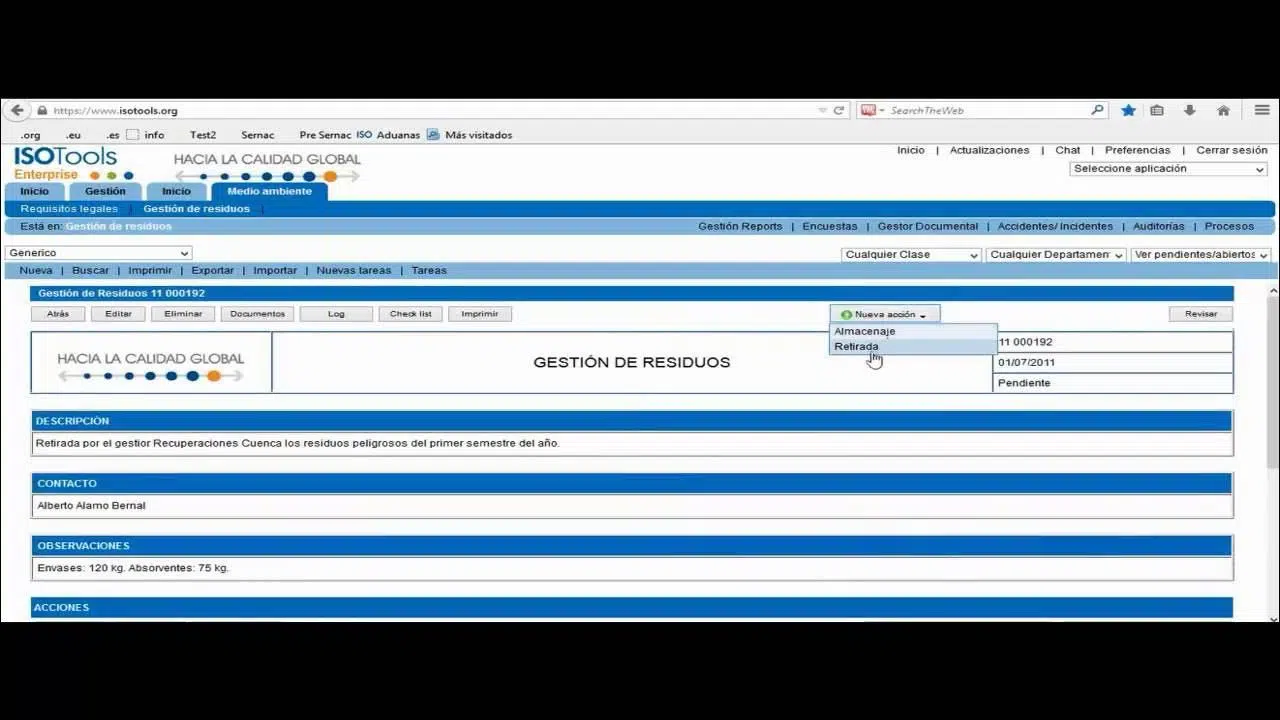
- ISOTools digitizes the EMS: context, risks, KPIs, traceability, and audits in an integrated environment.
The update to the world's most well-known environmental standard is just around the corner, and many organizations are already preparing. ISO 14001:2026 refines and modernizes the EMS without breaking it , and ISOTools is a perfect fit to accelerate the transition with data, traceability, and automation.
If you've been working with ISO 14001:2015 for a while or are considering certification, this content will help you quickly get up to speed. You'll find information on planned changes, the timeline, practical recommendations, the AMD 1:2024 climate amendment , certification steps, required documentation, the current situation in different countries, and, most importantly, how to use ISOTools to ensure smooth compliance.
What changes with ISO 14001:2026
The 2026 revision maintains the common structure of management systems but improves the clarity of the text and its applicability. It aligns with the Harmonised Structure (HS, formerly Annex SL) to facilitate integration with other standards such as ISO 9001, 45001, and 50001.
One of the key aspects is broadening the focus on strategic environmental issues. The role of climate change, biodiversity, and the circular economy is being strengthened , making their consideration a cross-cutting factor in context, planning, and performance evaluation.
Risk-based thinking is maintained and refined. A structured assessment of long-term environmental risks and the proactive identification of opportunities are promoted , orienting the EMS towards resilience and forward-thinking decision-making.
Life cycle management is gaining practical importance. A full LCA is not required, but it is essential to consider all relevant stages of the product or service for the purposes of planning, operational control, and environmental communication.
There is also a focus on external relations. Environmental management in the supply chain is clarified, with criteria for suppliers, and monitoring and traceability of impacts throughout the entire value chain.
Communication is evolving towards greater transparency. There is a demand for verifiable data, accessible formats, and consistency with non-financial reporting frameworks (e.g., CSRD, GRI, or ESRS), strengthening stakeholder trust.
There is explicit recognition of the role of digitization. Real-time monitoring, automatic data capture, and integration with business processes are moving from recommendations to almost inevitable best practices.
Leadership doesn't disappear, it intensifies. Senior management must be visibly involved, accountable, and provide resources for the EMS , placing environmental performance on the executive agenda and among critical indicators.
In addition, the planned consolidated review announces improvements to the Annex A guidance, explanatory notes on requirements, and a new reference to change management to govern modifications and ensure system consistency.
Timeline and transition period
The most frequently cited timeline places the publication in 2026, with preceding milestones. An international project is planned for February 2025, with the official launch expected around the first quarter of 2026 , though this may vary between January and February depending on editorial progress.
Regarding the transition, the scenarios mention two likely ranges: a classic one of three years (2026–2029) and a shorter one, between 12 and 36 months , depending on the final scope of the changes and the accreditation decisions.
The practical lesson is clear: it is advisable to get ahead with training, gap analysis and document updates , so that the migration audit arrives with the system running smoothly.
AMD Climate Amendment 1:2024: What it entails
ISO's decision to strengthen climate change considerations in all standards based on Annex SL is already in place. In ISO 14001, notes have been added to clauses 4.1 and 4.2 to explicitly address climate change within the context of stakeholder needs.
It does not require redoing the EMS, but it does require evidence. You must demonstrate that you have assessed physical risks (heat waves, floods, droughts), transition risks (regulation, technology, reputation) , and potential financial impacts.
This translates into matrices and plans. It updates the context analysis, reviews the stakeholder matrix with climate expectations , connects environmental objectives with mitigation/adaptation, and incorporates plausible climate scenarios.
And don't forget legal compliance. Include the climate variable in the assessment of legal requirements and other commitments , with a dynamic vision towards future regulations and ESG requirements.
How to prepare for the 2026 transition
Training first, always. Train your team on the changes in the standard, climate risk-based thinking and the circular economy , and participate in transition sessions and sector forums.
Continue with a thorough gap assessment. Evaluate your WMS against the new nuances of 2026, identify differences, and develop a phased plan with priorities, responsible parties, and realistic deadlines.
Digitize critical data as soon as possible. Implement automatic data capture, real-time dashboards, and workflows to avoid reaching the end of the transition with loose sheets and scattered records.
Review policies and procedures. Update the environmental policy, broaden the life cycle approach, incorporate criteria for suppliers , and strengthen key operational controls.
Rehearse the audit. Conduct preliminary internal audits, prepare evidence of the new requirements, and coordinate the migration timeline and scope with the certification body.
How ISOTools makes adaptation easier
ISOTools is a modular platform that enables end-to-end digitization of the WMS. It integrates context analysis, risks and opportunities, environmental indicators (KPIs), actions, and document traceability into a single environment, eliminating information silos.
Its SaaS architecture offers clear operational advantages. Cloud availability, advanced security, automatic updates, and multi-device access reduce technical friction and maintenance costs.
Integration with other ISO systems is native. Thanks to the Harmonized Structure, it links with ISO 9001, 45001, 27001, and 50001 , simplifying integrated management and avoiding duplication.
Furthermore, it's designed for the PDCA cycle. Planning, doing, checking, and acting becomes a guided experience , with approval workflows, alerts, and audit-ready evidence.
A key differentiator is the expert support. The platform includes consulting and training, with customizable modules so you only pay for what you need and can grow in stages.
Practical comparison: 2015 vs. 2026 (planned)
Structurally, there will be no revolutions. The high-level architecture is maintained with modernized language and improved footnotes for correctly interpreting each section.
In terms of scope, major themes are explicitly addressed. Climate change, biodiversity, and circularity are directly referenced , reducing ambiguity regarding their inclusion in the EMS.
In risk management, more strategy is required. The long-term focus and organizational resilience are reinforced , connecting environmental performance with business continuity.
In the supply chain, the bar is being raised. More control is needed over relevant external processes and services to ensure consistent environmental outcomes across the entire value chain.
In communication, there is more evidence and consistency. Verifiability and alignment with global non-financial reporting standards are being promoted, making reports more useful and comparable.
Steps to become ISO 14001 certified
The path to certification is well-known and effective. It begins with understanding the standard and securing commitment from senior management to ensure resources and strategic priority.
Continue with training and initial assessment. Train staff, conduct a gap analysis, and define the scope of the EMS in processes, locations, and activities.
Next, document and deploy. Develop policies, procedures, operational controls, and record aspects and impacts , integrating the system into daily operations.
Measure, audit, and improve. Monitor consumption, emissions, and waste; conduct internal audits and management reviews to ensure efficiency and continuous improvement.
Finally, certify and maintain. Pass the external audit in two stages, resolve nonconformities, and sustain the system with periodic audits and triennial recertification.
Most common required documentation
Your EMS must be supported by controlled, documented information. An environmental policy and an EMS manual or description that defines scope, processes, and responsibilities are essential.
Procedures and records are also required. These include operational control, emergency management, legal compliance assessment , and records of audits, management actions, and reviews.
Don't forget the environmental analysis. Identify and evaluate aspects and impacts, and register legal and other requirements applicable to your activity.
Communication must be regulated. An internal and external communication procedure and an EMS plan with objectives, goals, and programs complete the core documentation.
A risk-based approach is key. A methodology for identifying and assessing environmental risks and opportunities , linked to objectives and controls, will facilitate the audit.
Relevance of climate change in ISO 14001
Following AMD 1:2024, climate is no longer a guest, it's a key player. Incorporate it into context analysis, stakeholder engagement, and WMS planning , providing evidence for decisions and monitoring.
To put it into practice, work in layers. Update your environmental SWOT analysis, link objectives with mitigation/adaptation, evaluate scenarios, and review anticipated regulatory requirements in your sector.
ISOTools fits perfectly here. It centralizes assessments, documents, indicators, and action plans with full traceability, preventing gaps and surprises in audits.
Relationship with other standards and trends
The Harmonized Structure acts as a bridge between standards. ISO 9001 is under review for 2026 and is expected to place greater emphasis on risk, culture, technology, and change management , with expanded guidance annexes.
In ISO 14001:2026, the approach is consistent and clear. Annex A is improved, obsolete references such as Annex B on correspondences are removed , and relevant external communication and outsourcing are addressed in greater depth.
This strengthens integrated management. Quality, environment, safety, and compliance share a common language, controls, and metrics , simplifying combined audits and executive decisions.
Status of ISO 14001 by country
Adoption is growing and diversifying across sectors. Spain stands out with 14.967 certificates and 31.846 sites (2022) , with manufacturing and services leading the way.
Colombia maintains a solid pace. 3.219 certificates and 5.047 sites (2022) and strong manufacturing weight show traction and cross-cutting opportunities.
Peru reinforces its commitment. 1.468 certificates and 2.276 sites (2022) in a context of great biodiversity , with a focus on deforestation, water and waste.
Chile is making steady progress. 892 certifications and 3.321 sites (2022), with manufacturing leading the way , bolstering responsible business practices.
Mexico consolidates its progress. 2.708 certificates and 3.879 sites (2022), strong industrial presence , and increasing demands for sustainability in the value chain.
Useful resources: tables and downloadable information
Many organizations require operational materials. Having an illustrative requirements table and an explanatory PDF dossier helps with internal communication and rapid team building.
To gain efficiency, digitize those resources. With ISOTools you can version them, share them, and link them to processes, risks, and records , maintaining document control and evidence of use.
ISO 14001 Software: Features That Add Up
In addition to ISOTools' specific focus, a good WMS software should cover the entire lifecycle. Process automation, real-time dashboards, report generation , and compliance with current legislation are crucial.
This translates into hours saved and fewer errors. Workflows, notifications, traceability, and data security increase system reliability and auditor confidence.
Modularity is another key advantage. Integrate ISO 14001 with 9001, 27001, or 45001 in the same environment to reduce duplication, increase consistency, and facilitate integrated audits.
Sources and bibliography consulted
To supplement and verify the information above, recognized technical literature has been consulted. ISO 14001:2015 and its implementation guide ISO 14004:2016 remain the standard for requirements and best practices.
Studies on SMEs and WMS also provide context. Hillary (2004) in Journal of Cleaner Production offers insights into challenges and solutions for small businesses.
Finally, United Nations materials are useful. The UNEP Guidelines for Environmental Management Systems (2019) offer a practical approach aligned with global trends.
Being ahead makes all the difference: with a planned transition, up-to-date documentation, a well-integrated climate perspective and the digital support of ISOTools, adapting your EMS to ISO 14001:2026 is viable, organized and with a tangible return in compliance, efficiency and reputation.

Passionate writer about the world of bytes and technology in general. I love sharing my knowledge through writing, and that's what I'll do on this blog, show you all the most interesting things about gadgets, software, hardware, tech trends, and more. My goal is to help you navigate the digital world in a simple and entertaining way.