- Fujitsu promotes technologies for multiple agents of IA collaborate safely between companies and sectors, with a special focus on supply chains and healthcare.
- Services such as Fujitsu Kozuchi AI Agent and AI Auto Presentation demonstrate how AI agents can act as team members, automate presentations, and respond in real time.
- The strategic alliance with NVIDIA It allows Fujitsu to build a complete AI infrastructure, with FUJITSU-MONAKA CPUs, NVIDIA GPUs, and NIM microservices for self-evolving agents.

Fujitsu's commitment to artificial intelligence agents is redefining how companies interact with data, automate processes, and coordinate with each other in complex environments such as supply chains, healthcare, and manufacturing. Far from simply offering isolated AI models, the Japanese company is building a complete ecosystem where multiple intelligent agents can collaborate with each other and with people in a secure and governed manner.
In recent years, Fujitsu has introduced several key technologies : platforms for AI agents from different companies to collaborate, services like Fujitsu Kozuchi AI Agent that act as an integral part of the team, avatars capable of creating and delivering presentations in over 30 languages, and a powerful partnership with NVIDIA to support all of this with a high-performance computing infrastructure. This entire movement has a clear objective: to accelerate the adoption of AI in the business and social fabric while maintaining the autonomy and control of organizations.
Technology for multiple AI agents to collaborate across companies

One of Fujitsu's most significant innovations is the development of collaborative technologies between multiple AI agents from different companies and suppliers. This capability is especially critical in environments such as the supply chain, where manufacturers, distributors, pharmaceutical companies, logistics operators, and many other stakeholders need to coordinate without compromising the security or confidentiality of their data.
Fujitsu's proposal allows AI agents from different organizations to cooperate securely , exchanging information and reacting quickly to sudden changes in the environment. These situations include unexpected spikes in demand, supply disruptions, natural disasters, or critical production incidents at key suppliers.
To demonstrate the potential of this technology, Fujitsu will begin field trials with Rohto Pharmaceutical and the Tokyo Institute of Science (Science Tokyo) starting in January 2026. The goal is to optimize Rohto's supply chain, improving responsiveness, reducing inefficiencies, and ensuring a swift recovery from unforeseen events—something especially critical in the pharmaceutical sector.
This initiative also falls within the activities of the Council for Competitiveness-Nippon (COCN) , where Fujitsu will participate to promote AI spaces that enable companies to collaborate by securely sharing data and intelligence. The aim is to strengthen the competitiveness of Japanese industry through AI agents operating in multi-company ecosystems while maintaining a focus on governance and trust.
In the medium term, Fujitsu plans to extend this technology to broader and more complex supply chains , offering it within its Dynamic Supply Chain services, integrated into the Uvance business model. The goal is to help organizations design much more resilient supply chain strategies, capable of operating sustainably despite global volatility, and based on cooperation between AI agents that cross organizational and sectoral boundaries.
Fujitsu Kozuchi AI Agent: AI as another member of the team
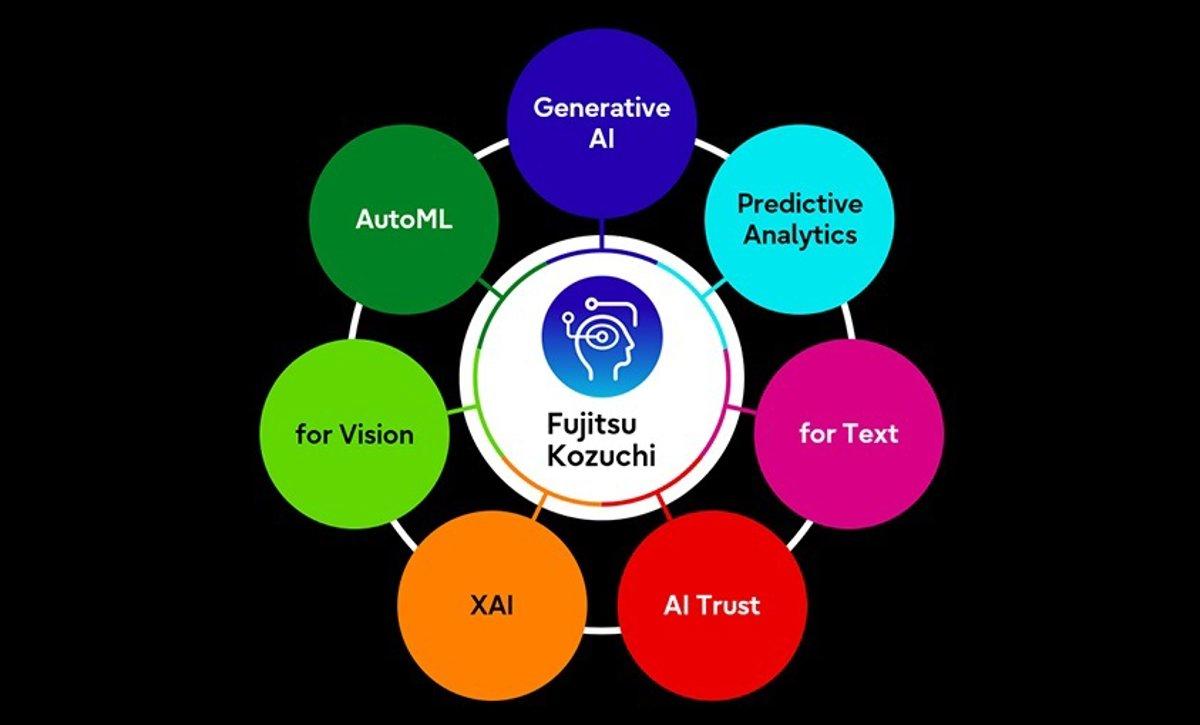
On the corporate front, Fujitsu has launched Fujitsu Kozuchi AI Agent , a service designed to enable AI agents to perform high-level tasks both autonomously and in coordination with humans. It's not just a simple assistant, but an agent capable of understanding complex objectives, proposing approaches, and executing plans using various AI models.
Thanks to a proprietary processing logic developed by Fujitsu , Kozuchi AI Agent can break down abstract questions raised in a conversation into concrete, manageable tasks. From there, it generates an action plan, selects the most suitable AIs for each task, gives them specific instructions, and formulates a proposal or solution based on the information gathered.
The service integrates both Fujitsu's own AI models, such as Takane and Kozuchi AutoML, and other external models. Takane stands out for its exceptional Japanese language proficiency and extensive customization options, while Kozuchi AutoML automates the generation of advanced machine learning models in a very short time, making it easier for companies to create tailored solutions without requiring large teams of data scientists.
All of this is offered through Fujitsu Data Intelligence PaaS , the company's all-in-one data operations platform, integrated into the Fujitsu Uvance business model. This platform acts as the backbone for deploying AI agents, connecting disparate data, and orchestrating complex workflows across various business areas.
The first sales agent in this family is geared towards discussions on business profitability and commercial negotiations . This agent is designed to gather relevant information, present key indicators, and suggest measures to improve the company's position during negotiations. Building on this foundation, Fujitsu plans to roll out new agents specializing in production management, legal matters, and other corporate areas where intelligent automation can provide a competitive advantage.
Fujitsu has also announced a wider rollout of Kozuchi AI Agent during fiscal year 2024 , integrating it into its digital offerings, including the Work Life Shift program within Fujitsu Uvance. In this way, the company aims to make collaboration between humans and AI agents a part of the daily operations of organizations, from decision-making to time and task management.
AI agent platform for Japanese healthcare
The healthcare sector is another major area where Fujitsu's strategy is being implemented. The company has developed a specific AI agent platform for the Japanese healthcare system , aiming to improve operational efficiency, ensure continuity of medical services, and alleviate the workload of clinical and administrative staff.
At the heart of this proposal is an AI orchestrator or coordinator agent , which acts as a centralized system to coordinate multiple agents specializing in different tasks within the medical workflow. These agents can be developed by Fujitsu or its technology partners, and encompass functions such as structuring clinical data, monitoring interoperability, managing appointments, supporting coding and billing, and assisting with patient triage, among others.
The platform is designed to enable AI agents to collaborate seamlessly , combining their capabilities to transform end-to-end healthcare operational processes, both within medical centers and in interactions with other stakeholders in the system (laboratories, insurers, government agencies, etc.). The coordinating agent can control and automate complex workflows, connecting various specialized medical applications without requiring healthcare professionals to switch between systems.
With this approach, Fujitsu aims to allow healthcare professionals to focus on high-value tasks such as diagnosis, clinical decision-making, and direct patient care. Facility managers will be able to reassign staff to critical roles, improve overall productivity, and offer better working conditions—key factors in retaining talent and reducing burnout.
Patients, for their part, will benefit from shorter waiting times and more personalized services , tailored to their needs and circumstances. With more coordinated and automated workflows, the healthcare system can better respond to peak demand, manage appointments more accurately, and reduce errors stemming from fragmented manual processes.
This healthcare AI agent platform is being developed with technological support from NVIDIA , which is contributing its expertise in accelerated computing and key AI agent technologies, such as NVIDIA NIM microservices and NVIDIA Blueprints. The goal is to combine Fujitsu's deep understanding of medical information systems in Japan with the power of NVIDIA's AI infrastructure to enable cutting-edge medical operational practices globally.
Looking ahead to 2025, Fujitsu plans to accelerate the commercialization of this platform , collaborating with leading medical institutions and international partners to validate the effectiveness of the coordinating agent and develop new, specialized agents for different areas of healthcare. Under the Uvance umbrella, the company aims to continue transforming both healthcare and drug discovery through the intensive use of data and AI agents, with a focus on increasingly personalized medicine and improving people's well-being.
Fujitsu AI Auto Presentation: Avatars that present and respond in more than 30 languages
Another of Fujitsu's most striking developments is Fujitsu AI Auto Presentation , a technology that allows AI avatars to create, deliver, and adapt presentations in a completely automated way. This solution is part of the Fujitsu Kozuchi AI service and integrates as an agent within the Microsoft 365 Copilot ecosystem.
The tool can generate and deliver presentations from Microsoft PowerPoint files , extracting the content from the slides and constructing a coherent presentation in the user's chosen language. But it doesn't just read text: the avatar can answer audience questions in real time, drawing on pre-integrated materials thanks to a Retrieval Augmented Generation (RAG) approach, allowing it to provide answers based on corporate or technical documentation.
A key differentiator is the ability to create personalized avatars using the user's own image and voice . Through speech recognition technologies, large language models (LLM), and speech synthesis, the avatar not only presents the content but does so with a natural tone that closely matches the style of the person it represents. Furthermore, the tool supports over 30 languages, facilitating communication in international settings even if the presenter is not fluent in every language involved.
Fujitsu AI Auto Presentation incorporates a patented, time-controlled, autonomous slide transition feature . The system generates the text to be displayed based on the number of characters on each slide and the time constraints set for the presentation, automatically changing slides at the appropriate moment to fit the planned duration without losing fluidity.
The solution also allows for granular customization of the presentation content . Slide by slide, prompts can be added to fix certain text, generate additional content, insert specific information, or adjust the writing style (more formal, more direct, sales-oriented, etc.). This flexibility makes it possible to reuse the same slide deck, quickly adapting it to different audiences or contexts.
This development was carried out jointly with Headwaters Co., Ltd. , a company specializing in AI solutions, and will be offered as the "Fujitsu AI Auto Presentation" AI agent within the Microsoft 365 Copilot declarative agent framework. Fujitsu will begin using this technology internally starting in the second quarter of fiscal year 2025 and plans to roll it out to customers worldwide starting in the third quarter, with plans to integrate it directly into Microsoft Teams and PowerPoint.
The goal of this tool is to democratize the process of creating and delivering presentations . People with limited time, no public speaking experience, or language barriers can delegate the delivery of their message to an avatar, ensuring a professional and consistent level of quality. According to Fujitsu, this will help organizations share high-quality information, gain operational efficiency, and move toward a more inclusive digital society, in line with its Materiality strategy.
The official announcement was endorsed by executives from Microsoft Japan and Headwaters . Microsoft emphasized that the integration of Fujitsu AI Auto Presentation into Microsoft 365 Copilot will help companies streamline the creation of multilingual content, optimize marketing operations, and facilitate faster knowledge sharing both within and outside the organization. Headwaters highlighted that the project demonstrates the practicality of AI agents integrated into real-world business processes and their enormous potential to improve operational efficiency, with a commitment to further democratizing these agents.
Fujitsu-NVIDIA strategic alliance for a complete AI agent infrastructure
To support this deployment of intelligent agents, Fujitsu has strengthened its strategic collaboration with NVIDIA with the goal of building a high-performance AI infrastructure that natively integrates AI agents across multiple sectors. This alliance aims to provide a robust technology platform that allows companies to leverage AI while maintaining their autonomy in managing data, models, and operations.
The collaboration focuses on the joint development of an AI agent platform and a state-of-the-art IT infrastructure . On the one hand, they are working on a platform tailored to specific sectoral needs (healthcare, manufacturing, robotics, among others), supporting multi-tenancy environments where different organizations can use agents securely and independently, while sharing an efficient technological foundation.
To achieve this, Fujitsu is integrating its AI workload orchestration technology, based on its AI computing intermediation, with the NVIDIA Dynamo platform . The goal is to create mechanisms that allow AI agents and models to evolve autonomously and be customized according to industry and client, leveraging NVIDIA NeMo and enhancing Fujitsu's multi-AI agent technologies, including Takane model optimization.
The agents developed in this environment will be delivered as NVIDIA NIM microservices , designed to offer highly optimized inference. This will make it easier for businesses to adopt advanced AI agents without having to deal with the complexity of deploying and scaling large models on their own, accelerating the AI industrial revolution with agents that continuously learn and improve.
On the infrastructure front, the alliance envisions the creation of a silicon-optimized AI computing platform that integrates the FUJITSU-MONAKA CPU series with NVIDIA GPUs via NVIDIA NVLink-Fusion technology. The goal is to achieve near-zero-scale performance, enabling widespread industrial adoption in compute-intensive fields such as scientific simulation, advanced manufacturing, and autonomous robotics.
This infrastructure will include a complete HPC-AI ecosystem , combining Fujitsu's high-speed software for ARM with NVIDIA CUDA . This will provide comprehensive support for the entire AI lifecycle: from model training and tuning to the deployment and operation of agents in production, as well as continuous monitoring and updates.
The agreement also places great emphasis on creating a robust ecosystem of partners and customers . Fujitsu and NVIDIA aim to drive joint programs with companies, institutions, and developers to expand the use of AI agents and models, generating transformative use cases in sectors such as manufacturing, healthcare, energy, and robotics. Among the initial applications are digital twins to accelerate manufacturing processes, robotics to address labor shortages, and advanced automation systems based on physical AI.
The leadership of both companies has emphasized that the AI industrial revolution is already underway and that it is urgent to build the necessary infrastructure to support it. Fujitsu, with its track record in supercomputing, quantum research, and enterprise systems, is positioned as a key partner for NVIDIA in Japan and beyond. Together, the two companies aim to establish this AI infrastructure as a cornerstone of Japan's digital society by 2030, with the intention of later expanding it to other global markets.
Strategically, Fujitsu frames this alliance within its objective of driving sustainable social and business transformation , aligned with the Sustainable Development Goals (SDGs). By offering a cross-cutting infrastructure for AI agents, the company aims to help ensure that innovation in artificial intelligence is not limited to large corporations, but extends to sectors and organizations that have previously faced prohibitively high barriers to entry.
With over 113.000 employees worldwide and consolidated revenue of several trillion yen, Fujitsu remains the Japanese leader in digital services . Its strategy combines five key technological pillars—AI, computing, networking, data and security, and convergent technologies—with a clear purpose: to build social trust through innovation and underpin sustainable digital development. The collaboration with NVIDIA, along with the AI agent platforms described, fits perfectly into that purpose.
Taking all these initiatives together—collaboration between agents from different companies, services like Kozuchi AI Agent, healthcare platforms, avatars for presentations, and a complete AI infrastructure with NVIDIA— Fujitsu is building an ecosystem where AI agents become central to economic and social activity . The vision is not limited to automating isolated tasks, but rather to orchestrating complex collaborations between humans and machines, across organizations and sectors, supported by a powerful, secure, and governed technological foundation that aims to set the pace for the new era of applied artificial intelligence.


Passionate writer about the world of bytes and technology in general. I love sharing my knowledge through writing, and that's what I'll do on this blog, show you all the most interesting things about gadgets, software, hardware, tech trends, and more. My goal is to help you navigate the digital world in a simple and entertaining way.