- Bazzite strengthens its role as an alternative to SteamOS with new features, an optimized kernel, and graphical improvements.
- Key issues in handhelds have been resolved (suspension, audio, TDP) and support for AMD and Nvidia has been improved.
- The Open Gaming Collective unites efforts in kernel, Gamescope and drivers for the entire gaming ecosystem on Linux.
- The transition to Fedora 40 and Bazzite 3.0 will bring more performance, stability, and options for players and developers.
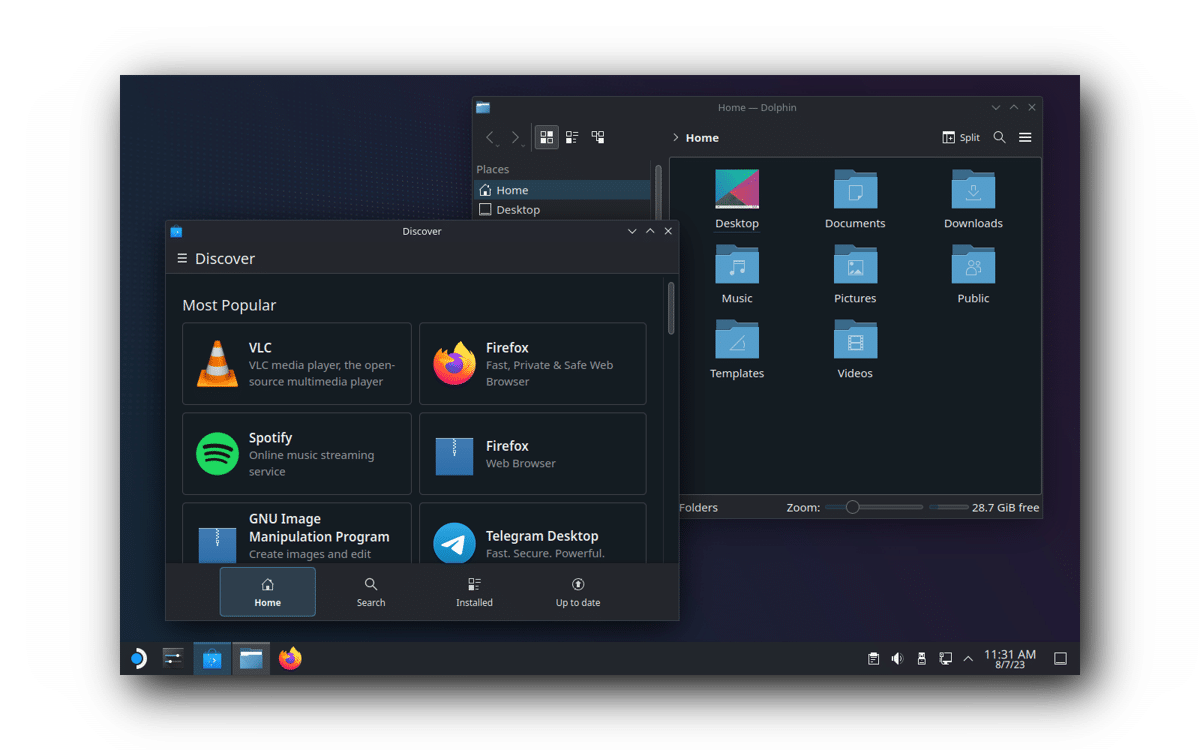
The arrival of the Steam Deck in 2022 completely changed the landscape of PC-based handheld consoles , and with it came a new wave of operating systems designed for gaming on Linux. Among them, Bazzite has become one of the most striking alternatives to SteamOS, offering a very similar experience in console and desktop modes, but with a more open and flexible approach for all types of PCs, HTPCs, and handhelds.
With the new Bazzite version 43.20260126 and the gradual upgrade to Bazzite 3.0 , the project has taken a significant leap forward in terms of new features, performance, and bug fixes. Furthermore, collaboration with other players in the Linux gaming ecosystem has been strengthened through the Open Gaming Collective, major issues have been resolved on devices such as the ASUS ROG Ally, Lenovo Legion Go, and several GPD consoles, and support for both AMD and Nvidia continues to be refined, including improvements for GameScope, Proton, and DX12/VKD3D.
What is Bazzite and why has it become so popular among Linux gamers?
Bazzite is a custom image of Fedora Atomic Linux built on Fedora 39 (and already being prepared for Fedora 40) using the Universal Blue framework. Its goal is to offer a "console" experience similar to SteamOS on the Steam Deck, other handhelds, and living room PCs, but without sacrificing a full desktop and all the advantages of a modern, atomically upgradable Linux system.
The project follows a continuous delivery model , meaning that new features, updated packages, current drivers, bug fixes, and improvements inherited from both Fedora and Universal Blue are released regularly. Everything is distributed as immutable images based on OSTree, which reduces the likelihood of system breakage over time and facilitates rollbacks if something goes wrong during an update.
One of Bazzite's great attractions is that it closely replicates the SteamOS Game Mode experience, taking advantage of Gamescope and the Big Picture-style interface, but allowing it to be used not only on the Steam Deck, but also on HTPCs, desktops, and a host of third-party handhelds such as the ASUS ROG Ally, Lenovo Legion Go, AOKZOE A1, Anbernic Win600, or various GPD models.
In addition, the system comes with a good number of tools designed for Linux gamers : integration with Proton and GE-Proton, ujust scripts to automate tasks (installing applications, fixing performance problems in Steam, configuring the machine, etc.), improved support for streaming with Sunshine/Moonlight, pre-configured Distrobox containers, and its own portal (Bazzite Portal) from which to install typical gaming software.
Key new features of Bazzite 43.20260126 and the current stable branch
Bazzite version 43.20260126 brings a series of technical improvements focused on performance and compatibility , especially for games that use modern technologies like DLSS, for AMD users, and for the different supported desktop environments.
One of the most interesting changes is the ability to enable global DLSS mode for Proton , similar to how it's done with the official Nvidia application on Windows. With this option enabled, games that support DLSS can benefit from improved performance and image quality without the need for complicated manual adjustments, provided the Nvidia GPU supports the technology.
As for the system's foundation, Bazzite has updated its core stack to Linux kernel 6.7.x (recent branches), Mesa AMD drivers 25.3.3, GNOME 49.3, and KDE in its modern branch (KDE Plasma 6.x in the transition to Fedora 40, beyond the 6.5.5 mentioned in previous iterations), resulting in better compatibility with recent hardware, more polished support for Wayland, and finer desktop performance.
All these components come with ongoing updates to PipeWire, XWayland, System76 Scheduler, LACT, and other key services that affect audio, video, power management, and overall game performance. Bazzite also adds specific patches to improve ray tracing on AMD (RADV), increasing performance in titles like Ghostwire Tokyo by up to 30% in certain cases.
It's worth remembering that SteamOS marked a turning point for Linux gaming , demonstrating that with good Proton integration, updated drivers (especially AMD drivers), and a well-tuned system, Linux can outperform Windows 11 in many performance scenarios. Bazzite builds upon that work by Valve and the community to offer an even more open and configurable experience.
Important fixes: stability, audio, and internal improvements
In addition to the new features, this batch of Bazzite comes loaded with corrections that improve the daily stability of the systemOne specific change is the terminal starting through xdg-terminal-exec upstreamThis makes it more reliable and less prone to hacks or strange behavior with different desktop configurations.
The startup of SDDM (the login manager in KDE) has also been adjusted to take slightly longer but be more robust , reducing boot sequence issues, especially on laptops and handhelds with unique hardware. In addition, the display tools have been improved with more compatible EDID dumping, which helps reduce errors with unusual resolutions or refresh rates on monitors and televisions.
On the software side, fixes have been implemented for Flatpak and tools like Protontricks , as well as improvements to build and automation scripts to prevent crashes during upgrades or branch changes. Some issues that could cause the upgrade process to hang (especially those related to initramfs and kargs arguments) have been mitigated with adjustments to the logic of bazzite-hardware-setup and other internal components.
One of the features that users of certain handheld consoles will appreciate most is the correction of audio problems in GPD devices , especially in models like the GPD Win Max 2 or earlier variants where the sound was reluctant to work properly or appeared with cuts and glitches.
GPD was one of the first companies to invest heavily in handheld PCs , with the original GPD Win launched in 2016 (long before the Steam Deck), and today they continue to position themselves in the high-end market with models like the GPD Win 5, which aims to be one of the most powerful x86 handheld consoles on the market with APUs from the Strix Halo family. Having a system like Bazzite that supports these devices well is key to getting the most out of them.
Nvidia support, high resolutions, and Gamescope
One of the areas where Bazzite has been pushing hardest lately is in Nvidia GPU support , both with proprietary drivers and by paving the way for the future of NVK (the open-source Vulkan driver for Nvidia). Several users have reported tangible improvements after the latest updates, especially regarding high resolutions and Game Mode stability.
For example, on systems with RTX graphics cards like the 3090 FE, powerful CPUs like the Ryzen 9 7950X3D, and 4K TVs , issues have been resolved where it was impossible to launch games above 1080p: when attempting to launch at 1440p or 4K, the system would display the Bazzite logo and return to the Game Mode menu, as if the session had restarted. With the new builds, these systems can now run games at 4K without problems, although the Game Mode menu itself remains limited to 1080p.
Everything points to these improvements stemming from GameScope adjustments, specific Nvidia patches, and enhancements to Proton integration . The community hopes that, as more fixes are added, performance in DX12/VKD3D-based titles on Nvidia GPUs will more closely resemble what's seen on Windows, or at least become less inconsistent.
In the Desktop branch, Bazzite has updated the Nvidia proprietary drivers to version 550 It has also enabled support for GSP firmware and adjusted parameters so that Flatpaks like Firefox can take advantage of hardware video acceleration. In parallel, the necessary components have been added to integrate NVK and the Vulkan driver. nouveau-experimental in the Nvidia images, although this support is still in an early stage.
The latest versions of XWayland and the graphics stack have also been used to fix security vulnerabilities and compatibility issues , which is crucial when Gamescope and Wayland are at the heart of Bazzite's console mode on PC and handhelds.
Suspension, handhelds, and a new overlay for controls and TDP
One of the most recurring headaches for Linux handhelds has been the behavior of sleep mode . Bazzite has worked closely with the community to stabilize this on key devices like the ASUS ROG Ally and the Lenovo Legion Go, which were particularly affected by bugs in kernel 6.7 related to sleep and resume.
Many users opted for overlay old images of Bazzite (for example, February 2024 builds) to work around the issues. Now, the team indicates that it is safe to revert to the Stable branch using the commands of rpm-ostree rebase specific for each device and environment (KDE or GNOME):
- ASUS ROG Ally KDE:
rpm-ostree rebase ostree-unverified-registry:ghcr.io/ublue-os/bazzite-ally:stable - ASUS ROG Ally GNOME:
rpm-ostree rebase ostree-unverified-registry:ghcr.io/ublue-os/bazzite-ally-gnome:stable - Lenovo Legion Go or other KDE handhelds:
rpm-ostree rebase ostree-unverified-registry:ghcr.io/ublue-os/bazzite-deck:stable - Lenovo Legion Go or other GNOME handhelds:
rpm-ostree rebase ostree-unverified-registry:ghcr.io/ublue-os/bazzite-deck-gnome:stable
With the latest patches, the suspension issues on Ally and Legion Go should be much more sporadic and not the constant disaster some users had experienced. Additionally, automatic VRAM logging has been implemented specifically for these machines, along with screen rotation and scaling fixes for multiple models.
Another notable new feature for handhelds is the new HHD-UI overlay , accessible by double-tapping the quick access button (QAM or equivalent) above Steam. This overlay allows you to change the TDP, adjust fan curves, manage specific controller functions (such as the gyroscope on the Legion Go), and generally centralize critical hardware settings without having to leave the game.
To complete the thermal and acoustic control, Bazzite facilitates the installation of CoolerControl using the command ujust install-coolercontrolproviding a graphical interface for regulating fans on compatible hardware. This is especially useful in HTPCs and high-performance laptops, where preventing unnecessary system noise is almost as important as maximizing FPS.
User surveys, typical profile, and quality of experience
The Bazzite team has conducted regular surveys to better understand how and where the system is used . One of the most recent surveys included 73 users, which isn't a statistically perfect sample, but it does provide a fairly clear picture of the community's typical profile.
The most common combination is a desktop PC running KDE Plasma with AMD hardware for both CPU and GPU . Most have used ujust commands at some point, roughly half work with containers (Distrobox or Toolbox), and a significant number also use virtualization or dual booting to run other operating systems.
Regarding remote play, Moonlight/Sunshine appears to be the preferred method , both for streaming within the local network and for more complex scenarios. And, although Steam remains the dominant platform, many users point to the Epic Games Launcher and GOG as the most popular PC gaming services outside of Steam.
The most striking thing is that, apart from five people who rated their experience as "average", the rest rated Bazzite between "good" and "great" , which indicates that the combination of unchanging image, integration with Steam and specific settings for gaming fits very well with the expectations of the target audience.
All feedback gathered is collected in dedicated threads and is being used to prioritize improvements such as rewriting the Bazzite Portal, tweaking the installer, adding pre-installed offline documentation, creating a GUI to manage OSTree , and expanding the repertoire of available ujust scripts.
Bluefin, Universal Blue's new website and the project's health
Universal Blue, the organization behind Bazzite, not only maintains this image but also other projects like Bluefin , geared towards developers and users who want a virtually maintenance-free Linux desktop. Bluefin has been accumulating features and is now ready to leave beta, with a future KDE-based variant.
The Universal Blue website has been completely redesigned , with clearer explanations of each image, usage metrics, project goals, and a more readable catalog of the different variants. The lead maintainer of Bazzite played a key role in this redesign, reinforcing the idea that the community remains very active.
The numbers also speak for themselves: Universal Blue images have surpassed 10 million pulls , and had previously crossed the 6 million mark. This doesn't equate to the number of users, since a single device can download multiple updates, but it does indicate heavy usage and a significant installed base.
Several Bazzite maintainers have attended events such as the Southern California Linux Expo 21x to promote the project, distribute merchandise, and chat with other enthusiasts about the potential of immutable images for gaming and desktop use.
While preparing for the transition to Fedora 40 (with Plasma 6 and GNOME 46, improved HDR support, etc.), Bazzite is focusing on to make maintenance more sustainable and the core of the system less experimental, leaving the testing space to specific branches such as :testing and reserving the stable branch for more polished experiences.
Open Gaming Collective: shared kernel and standardization for gaming on Linux
One of the most powerful news items related to Bazzite is the creation of the Open Gaming Collective (OGC) , a technical working group in which several of the main gaming distributions on Linux have joined together to collaboratively develop the critical components of the gaming stack.
Founding members include Universal Blue, Bazzite, ASUS Linux, ShadowBlip, PikaOS, and Fyra Labs , while ChimeraOS, Nobara, and Playtron are listed as strategic partners and contributors. The idea is to stop duplicating efforts on kernel patches, controller support, modified GameScope, etc., and share a robust common base upon which each distribution can build its own experience.
The heart of this initiative lies in what are called "shared technical pillars ." The OGC focuses on the "plumbing" of the Linux gaming stack: kernel, drivers, presentation layer (Gamescope), support for gamepads and peripherals like steering wheels, as well as critical features such as Secure Boot.
One of the first results is the OGC Kernel, a kernel specifically optimized for gaming , with improved support for secure boot, controller input, and specialized peripherals. Alongside this kernel, a fork of Gamescope is being developed that aims to drastically improve compatibility with new hardware, overcoming the limitations of implementations focused on specific devices like the Steam Deck.
The group also adopts a strict "Upstream First" policy : everything developed must aim to reach the original project (Linux kernel, Mesa, Gamescope, etc.) instead of remaining as a perpetual fork. This is intended to reduce fragmentation in the long term and ensure that improvements benefit the entire Linux ecosystem.
Changes to Bazzite due to the OGC: InputPlumber, launchers, and quality of life
The adoption of Open Gaming Collective standards has already begun to be noticeable at Bazzite. One of the most significant changes is the gradual abandonment of Handheld Daemon (HHD) as a system for managing controllers and handheld-specific hardware.
Instead, Bazzite is embracing InputPlumber, the same input framework used by SteamOS and other builds designed for handheld consoles. This should standardize the behavior of controllers, gyroscopes, touchpads, and other controls across different devices, facilitating cross-compatibility and reducing rare issues when switching hardware.
Another consequence of this standardization is the integration of RGB lighting controls and fan management directly into the Steam interface whenever possible. In cases where the Steam UI doesn't cover certain specific options, Bazzite will use a separate overlay, but the priority is for the user to be able to control most settings without leaving the game environment.
In parallel, the system will incorporate rollback and pinning mechanisms to maintain older versions of libraries when necessary to ensure the stability of certain games or applications, something very useful when an update breaks compatibility with sensitive titles.
In the realm of launchers, Bazzite is testing the Faugus Launcher on its beta branch as a potential replacement for Lutris . Faugus aims to offer a more modern and specific experience for the current Proton, Flatpak, and cross-platform gaming environment, although nothing is finalized yet. The team has promised that if they decide to retire Lutris, they will provide at least six months' notice so users can migrate their libraries without undue haste.
Updates, Desktop and Steam Deck/HTPC images
Updating Bazzite is relatively simple thanks to its atomic image model and continuous update system . In Desktop images, the system typically updates only once a day and applies the changes on the next reboot.
To force the update, simply Open the System Update tool or run the command in a terminal ujust updateWait for it to finish and restart. This will ensure you get the latest images, patches, and updates for user-installed applications.
In the Steam Deck, HTPC, and handheld images, from Game Mode you need to go to Settings > System and click on "Check for updates" . Alternatively, you can switch to desktop mode and use the same method as in Desktop, either System Update or the terminal.
Internally, Bazzite has been refining details such as custom initramfs arguments that now execute correctlyAutomatic device restart after bazzite-hardware-setup, restoration of packages required for tools like EmuDeck, and removal of problematic utilities such as rmlint (although it can be reintroduced via ujust if desired).
In the virtualization section, more options and scripts have been added to add the user to the libvirt group , problems with Distrobox have been fixed, Waydroid integration has been improved (including fixes under SELinux), and virtualization now works correctly even on the Steam Deck, although IOMMU is still not supported.
Bazzite 2.2.0 and 3.0: Recent milestones and future plans
Before the current build branch, Bazzite released a very important version, 2.2.0 , which represented a significant leap forward in terms of hardware support and new features. Among other things, it introduced official support for the Steam Deck OLED (with some limitations regarding Wi-Fi, rotation, and even audio blocking upon resuming from sleep), expanded support for handhelds such as the AOKZOE A1 and Anbernic Win600, and numerous improvements to Ally and Legion Go.
This version also consolidated changes such as the Prompt terminal as the default in all images (focused on workflows with containers), the inclusion of Pods as a GUI to manage Distrobox, and the arrival of the Linux Mint Webapp Manager to easily create shortcuts to web applications.
Visually, Bazzite debuted a new custom boot video for the Steam Deck/HTPC/Handheld images , replacing the SteamOS branding with a community-created animation. Additionally, the branding and themes for KDE and GNOME were refined, with new backgrounds, extensions, application categories, and tweaks designed to polish the desktop experience.
Looking ahead, the team is working on the launch of Bazzite 3.0which will be accompanied by the migration to Fedora 40, KDE Plasma 6 and GNOME 46, better HDR support, developer-oriented images (-dx), a new Fedora installer with offline ISOs, pre-configured toolbox containers, better sysext support, more desktops (with Budgie in the spotlight), lighter update downloads, up-to-date GE-Proton/WINE, possible integration of OpenGamepadUI as an alternative to Big Picture, and, in the long term, support for ARM architectures.
Among the ideas on the horizon is also a "Powerwash" type function to leave Bazzite as if it were newly installed without having to reinstall from scratch, which fits very well with the concept of immutable images and easy rollbacks.
Ultimately, Bazzite is establishing itself as one of the leading Linux distributions for gaming , combining the best of SteamOS with a Fedora Atomic base, a strong focus on performance and stability, and a community that constantly refines features for handhelds, desktops, and HTPCs. With the support of the Open Gaming Collective, ongoing improvements for AMD and Nvidia, the standardization of drivers and launchers, and the upcoming release of Fedora 40, it seems this system still has plenty of room to continue its strong performance as a viable alternative to Windows in the gaming arena.


Passionate writer about the world of bytes and technology in general. I love sharing my knowledge through writing, and that's what I'll do on this blog, show you all the most interesting things about gadgets, software, hardware, tech trends, and more. My goal is to help you navigate the digital world in a simple and entertaining way.