- Professional graphics card with 32 GB of GDDR6 ECC memory and Intel Xe2 architecture.
- Ability to scale up to 4 GPUs to reach 128 GB of VRAM in a single system.
- Turbine ventilation design and stainless steel chassis for heavy-duty 24/7 use.
- Full compatibility with AI frameworks such as PyTorch, Ollama, and vLLM.

It seems ASUS has decided to re-enter the Intel discrete graphics market, and they're doing it in a big way. The ASUS UGen Intel Arc Pro B70 is a beast designed specifically for those involved in artificial intelligence inference and heavy professional workloads, allowing companies to manage their AI workloads without relying on the cloud or external servers.
This card isn't for the average user who wants to play a few video games, but rather a precision tool based on the Intel Xe2-HPG (Big Battlemage) architecture . Its primary focus is to offer stability and considerable raw power to run complex computing language models and processes directly from the computer chassis, saving operating costs and improving data privacy.
Raw power and technical architecture
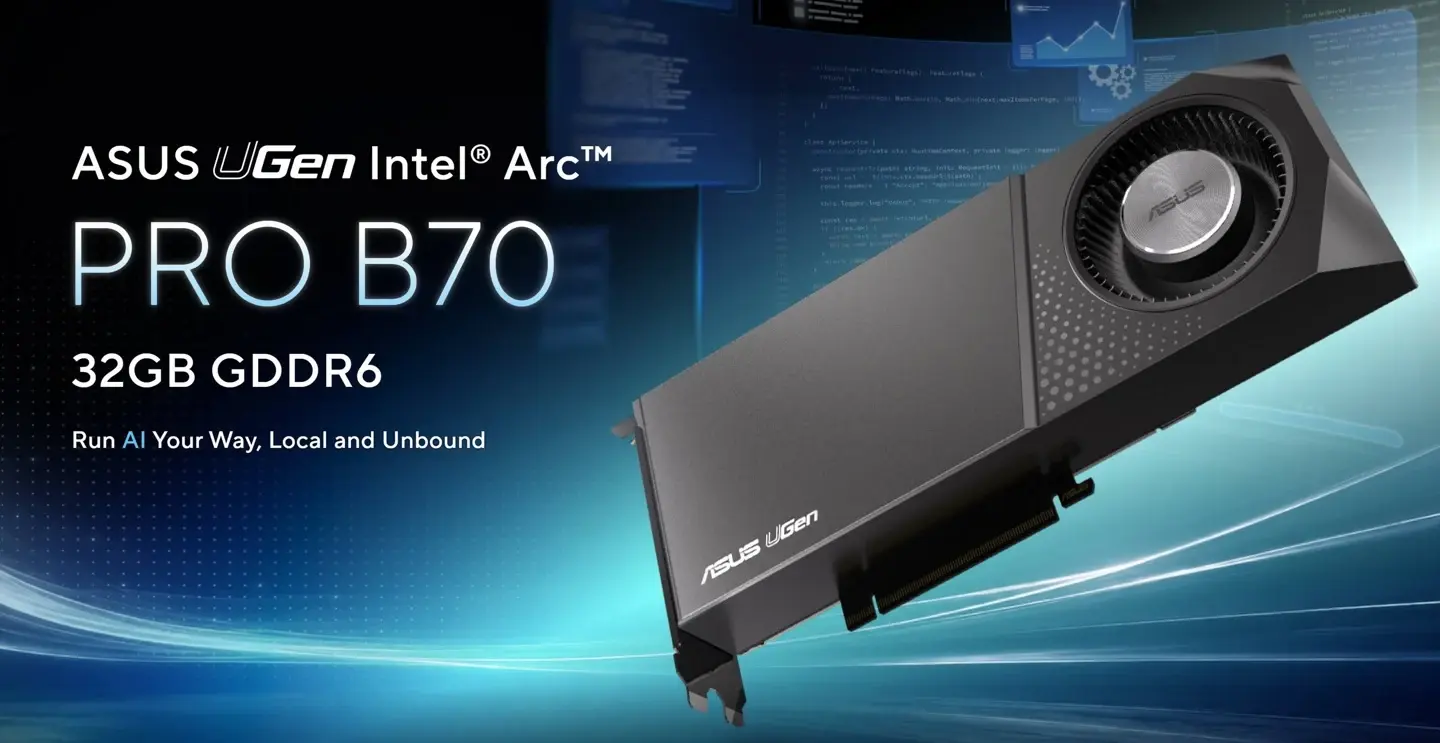
If we delve into the specifications, the UGen Arc Pro B70 is a true gem. It boasts 32 Xe cores and 256 dedicated XMX engines for AI, resulting in an INT8 AI performance that reaches 367 TOPS Peak . For those seeking traditional computing power, it offers FP32 performance of 22,94 TFLOPS with a dynamic clock speed that can scale up to 2800 MHz.
In terms of connectivity, the card takes advantage of the PCIe Gen 5x16 bus , ensuring no data transfer bottlenecks. For image output, ASUS has generously included three DisplayPort 2.1 (UHBR13.5) ports and one HDMI 2.1b port, allowing for the management of up to four displays with a maximum resolution of 7680 x 4320 at 120 Hz.
Massive memory for AI models
The real strength here is the memory. The card comes equipped with 32 GB of GDDR6 memory with ECC (Error Correcting Code) support, which is vital for preventing crashes during extended work sessions. With a bandwidth of 608 GB/s and a 256-bit bus , this memory can handle large contexts and multiple requests simultaneously without breaking a sweat.
But what's most incredible is its scalability. Although a single card can handle models with up to 27 billion parameters (like Llama 3.1 8B ), the system allows you to group up to four accelerators in the same machine. This gives us a staggering 128 GB of local VRAM , opening the door to running massive architectures with up to 120 billion parameters in quantized formats , completely eliminating the need for external APIs.
Industrial design and refrigeration
To prevent all this hardware from turning into an oven, ASUS has opted for a two-slot form factor with blower-style cooling . This design is key because it expels hot air directly out of the case, allowing the cards to be placed side-by-side in high-density servers without blocking airflow.
Durability is a key focus, utilizing a 304 stainless steel structural support and dual ball-bearing fans to withstand the demands of 24/7 operation. Furthermore, a phase-change thermal pad has been implemented to optimize contact with the chip, and the power connector (1x 12V-2x6) has been relocated to the rear to minimize cable clutter when installing multiple GPUs.
Software and compatibility
Hardware is useless without the right software, and here the UGen Arc Pro B70 shines thanks to its open ecosystem. It's compatible with major frameworks like vLLM, llama.cpp, Ollama, and PyTorch , and also leverages OpenVINO and oneAPI. Thanks to tools like ASUS Zenni Claw and Intel SuperClaw , managing local agents is much simpler, reducing traffic to external services by up to 70%.
- Consumption and energy: The TBP is 290 W (although some reports mention up to 310 W), requiring a power supply of 750 W.
- Dimensions It measures 267 x 111 x 40 mm and weighs approximately 1.094 kg.
- Operating systems: Full support for Windows 11 and Linux.
- Warranty: It has limited global technical coverage of 3 years in the Making.
Although ASUS hasn't released the final price, it's estimated that the market range for this type of professional hardware is between $1.299 and $2.000 . In short, we have a powerful tool that combines the Intel Xe2 architecture with expandable memory up to 128 GB, all housed in a robust steel chassis with turbine cooling to dominate local AI inference in professional environments.

Passionate writer about the world of bytes and technology in general. I love sharing my knowledge through writing, and that's what I'll do on this blog, show you all the most interesting things about gadgets, software, hardware, tech trends, and more. My goal is to help you navigate the digital world in a simple and entertaining way.