- Erosion combines isometric roguelike action, voxel open world, and time loops, where each death advances a decade and changes the state of the world and the characters.
- The player embodies a father attempting to rescue his kidnapped daughter, while the Living Column distorts There and transforms towns, factions, and regions with each time jump.
- The game offers procedurally generated dungeons, a destructible open world, and over 100 skills, with surreal weapons, customizable vehicles, and varied activities such as duels, races, and bounty hunting.
- Erosion will arrive in early access on PC and Xbox Series in spring 2026, with full release later for PS5, Xbox Series and PC, including availability on Game Pass.
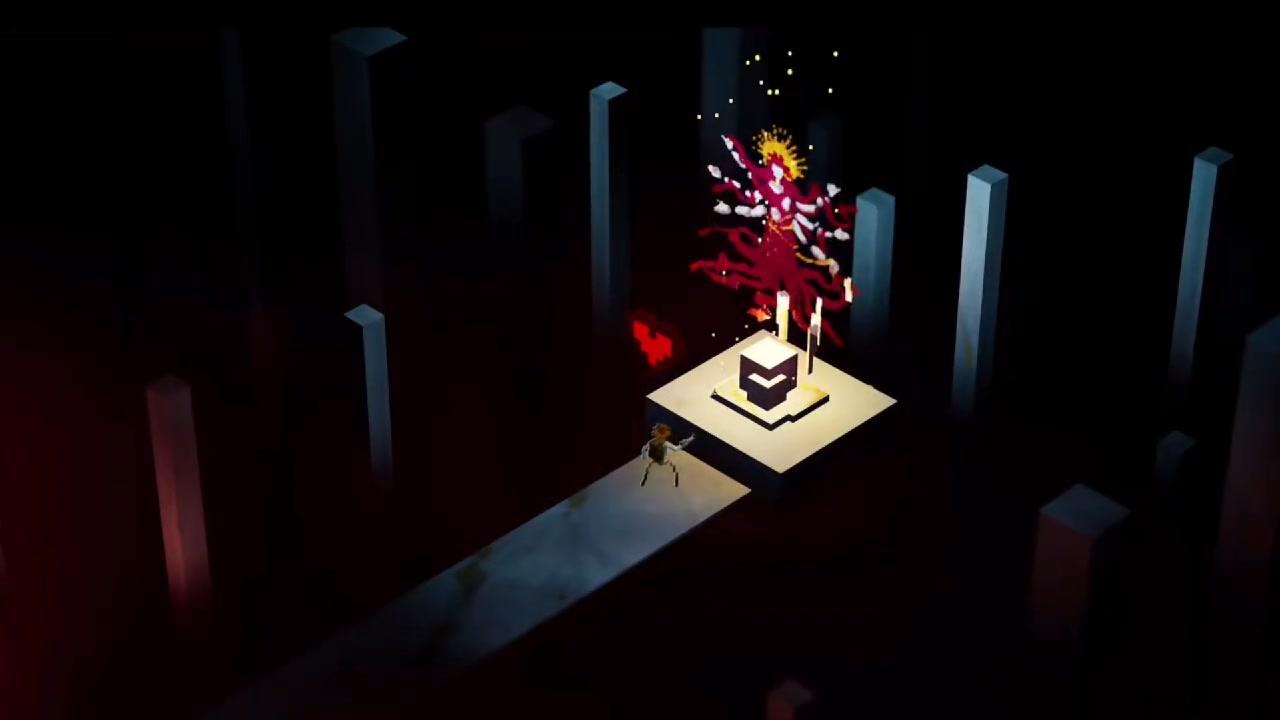
Erosion has become one of the most talked-about names in the modern roguelike scene, and for good reason. The new game from Plot Twist, the studio known for The Last Case of Benedict Fox, and publisher Lyrical Games, blends isometric action, open world, voxel art, and time travel in a post-apocalyptic Wild West unlike anything you've seen before, evoking, in certain passages, a new journey into a nightmare.
In this title, you play as a desperate father trying to rescue his daughter , kidnapped by a warlord and taken to an enigmatic structure known as the Living Column or the Pillar, capable of warping time and devouring entire civilizations. The twist comes when, each time you die, you don't simply return to the beginning; instead, the world advances a decade: your daughter ages, social factions change, and the people you remember are no longer what they once were. This idea that the world itself also "retry the run" with you is the defining characteristic of Erosion.
An open-world action roguelike with time loops

Erosion presents itself as an isometric action roguelike set in a vast open world , where death is not just a penalty for the player, but a veritable earthquake for the game's universe. Plot Twist combines the classic procedurally generated dungeon structure with a hand-crafted outdoor environment that serves as a nexus, testing ground, and chaotic playground.
Far from being just "another run," every attempt in Erosion is marked by the time-jump mechanic : if you fall in combat, the protagonist awakens ten years later. That decade that suddenly passes isn't just a number; it's reflected in the characters' appearance, the political situation of the factions, and the very social geography of the map. What is a quiet village today may have become a delusional cult tomorrow.
The setting blends a post-apocalyptic Wild West with futuristic technology and voxel aesthetics . You'll see classic revolvers alongside guided smart pistols, souped-up vehicles traversing desert salt flats, and gigantic voxel structures crumbling under enemy fire. All of this is presented with an isometric camera reminiscent of the greats of the tactical action genre, but with the pacing of a bullet hell.
This combination of genres and visual elements makes Erosion not simply "another roguelike" , but a proposal that feeds on references like Sifu (for aging and the passage of time) and classic dungeon crawlers, but taken to an open world context where your decisions leave a persistent mark.

The story: a father, a daughter, and a Column that devours time
At the heart of it all is a premise as simple as it is powerful : your daughter has been kidnapped by a chieftain and taken to the Living Column, a strange, sentient rock formation—also called the Pillar in some descriptions—that feeds on civilization and distorts time at will. Your objective is to fight your way to this impossible place before it's too late for her.
What complicates the mission is that each death advances the timeline by ten years . When you fail in a dungeon or are killed in a firefight in the open world, you don't respawn at the same point: you wake up a decade later. This jump affects everyone, starting with your own daughter, who ages as you repeat the attempt again and again, anxious that you might find her an old woman… or never find her at all.
The Living Pillar acts as the epicenter of temporal corruption . Around it, villages, farms, and cities are transformed with each cycle. You might stumble upon a humble peasant farm in one timeline, and after your next death, discover that a fanatical cult worshipping the so-called Great Ancestral Rooster has taken root there. Or the small shop you helped build with a side quest might now have grown into a commercial empire dominating an entire region.
This approach transforms the narrative into a succession of possible futures that you can observe, alter, and revisit from different perspectives. Factions change leaders, some characters age, others disappear, new opportunities and threats arise, and your role in history is rewritten time and again based on the decisions you made in previous decades.
How the time and death mechanics work
The defining gameplay feature of Erosion is its treatment of death as a time-consuming resource . Instead of a completely independent run like other roguelikes, the timeline progresses, and everything adjusts to this new reality. The world doesn't wait for you to catch up: it evolves with you, or in spite of you.
Each time you die, you awaken 10 years later in a different version of the world . The consequences of your past actions remain: factions remember your decisions, buildings remain destroyed if you razed the area, alliances persist or break down over time, and the characters you helped may have grown to become undisputed powers.
The beauty of it is that not all the consequences are positive . The aforementioned farm could degenerate into a dangerous cult; a group of merchants you helped could become a ruthless oligopoly; even entire regions are transformed based on how you interacted with them decades ago. This approach forces you to think long-term and assess which risks are worth taking on each run.
Although the timeline progresses forward with each death, the game also offers tools to manipulate it . Clearing dungeons or completing key objectives in the open world grants you resources, abilities, and opportunities to "travel back" through certain narrative and gameplay systems, altering the fate of the world and your daughter. This isn't classic time travel where you undo everything, but rather a way to reinterpret and redirect your own story with more power and information.
In this context, the question posed by the study—"Can you save your daughter before she grows old and dies?"—becomes the guiding thread of every decision you make . It's not just a mechanical challenge, but a constant pressure that makes each death weigh much more heavily than a simple "Game Over" screen.
Voxel open world: exploration, factions, and activities
Far from limiting the experience to dungeon chains, Erosion offers a desolate yet vibrant open world , hand-crafted but supported by dynamic systems that keep it constantly evolving. This futuristic Wild West landscape is built with voxel graphics, allowing not only a highly recognizable look but also a high degree of environmental destruction, similar to Minecraft's voxel maps and its unique features.
During your exploration, you can join quirky factions or simply cause mayhem . Among the possibilities shown are joining local cults, stealing shiny vehicles to cruise the salt flats, or gambling away cheddar at the Al Casino. There are also more leisurely activities like fishing for creatures buried in the sand, as well as bounty hunting missions or participating in duels in true Western style.
The world is dotted with side quests that are far from mere filler . Completing these quests can unlock permanent upgrades, open new routes, alter a region's economy, or completely change the fate of a town. These optional stories are integrated into the timeline: decades after helping a minor character, you might find them transformed into a key figure in the plot, or their failure might lead to a far more hostile future.
In addition to on-foot exploration, customizable vehicles play a significant role . They serve both to traverse the map at high speed and to participate in specific activities, such as races in the salt flats or chases against enemy gangs. This driving element adds variety to the gameplay, moving it away from the typical "dungeon-dungeon-dungeon" structure.
This highly destructible voxel environment means that every encounter can completely alter the landscape . It's not uncommon that, after an intense firefight or a particularly tough boss battle, the area where the fight began is utterly unrecognizable, with walls torn down, buildings half-collapsed, and cover reduced to dust.
Frenetic combat: isometric action and bullet hell
In terms of gameplay, Erosion focuses on intense and highly dynamic combat viewed from an isometric perspective. The pace is similar to that of a bullet hell game: projectiles flying everywhere, attack patterns that force constant movement, and situations where spatial awareness is just as important as aiming.
The procedurally generated dungeons are designed as challenging dungeon crawlers filled with enemies and bosses . Each incursion forces you to carefully manage your resources and learn the attack patterns of each creature, but also to improvise, since environmental destruction can open paths, destroy cover, or trigger collateral explosions that completely change the course of the encounter.
The open-world action maintains that same frenetic pace, though it's interwoven with more organic encounters and emergent events . You might find yourself caught in an impromptu shootout while crossing gang territory, responding to an ambush in the middle of the desert, or intervening in a caravan raid. All this while trying not to die "too soon," knowing that each death takes you ten years closer to your daughter.
The destructible nature of the environments means that cover is never completely reliable . Walls fall, parapets crumble, and any object can be reduced to dust if the battle drags on long enough. This forces you to constantly move, to never rely on a corner to save you forever, and to use the environment as another weapon, triggering collapses or explosions to your advantage.
Surreal arsenal and over 100 skills
What truly sets Erosion apart is the sheer variety and absurdity of its arsenal . While it starts with a Western foundation—featuring bows, revolvers, and classic firearms—it quickly expands into far more outlandish offerings. There are ritual bows that feed on your own blood, homing smart pistols that pursue enemies, and legendary weapons like the Ebony Rooster, capable of firing eggs that ricochet across the stage, sowing chaos. As with other lists of unique weapons , weapon design is a key draw here.
This arsenal of weapons is complemented by a vast system of skills and modifiers , with over 100 options to customize your playstyle. You can specialize in crowd control, burst damage, extreme mobility, or summons, among other possibilities, creating builds that fit the way you like to approach each run.
The game encourages players to experiment with absurd and creative combinations . Nothing prevents you from building an army of combat cats that follow you everywhere, deploying orbital turrets that obliterate everything that moves from the sky, or even cloning yourself to flood the screen with versions of yourself firing nonstop. This irreverent and somewhat surreal tone blends seamlessly into the post-apocalyptic setting.
With each run, the weapons and abilities you unlock strengthen your capacity to alter the timeline . Succeeding in a dungeon or an open-world objective not only rewards you in the short term, but also better prepares you for future runs, allowing you to face more dangerous routes, tougher enemies, and decisions with greater narrative impact.
Total destruction of the environment and voxel chaos
The voxel aesthetic isn't just a matter of visual style: it serves as the foundation for a very deep destruction system . Every wall, building, or structure is composed of blocks that can disappear under fire from the player or enemies, transforming the battlefield as combat unfolds.
In practice, this translates into completely destructible environments where nothing remains intact if the fight gets tough. Demolishing walls can open up lines of fire, create new escape routes, or expose enemies who thought they were safe behind solid cover. At the same time, that destruction can backfire if, for example, you inadvertently remove the only shield protecting you from a particularly aggressive boss.
This approach reinforces the sense of controlled chaos that characterizes the game. The developers promise bullet hell combat filled with voxel physics and effects , with projectiles piercing walls, explosions tearing off entire chunks of the scenery, and shootouts turning recognizable locations into veritable wastelands of rubble.
The state of the world after each battle isn't merely decorative. Returning to the same place years later, you might find it scarred by the ravages of your past actions , adding an extra layer of coherence to the narrative of a shifting future. The world doesn't just age; it also bears the marks of your choices.
Platforms, early access, and launch window
Lyrical Games and Plot Twist have confirmed that Erosion will have a staggered release supported by early access programs. The idea is to refine the roguelike's balance, faction behavior, and the impact of time-based decisions with the help of the community.
The game will first launch in early access on PC ( Steam and Microsoft Store) and Xbox Series X|S , through Steam Early Access and Game Preview respectively. This phase is scheduled for spring 2026, during which time it will also be available through Xbox Game Pass Ultimate and PC Game Pass, allowing many players to try it from day one.
Once this open development phase is complete, version 1.0 will be released later that year , expanding the number of platforms. At that point, the game will also arrive on PlayStation 5, alongside the final versions for Xbox Series X/S and PC. This way, all major systems will receive the title when the experience is polished and all its core content is available.
Although no exact date beyond the spring early access window has been specified yet , the trailers shown at the Xbox Partner Preview already reveal a fairly advanced state of development: playable missions, fluid combat, environmental destruction, and several examples of divergent timelines in action.
Erosion is shaping up to be a highly ambitious open-world roguelike , blending the constant tension of time's passage, the freedom of a large and destructible map, a wild arsenal, and a progression system that doesn't forget what happened in previous playthroughs. If you're drawn to games where death has real consequences, the idea of seeing how your actions resonate decades later, and the quirky charm of a post-apocalyptic voxel western, this game has a good chance of grabbing your radar when its release approaches.

Passionate writer about the world of bytes and technology in general. I love sharing my knowledge through writing, and that's what I'll do on this blog, show you all the most interesting things about gadgets, software, hardware, tech trends, and more. My goal is to help you navigate the digital world in a simple and entertaining way.